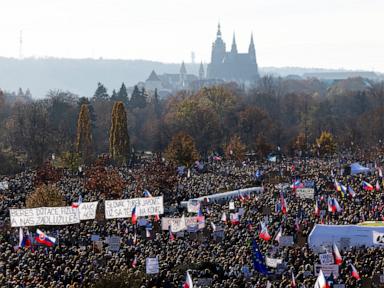
At 4:36 a.m. on a Saturday morning in October 2026, lawmakers in Prague pushed through a bill that triggered the largest wave of street demonstrations the Czech Republic has seen in years. On the surface, the legislation sounds like a gift to taxpayers. Prime Minister Andrej Babiš and his governing coalition want to abolish the mandatory monthly household license fee for Czech Television (ČT) and Czech Radio (ČRo), replacing it with direct funding from the national state budget.
Yet instead of celebrating a lower monthly bill, an estimated 350,000 people flooded Prague's Letná Park on November 15 to demand the government drop the plan.
Why would citizens march in the freezing autumn cold to protect a bill they have to pay every month? Because in Central Europe, everyone knows how this story ends. When politicians control the purse strings of public broadcasters, editorial independence doesn't survive for long.
How the Czech Public Media Funding Overhaul Actually Works
Right now, Czech households pay a combined monthly fee of 205 Czech crowns—roughly $9.45—to fund Czech Television and Czech Radio. Following a 2025 update to the law, that obligation applies to households with internet-connected devices like smartphones and computers, not just traditional television sets. That money goes straight to the broadcasters. Politicians don't touch it during annual budget negotiations.
Under the overhaul pushed by Babiš's ANO party and its coalition partners, including far-right parliamentary speaker Tomio Okamura's SPD, that direct link gets severed.
Here is what the government's proposal actually changes:
- Abolishes direct household fees: Families stop receiving the separate 205-crown monthly bill for public television and radio.
- Moves funding to the state treasury: Money for ČT and ČRo gets folded directly into the national budget alongside healthcare, defense, and infrastructure.
- Slashes overall budgets: The transition isn't a dollar-for-dollar swap. According to European Parliament assessments and independent analyses, the reform cuts the broadcasters' combined financial resources by roughly 15 percent.
Babiš argues he's simply keeping a campaign promise to ease the financial burden on ordinary families. He has publicly insisted that "nobody wants to control public media, let alone nationalise them," dismissing the protesters' fears as baseless.
Honestly, nobody buys that explanation. When you strip away an independent revenue stream and replace it with a smaller allowance handed out by the finance ministry, you create immediate financial dependency. Even if a prime minister never picks up the phone to censor a news broadcast, newsroom editors suddenly have to wonder whether an investigative report on government corruption will cost them next year's budget allocation.
The 4:36 A.M. Vote That Sparked a National Backlash
Process matters in democracies. Often, how a government passes a law tells you more about its intentions than the text of the bill itself.
The Czech coalition didn't build consensus for this overhaul. They didn't hold broad consultations with journalists, media unions, or civil society groups. Instead, ruling lawmakers forced the bill through its first reading in the Chamber of Deputies after an exhausting overnight session, calling the vote at 4:36 a.m. on October 24 before dozens of opposition MPs even had a chance to speak.
That timestamp immediately became a rallying cry across the country. Within hours, protests erupted in Brno, Liberec, and České Budějovice, followed by massive crowds packing Prague's Old Town Square on October 25.
The resistance quickly spread beyond street demonstrations:
- Newsroom strikes: On November 3, employees at Czech Television and Czech Radio staged a coordinated one-day strike, disrupting normal programming to warn viewers about the threat to their independence.
- Cultural boycotts: Artists, actors, and university students rallied behind the broadcasters, launching boycotts and campus walkouts ahead of the November 17 anniversary of the 1989 Velvet Revolution.
- Institutional pushback: Even Czech President Petr Pavel stepped in to question the hurried parliamentary tactics and call for a calmer, more transparent debate.
Timing the climax of the protests right before November 17 wasn't an accident. In 1989, Czechs overthrew a communist regime that used state television and radio as blunt instruments of propaganda. For people who remember living under state-controlled information—or who watched neighboring countries like Hungary and Slovakia dismantle independent media over the past decade—seeing a billionaire prime minister with unresolved business conflicts of interest reach for the broadcasters' budget sets off every alarm bell.
Does State Budget Funding Always Mean State Control?
If you want to look at this fairly, you have to acknowledge a genuine nuance. Does funding a public broadcaster through the national budget automatically turn it into state propaganda?
No. Several Western European democracies—including countries like Sweden, Finland, and Spain—fund their public broadcasters through general taxation or state allocations rather than traditional TV license fees. Supporters of the Czech government's bill point to these models to argue that abolishing the 205-crown fee is simply modernizing an outdated tax.
That comparison falls apart when you look at the guardrails.
In countries where tax-funded public media stays fiercely independent, the funding formulas are locked into multi-year statutory frameworks indexed to inflation, insulated from annual cabinet votes, and overseen by genuinely pluralistic boards. You can't slash the budget by 15 percent overnight just because the prime minister dislikes the evening news.
In the Czech Republic, critics point out that the government's bill lacks those ironclad legal protections while simultaneously squeezing the broadcasters' finances. Combining a 15 percent budget cut with direct ministerial control over the purse strings doesn't modernize public media. It starves it. A 15 percent drop in revenue forces ČT and ČRo to shut down regional bureaus, scale back expensive investigative journalism, and cut original cultural programming—the exact things commercial networks won't produce because they aren't profitable.
Brussels Steps Into the Fight
This isn't just a domestic squabble anymore. On November 25, 2026, the European Parliament intervened directly, passing a sweeping resolution by 442 votes to 158 that condemned the Czech government's handling of the media reform.
Members of the European Parliament didn't mince words. They flagged the lack of transparency in the 4:36 a.m. vote, warned against political interference in public broadcasting, and pointed out that the overhaul clashes with the European Media Freedom Act—EU legislation specifically designed to protect public service media from political capture and financial strangulation.
Brussels also raised alarms about a broader pattern of pressure on independent voices in Czechia, including smear campaigns against journalists, outlets being barred from government press conferences, and proposals to force civil society groups receiving foreign grants onto a special register. MEPs formally asked the European Commission to monitor the legislation for rule-of-law violations, a step that can eventually trigger freezes on EU structural funds.
What Czech Households and Observers Need to Know Right Now
Because the bill has only cleared its first reading in parliament, the legal reality on the ground hasn't changed yet. Confusion spreads fast during political standoffs, and Czech Radio has already had to issue public guidance to clear up misconceptions.
If you live in the Czech Republic or follow European media policy closely, keep these immediate facts straight:
- Keep paying your monthly fee: A draft bill passing a preliminary vote does not cancel existing law. Households must continue paying the 205-crown monthly fee for ČT and ČRo until legislation formally passes all parliamentary readings, receives presidential review, and takes effect. Stopping payments now will only land you in arrears with collection penalties.
- Watch the Senate and presidential veto: The bill still faces second and third readings in the lower house before moving to the Czech Senate, where opposition parties hold strong sway, and eventually to President Petr Pavel's desk. While the lower house can override a Senate or presidential veto, doing so requires an absolute majority of all 200 deputies—meaning every single defection inside Babiš's coalition matters.
- Follow the EU enforcement track: Watch how the European Commission responds to the European Parliament's November 25 resolution. If Brussels opens an infringement procedure under the European Media Freedom Act, Prague will face steep financial and legal pressure to rewrite the funding safeguards before the law ever goes live.
For further details on the street demonstrations and parliamentary pushback, see Al Jazeera's coverage of the Prague rallies and the European Parliament's official resolution demands. Check Hundreds of thousands protest over Czech public media funding changes for footage showing the scale of the Prague demonstrations against the proposed state budget shift.


