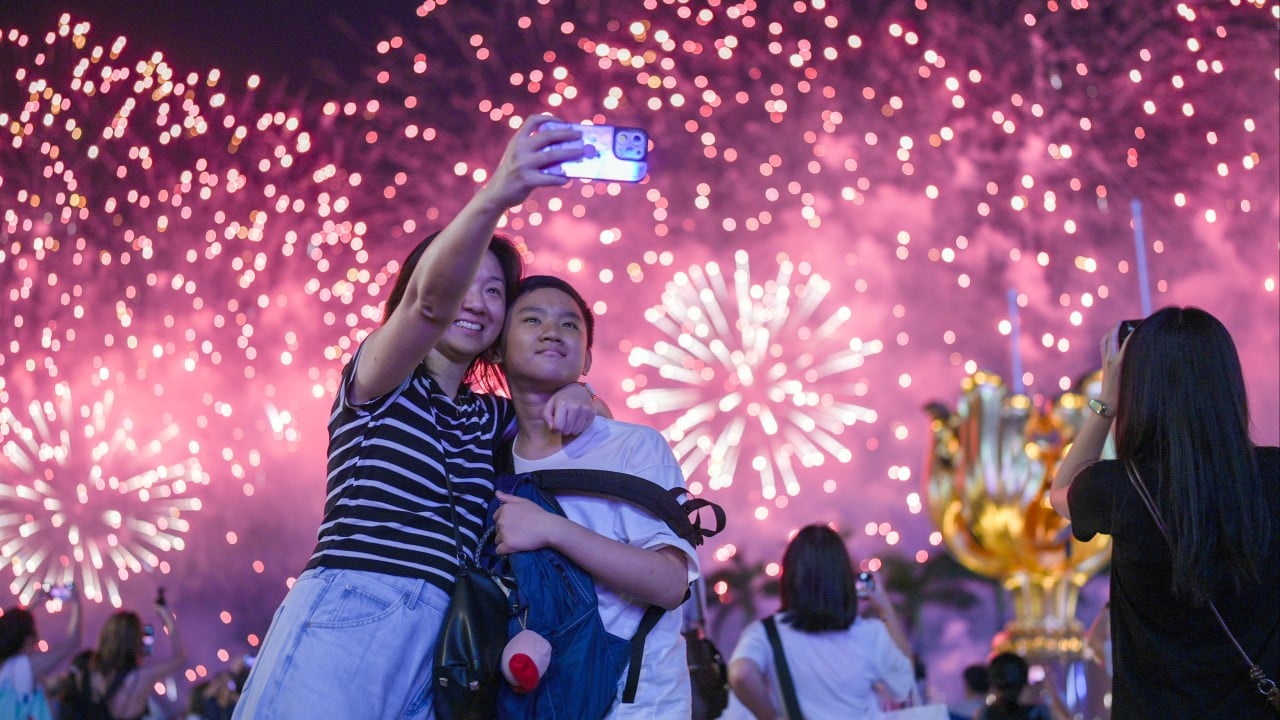
Mass public celebrations funded by municipal authorities function primarily as capital-allocation instruments disguised as cultural spectacles. When the Government of the Hong Kong Special Administrative Region deploys resources toward a 23-minute pyrotechnic display featuring sunflower motifs for National Day, the event must be evaluated not through aesthetic appreciation, but through the mechanics of municipal return on investment. Civic expenditure on this scale alters local liquidity, shifts consumer behavior across retail and hospitality sectors, and acts as a psychological stabilization mechanism for consumer confidence.
Analyzing the fiscal mechanics of such large-scale civic activations requires deconstructing the input costs, the secondary economic velocity, and the opportunity costs borne by the public sector. Urban administration budgets are finite pools of capital. Diverting resources to hyper-targeted visual spectacles establishes a baseline expectation among commercial stakeholders who rely on foot traffic surges to offset structural margin compression. You might also find this connected article useful: The Neon Haze That Smuggled Euphoria Into Quiet Rooms.
The Dual-Channel Capital Allocation Model
Municipal event funding operates across two distinct financial vectors: direct treasury expenditure and indirect infrastructural support. The direct vector covers procurement contracts for pyrotechnic materials, barge positioning, safety compliance personnel, and municipal sanitation crews deployed before and after the event. Sunflower-themed visual patterns require specialized multi-shell aerial choreography, increasing the complexity of electronic timing networks relative to standard rhythmic detonations.
The indirect vector involves opportunity costs. Deploying thousands of police officers for crowd control, traffic redirection, and perimeter security represents a reallocation of fixed municipal labor from routine civil enforcement to temporary commercial protection. As discussed in latest articles by NPR, the effects are notable.
- Direct procurement expenditure targets specialized pyrotechnic engineering firms.
- Labor deployment requires overtime compensation formulas for disciplined services.
- Security perimeters restrict normal commercial transit within immediate viewing corridors, creating localized revenue drops for non-participating vendors.
Commercial venues adjacent to Victoria Harbour capture the majority of the velocity generated by the display. Hotels with harbor-view rooms implement surge pricing models, elevating average daily rates by multiples of three to five times standard operational baselines. Food and beverage operators within the same geographic footprint enforce minimum spend thresholds and fixed-price menu structures.
This creates a concentration of financial benefit within a narrow tier of premium operators while broader retail districts outside the immediate visual corridor experience depressed foot traffic. Shoppers often avoid the urban core entirely due to anticipated congestion, displacing baseline retail spend from small merchants to centralized hospitality conglomerates.
The Attention Economy and Consumer Confidence Metrics
Public displays executed on milestone anniversaries serve an unstated macroeconomic objective: signaling stability to external investors and domestic consumers. In an economy sensitive to regional capital flows, visible expressions of structural continuity help anchor sentiment indicators.
Consumer confidence indices frequently correlate with high-visibility public events because such spectacles project institutional solvency and administrative control. When authorities execute complex, synchronized pyrotechnic displays featuring intricate geometric patterns like sunflowers, the underlying message is operational competence.
However, the correlation between momentary consumer euphoria and sustained retail turnover remains weak. High-density events compress spending into a narrow window of four to six hours. This concentration strains point-of-sale infrastructure and creates labor scheduling inefficiencies. Hospitality venues must overstaff to handle the sudden volume surge, running the risk of diminished service quality or inflated labor cost ratios that erode the gross margins captured through surge pricing.
Spatial Bottlenecks and Crowd Dynamics
Urban density transforms a 23-minute visual display into a massive logistical challenge. Managing hundreds of thousands of spectators along constrained waterfront promenades requires predictive modeling of pedestrian flow rates.
The physical geography of Victoria Harbour restricts viewing angles, forcing high-density clustering in specific nodes such as Tsim Sha Tsui, Central, and Wan Chai. These nodes function as choke points where pedestrian velocity drops to near zero during peak accumulation phases.
Municipal transit systems absorb the shock of mass ingress and egress through dynamic scheduling modifications, including extended operating hours and increased train frequencies. Yet, the systemic stress placed on rail infrastructure introduces maintenance wear that accumulates over successive calendar events.
- Ingress phases distribute arrivals across a three-hour window, mitigating structural overload.
- Egress phases compress departures into a 45-minute window immediately following the final detonation, maximizing pressure on station access gates.
- Emergency evacuation corridors must remain sterile despite encroaching spectator density, requiring continuous enforcement by security details.
Evaluating the Fiscal Efficiency of Pyrotechnic Tourism
Proponents of municipal fireworks cite tourism stimulation as the primary justification for public outlays. International visitors drawn to major celebrations contribute to foreign exchange earnings, filling airline seats and booking multi-night stays.
Yet, isolating the incremental yield of a single 23-minute show from baseline tourism trends requires rigorous econometric controls. Travelers rarely select an international destination based solely on a brief national holiday celebration unless it forms part of a broader, multi-faceted itinerary.
The cost-per-visitor metric offers a clearer lens for evaluation. When total municipal expenditure is divided by the estimated number of incremental tourists specifically motivated by the event, the resulting acquisition cost per visitor frequently exceeds standard digital marketing acquisition benchmarks utilized by private tourism boards.
Municipal authorities must weigh this expenditure against alternative capital deployment strategies, such as subsidizing long-form cultural festivals, upgrading permanent public infrastructure, or funding targeted enterprise grants for digital transformation within the retail sector.
Strategic Realignment for Municipal Event Planning
Optimizing public-funded spectacles requires shifting the operational paradigm from passive consumption to interactive economic integration. To maximize the return on municipal capital invested in large-scale visual displays, administrative bodies should implement structural adjustments across procurement and logistical frameworks.
Private-public partnerships must replace fully subsidized public outlays. Commercial stakeholders who capture the direct financial upside—such as luxury hospitality chains and major property developers overlooking the harbor—should fund a proportional share of the core pyrotechnic procurement costs through targeted business improvement districts or direct sponsorship levies.
Simultaneously, event duration and spatial distribution must be re-engineered. Compressing spectator density into concentrated waterfront corridors creates diminishing returns in public safety efficiency and consumer experience. Decentralizing visual elements across multiple secondary nodes throughout the territory distributes economic activity more equitably across neighborhood retail districts while mitigating structural choke points in the urban core.