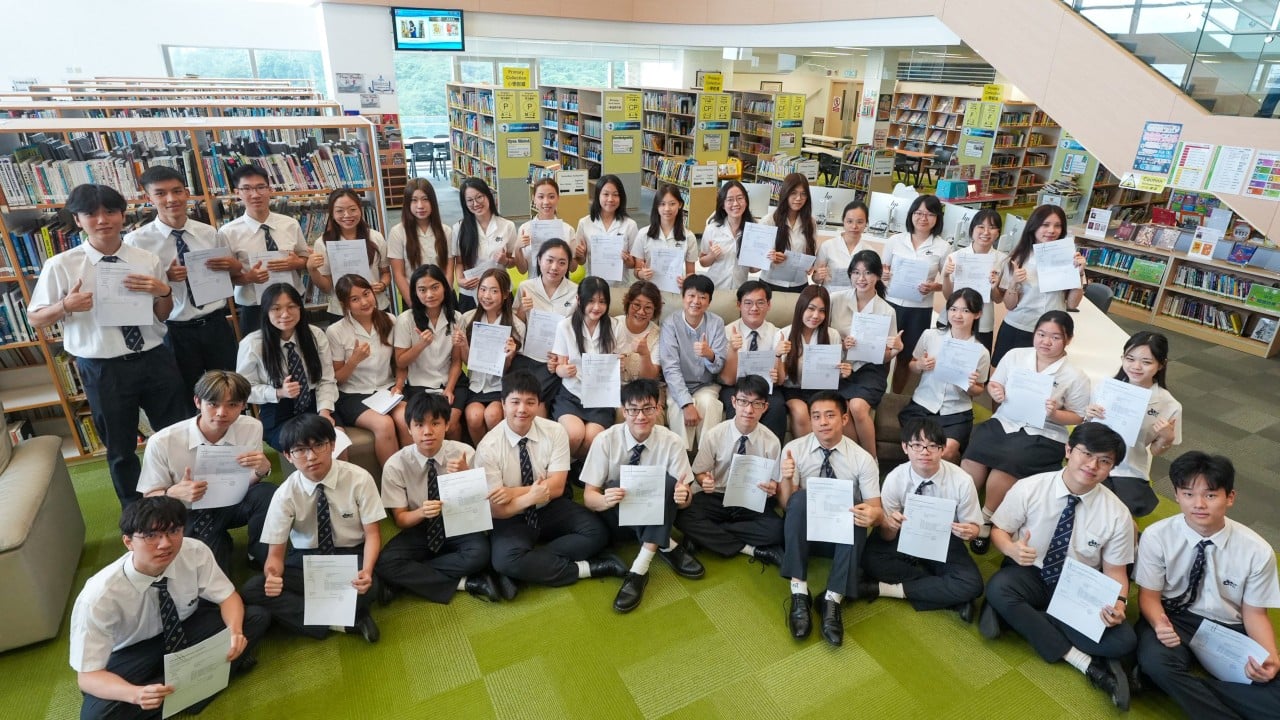
Hong Kong is celebrating its International Baccalaureate results again. The annual press releases are out, the elite schools are self-congratulating, and local media is swooning over how local students outpaced the global average. The narrative is always the same: Hong Kong students possess a superior work ethic, the city’s schools have cracked some secret pedagogical code, and a high IB score guarantees a straight line to global leadership.
It is a comforting story. It is also an absolute lie.
Comparing Hong Kong’s average IB score to the global average is not a sign of academic superiority; it is a statistical distortion. The city isn’t beating the world because its students study harder or because its teachers possess magical insights. It is beating the world because the local IB system is an aggressively engineered, hyper-vetted ecosystem designed to exclude anyone who might drag down the average.
We need to stop celebrating a metric that has been thoroughly bought, paid for, and structurally rigged.
The Survivor Bias in Hong Kong’s Classroom Data
The global average IB Diploma score hovers around 30 points. Hong Kong consistently tracks closer to 36 or 37. To the casual observer, that six-point delta looks like an educational miracle.
It isn't. It is classic survivor bias.
The global average includes comprehensive public schools in North America, underfunded state schools in Europe, and institutions offering the IB as an open-enrollment option where any student can take a shot.
In Hong Kong, the IB is almost exclusively the playground of elite international schools and highly selective Direct Subsidy Scheme (DSS) institutions.
The Financial Guardrail
Consider the barrier to entry before a student even sits for a single paper. Tuition at these institutions routinely exceeds $200,000 HKD annually. Add in mandatory debentures that can run into millions, and you realize the student pool is drawn from the topmost sliver of global wealth.
The Academic Purge
More importantly, these schools aggressively weed out underperformers long before the International Baccalaureate Organization (IBO) registers their existence. If a student struggles in Year 10 or 11, they are quietly guided toward alternative pathways, such as the British BTEC, or nudged to transfer.
A Lesson from Corporate Metrics: If a company fires its bottom 30% of performers every year and then brags that its average employee output is higher than the industry baseline, you wouldn't call that a management breakthrough. You would call it a mathematical inevitability.
Hong Kong schools do not take average students and make them exceptional. They take exceptional, highly resourced students and claim credit for their survival.
The Shadow Education System Nobody Wants to Credit
The mainstream press credits school infrastructure and dedicated faculty for these high marks. Walk into any major international school in Robinson Road or Kowloon Tong, and the principal will talk about "independent inquiry" and "critical thinking frameworks."
They are taking credit for work done in the dark.
The real driver of Hong Kong’s IB dominance is an aggressive, multi-million-dollar shadow education economy. I have advised families who spend more on private IB tutoring per month than some families spend on rent.
[Student Performance]
   └── Fueled by: Day School (30%) + Private Tutoring Industrial Complex (70%)
In Hong Kong, if a student struggles with the conceptual leaps required in Higher Level Physics or the abstract nature of the Theory of Knowledge (TOK) essay, they do not rely on school resources. They employ specialists—frequently former IB examiners flown in or retained at exorbitant hourly rates—to deconstruct the grading rubrics.
- The Reality: The high average score is a reflection of parental capital, not institutional brilliance.
- The Consequence: This creates an arms race where the actual school curriculum becomes secondary to the supplemental instruction happening between 4:00 PM and 9:00 PM.
To praise the schools for the scores is like praising a car manufacturer for a race win when the driver spent millions modifying the engine in a private garage.
The Grade Inflation Crisis the IBO Won't Acknowledge
We cannot talk about Hong Kong's success without looking at the structural shifts within the IBO itself. The organization has long maintained an aura of rigorous objectivity, but a look at the macro trends over the last decade reveals a distinct loosening of the belt.
The pandemic-era adjustments saw an explosion of perfect 45-point scores globally, with Hong Kong capturing a disproportionate share. While the IBO has made efforts to execute a "soft landing" back to pre-pandemic distributions, the reality is that the criteria for top marks have become highly gamified.
+-------------------------------------------------------------+
|   The Gamification Loop                                     |
|                                                             |
|   1. Rubric Optimization -> 2. Formulaic Responses         |
|         ^                                      |            |
|         +--------------------------------------+            |
+-------------------------------------------------------------+
The Extended Essay (EE) and Internal Assessments (IAs), which were intended to evaluate independent research, have been reduced to algorithmic execution. Students do not choose topics out of genuine intellectual curiosity; they choose topics that fit a historical sweet spot in the grading matrix. They use optimized templates that ensure high marks while suffocating actual original thought.
The True Cost of the 45-Point Obsession
Here is the counter-intuitive truth that universities are finally waking up to: a perfect score from a hyper-vetted, highly tutored environment is often a poor indicator of future academic success.
As an industry insider, I have tracked students who entered Ivy League institutions or Oxbridge with perfect 45s, only to falter in their second year. Why? Because they were removed from the scaffolding that manufactured their initial success.
When you spend two years being coached exactly what to write, how to structure your arguments to please a specific rubric, and when every hour of your day is managed by consultants, you do not develop intellectual self-reliance. You develop a high capability for compliance.
The Innovation Deficit
The British and American higher education systems are recognizing this distinction. Admissions tutors at elite universities are increasingly looking past the raw score. They are realizing that a 38 from a student who self-directed their studies at a resource-constrained school in rural Wales or public-school Ohio often indicates significantly more grit and intellectual upside than a 44 from a student whose environment was entirely sanitized of risk.
Hong Kong’s obsession with maximizing these scores has created an environment that actively penalizes intellectual risk-taking. If a student wants to explore an unorthodox hypothesis in their Internal Assessment, they are shot down by school advisors because it threatens the school’s average. The system optimizes for the safe 7 rather than the brilliant, unpredictable gamble.
Stop Asking "How They Did It"
The competitor articles ask the wrong question entirely. They look at the high averages and ask, "What can we learn from their preparation strategies?"
The correct question is: "What is this metric actually measuring?"
It is measuring wealth concentration. It is measuring a culture that views education as a real estate transaction—where you buy entry into an elite institution, buy the supplementary tutoring required to sustain the grades, and then cash in the token for an Ivy League acceptance letter.
If we want to measure true educational efficacy, we should look at value-add metrics. Show me a school that takes students entering with below-average literacy levels and guides them to a steady 34. That is an educational achievement worth printing an article about.
Celebrating elite international schools for turning wealthy, highly selected children into high-scoring IB graduates is simply applauding the sunrise. It requires no effort, it tells us nothing new, and it hides the rot underneath the surface.
Stop worshiping the 45. It is a metric of compliance, manufactured by money, and entirely divorced from the genuine intellectual curiosity the world actually needs.


