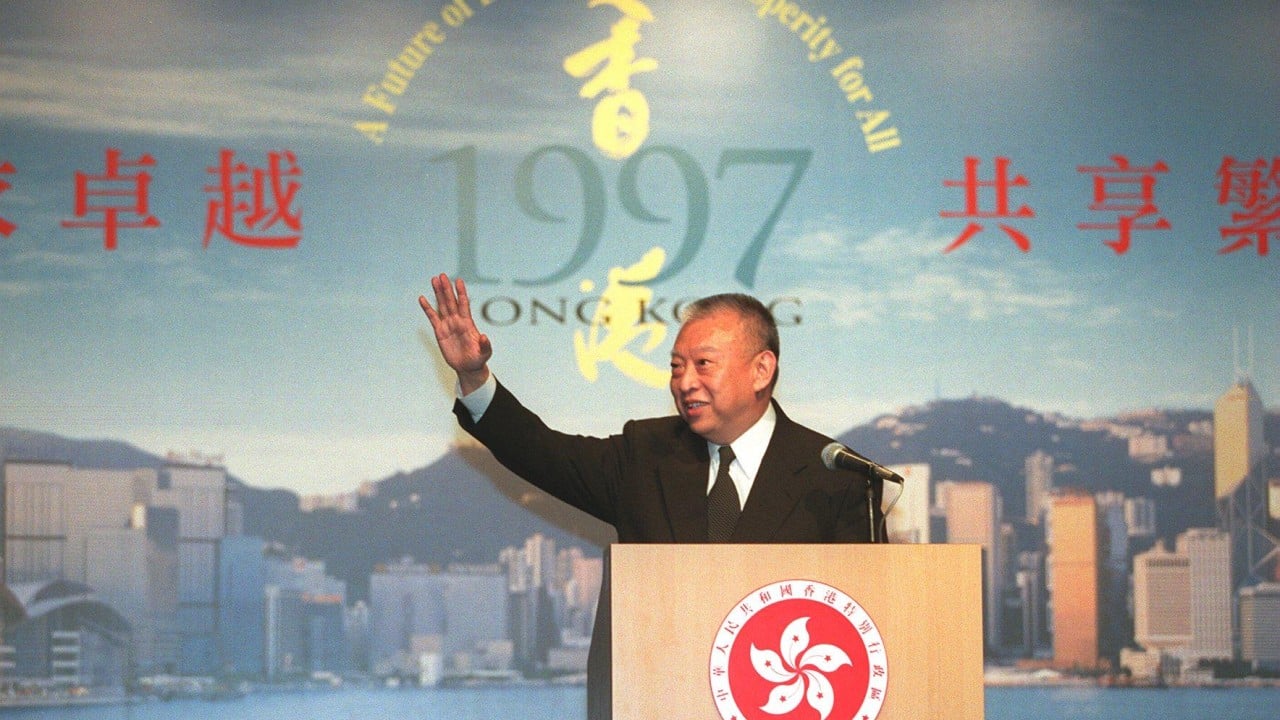
The corporate eulogies for Tung Chee-hwa read like a masterclass in historical amnesia. Open the business pages today and you will find the usual chorus of Hong Kong heavyweights hailing the city's first Chief Executive as a visionary statesman, a devoted patriot who steadied the financial helm, and a pillar of stability. Every anniversary or retrospective brings out the same polished platitudes from tycoons who owe their fortunes to property cartels and bureaucratic inertia. They want you to remember a benevolent shipping magnate who gracefully steered the special administrative region through the Asian Financial Crisis.
They are wrong. Not just slightly mistaken, but fundamentally, dangerously wrong about the legacy of a man whose tenure locked Hong Kong into a structural trap it is still struggling to escape.
Let us dispense with the polite fiction. Tung Chee-hwa did not fail because he was unlucky or because the handover was too complex. He failed because he attempted to run a hyper-competitive global financial hub like a traditional family shipping conglomerate. He confused political governance with boardroom paternalism, mistaking the absence of open dissent for actual economic health. When the tycoons praise his patriotism, they are celebrating a system that protected their monopolies while sacrificing the generational mobility of everyone else.
If you want to understand why Hong Kong's current commercial landscape feels like a high-stakes museum piece rather than a dynamic innovation engine, you have to trace the rot straight back to the foundational compromises of the Tung era.
The Myth of the Steady Hand
The standard narrative paints Tung as a reluctant hero thrust into the spotlight of 1997, holding the line against the Soros-backed currency speculators during the Asian Financial Crisis. The Hong Kong Monetary Authority spent billions buying up local equities in 1998 to crush the shorts, an intervention that textbooks love to cite as a stroke of defensive brilliance.
Here is the inconvenient reality that the boardroom crowd conveniently glosses over. That market defense saved the balance sheets of property conglomerates, but it permanently distorted price discovery. It sent a loud, unmistakable signal to the market: systemic risk in Hong Kong would always be socialized, while profits remained fiercely private.
Tung inherited a British laissez-faire apparatus that was already fraying at the edges, and instead of modernizing it for a digital, post-industrial century, he layered a thick coat of neo-mercantilist cronyism right over it. His administration was obsessed with grand infrastructure projects and ideological consensus, completely ignoring the creeping monopolization of land and capital. The eight-thousand-flat housing initiative, launched with ambitious populist fervor in 1998 to flood the market with affordable apartments, was quietly buried when property prices dipped. The tycoons panicked, the government capitulated, and a generation of young Hongkongers found themselves locked out of property ownership forever.
That was not administrative misfortune. That was a conscious policy choice that prioritized asset-inflation for the elite over long-term economic resilience.
The Fatal Illusion of Top-Down Innovation
Listen to any major business conference in Central today, and you will hear endless hand-wringing about how Hong Kong missed the tech boat. Speakers lament that the city lacks a Silicon Valley mindset, or that venture capital is too risk-averse. Then, with a straight face, they praise Tung Chee-hwa for his forward-thinking industrial policies.
The irony is thick enough to choke on. Tung was the original architect of Hong Kong's state-directed innovation fantasy. Cyberport was conceived under his watch not as an open ecosystem for garage-born disruptors, but as a real-estate play disguised as a digital hub—awarded without open tender to Richard Li's Pacific Century CyberWorks. It was property development in a tech costume.
When you treat innovation as a real estate subsidy scheme, you get exactly what Hong Kong got: massive office parks filled with traditional firms, sky-high rents that price out actual startups, and a bureaucratic mindset that waits for government grants rather than hunting for global market demand. The state cannot engineer a startup culture by pouring concrete and offering tax breaks to conglomerates. Innovation requires failure, chaos, and institutional friction—three things a paternalistic administration avoids at all costs.
Tung institutionalized the belief that the government could pick winners if it just had enough committee meetings. That bureaucratic paternalism bled into the DNA of the local business class. To this day, too many Hong Kong executives measure their success not by disrupting global markets, but by securing government advisory board seats and mainland joint-venture licenses.
Dismantling the Tycoon Playbook
The defenders of the old guard love to argue that Tung's hands were tied by a fractured legislature and colonial-era institutions. This is a convenient smokescreen. The executive branch under Tung held immense centralized power; what it lacked was intellectual courage.
Consider the structure of Hong Kong’s economy. For decades, it has relied on four pillars: financial services, tourism, trading and logistics, and professional services. Under Tung, little effort was made to diversify the revenue base because the four pillars generated enough rent-seeking income to keep the conglomerate balance sheets glowing. When the global economy shifted toward software, biotechnology, and decentralized supply chains, Hong Kong was busy building more luxury malls and luxury residential towers.
The business heavyweights remember Tung fondly because his administration preserved the status quo ante. If your business model relies on owning the land, controlling the ports, or dominating the licensed utilities, Tung Chee-hwa was a saint. He kept the entry barriers high and competition comfortably low.
If you are an entrepreneur trying to build something from scratch in a city where commercial rents consume half your revenue before you sell a single unit, Tung's legacy looks less like statecraft and more like a slow-motion economic strangulation.
The Unspoken Cost of Consensus
True leadership in a global financial center requires the stomach for creative destruction. Markets need to clear. Inefficient companies need to die so capital can recycle into productive new ventures. Asset bubbles need to pop before they consume the entire social fabric.
Tung Chee-hwa’s entire philosophy was the antithesis of creative destruction. He abhorred friction, conflict, and market volatility. He believed that harmony could be engineered through bureaucratic fiat and personal appeals to Beijing's elite. But markets do not care about harmony; they care about efficiency, transparency, and the rule of law.
When you prioritize social quietude and corporate comfort over brutal economic reality, you store up systemic instability for the future. The housing crisis, the brain drain, the lack of economic diversification—these are not accidental deviations from Tung's vision. They are the direct, logical consequence of executing his vision to the letter.
The tycoons will keep praising him at banquets because his policies built the moats around their empires. But if Hong Kong is ever going to reclaim its predatory, knife-edge competitiveness, it has to stop romanticizing the era that institutionalized its complacency.
The next time someone tells you Tung Chee-hwa was a misunderstood visionary who saved the city, ask them what happened to the dreams of everyone who has to spend three hours commuting from a shoebox apartment to finance a landlord's fifth yacht.
History has already rendered its verdict. The only people refusing to read it are the ones who wrote the check.