The modern American military machine runs on a myth of infinite industrial capacity, an illusion that shatters the moment anyone checks the concrete floors of defense-depot storehouses. Decades of post-Cold War consolidation left the defense industrial base hollowed out, optimized for lean-inventory efficiency rather than total-war endurance. When global conflicts erupted in Eastern Europe and the Middle East, Pentagon planners faced a brutal arithmetic. Their stockpile inventories were plummeting faster than domestic factories could forge replacement steel. To bridge this structural shortfall, Washington turned its gaze eastward, quietly leaning on South Korea to plug the gaping holes in Western supply chains.
This is not merely a story of international cooperation. It is an indictment of an American manufacturing ecosystem that forgot how to build heavy iron at scale.
The Anatomy of a Shell Shortage
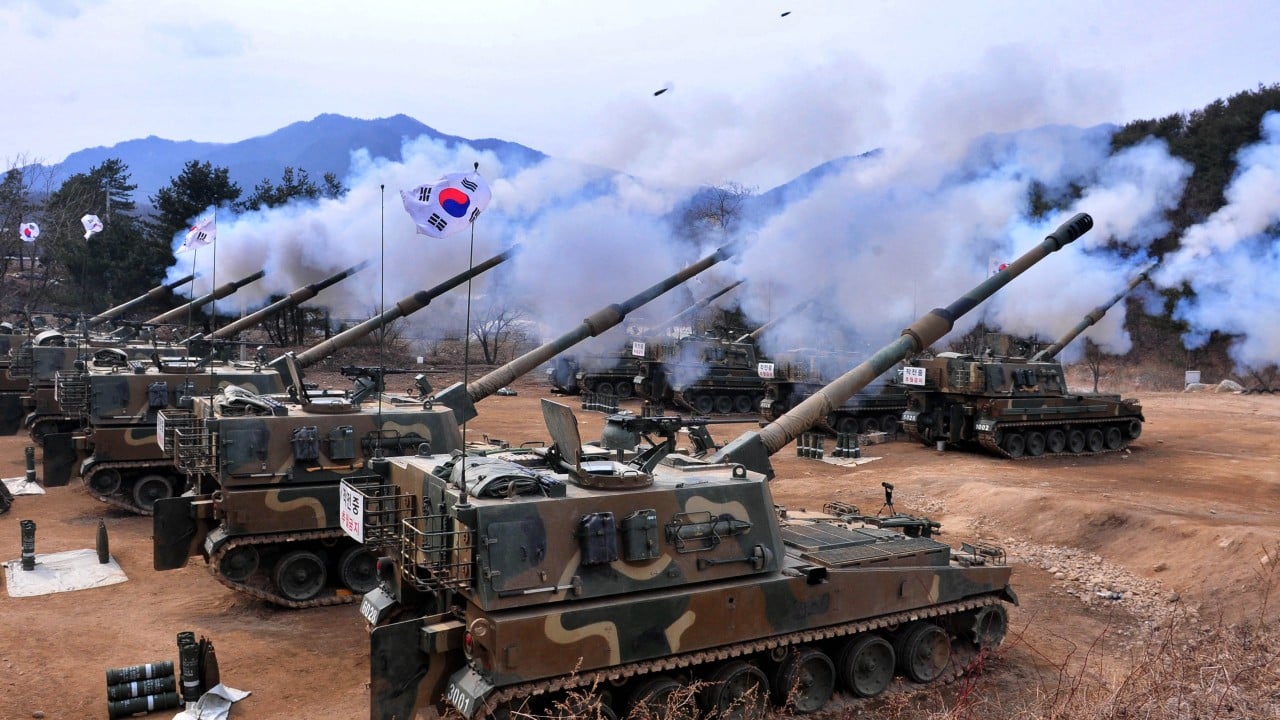
At the heart of the crisis lies the ubiquitous 155-millimeter artillery shell. For all the hype surrounding hypersonics, drone swarms, and fifth-generation stealth fighters, modern conventional warfare remains a grinding, high-explosive artillery slugfest. A single brigade engaged in high-intensity combat can exhaust thousands of rounds daily, turning steel tubes into scrap metal through sheer barrel wear and burning through national stockpiles in weeks.
The United States found itself trapped between political promises of unwavering support for allies and the harsh reality of domestic production ceilings. Even with multi-billion-dollar investments aimed at scaling up domestic plants run by firms like General Dynamics, American factories could not churn out shells fast enough to offset the daily expenditure. Washington needed millions of rounds yesterday. The domestic pipeline was too slow, restricted by environmental regulations, skilled labor shortages, and a corporate culture terrified of over-investing in production lines that might go cold if geopolitics shifted overnight.
Seoul became the logical emergency valve. Unlike its Western counterparts, South Korea maintained a mobilized, war-ready industrial apparatus born out of necessity under the constant shadow of the Demilitarized Zone.
Seoul’s Industrial Muscle and Legal Gymnastics
South Korea’s defense conglomerates, anchored by heavyweights like Hanwha Aerospace, operate with a level of manufacturing discipline that modern Western contractors abandoned decades ago. They kept assembly lines hot. They maintained massive stockpiles of high-grade explosive filler and forged steel casings continuously. When Washington came knocking, Seoul possessed what the Pentagon lacked: surplus capacity and immediate deliverability.
Yet, tapping this resource required walking through a minefield of domestic South Korean law. South Korea maintains a strict legal prohibition against exporting lethal weapons to active conflict zones. To bypass this barrier without triggering a constitutional crisis or breaking international statutes, defense bureaucrats and diplomats engaged in complex legal choreography. Arrangements were structured through lease agreements and indirect supply loops where Seoul transferred hundreds of thousands of 155mm rounds to the United States. This allowed the Pentagon to backfill its own depleted domestic depots, freeing up older American-owned stock for export elsewhere.
Consider a hypothetical example to clarify the mechanics. If a domestic warehouse in Pennsylvania holds ten thousand shells earmarked for strategic reserve, shipping them directly to an active front line drains the home deterrent to zero. By importing hundreds of thousands of newly manufactured units from a trusted allied partner in East Asia to replenish those domestic depots, Washington satisfies its legal constraints while keeping the foreign pipeline fed.
Recent legislative maneuvers in Washington reveal just how institutionalized this dependency has become. Lawmakers introduced bipartisan bills designed to formalize and accelerate the transfer of American-origin munitions through allied nodes like South Korea. These aren't temporary stopgaps anymore. They are permanent structural integrations of two distinct military-industrial complexes that were once oceans apart.
The Strategic Vulnerability of Borrowed Strength
Relying on Seoul is a functional short-term fix, but it introduces staggering long-term strategic risks for American hegemony. When a superpower outsources its basic ammunition production to an ally, it signals to adversaries that the arsenal of democracy has developed a severe domestic crack.
Furthermore, South Korea faces its own existential threats. Seoul cannot strip its own frontline defenses bare to satisfy every American strategic whim in distant theaters. Pyongyang watches every shipping container leaving Busan with calculating interest. If a regional crisis were to flare up on the Korean Peninsula simultaneously with prolonged engagements elsewhere, the fragility of this cross-continental supply chain would face an immediate breaking point. The dual-burden placed on South Korean manufacturers creates a single point of failure for multiple global flashpoints.
Throwing money at domestic prime contractors through multi-year defense appropriations bills will not instantly recreate the skilled workforce, machine tool foundries, and chemical precursors required to match Seoul's output. Factories require more than capital; they require institutional memory and continuous, uninterrupted supply chains for propellants, fuzes, and high explosives—materials where global bottlenecks are just as acute.
The partnership between Washington and Seoul underscores a humbling reality. The United States can design the most sophisticated guidance systems on earth, but when it comes to the brutal physics of industrial-scale attrition, American defense policy is currently renting its survival from an ally across the Pacific
article>