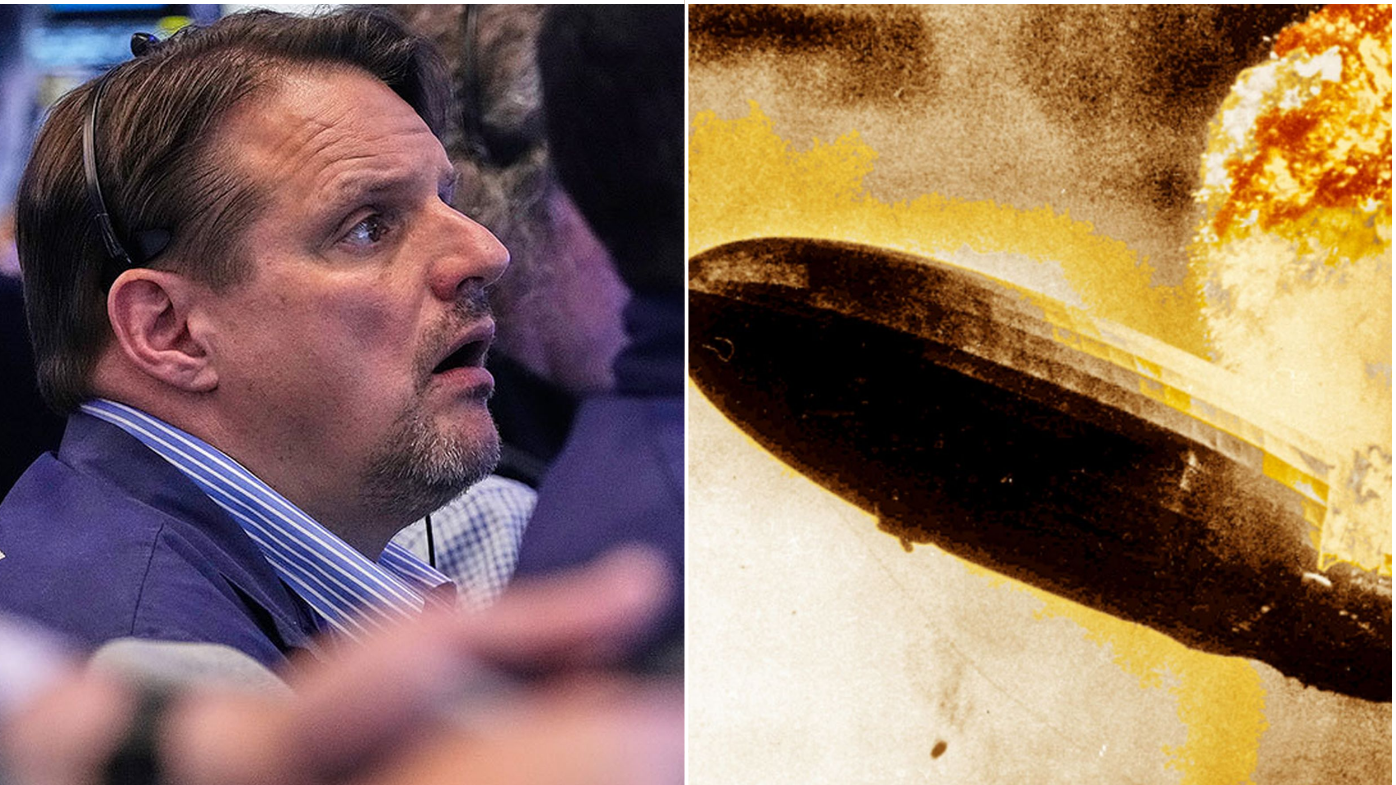
The Hindenburg Omen just flashed twice in a single window, a technical occurrence that historically suggests the stock market is standing on a trapdoor. To the casual observer, the major indices look healthy, trading near record highs with steady volume. However, this specific mathematical signal points to a internal fracturing where the number of stocks hitting new 52-week highs and new 52-week lows are both expanding simultaneously. This creates a state of extreme "bifurcation," meaning the market is no longer moving as a cohesive unit but is instead being pulled apart by opposing forces. When this divergence happens at the top of a cycle, the structural integrity of the bull market is compromised.
While the financial press often treats these technical signals as crystal balls, the reality is far more nuanced. The Omen is not a guaranteed crash trigger. Instead, it is a high-alert warning that the floor is thinning.
The Anatomy of a Market Schism
To understand why a double Hindenburg Omen matters, you have to look past the top-line numbers of the S&P 500 or the Nasdaq. Those indices are market-cap weighted, meaning a handful of trillion-dollar giants can mask the rot underneath. The Hindenburg Omen, developed by Jim Miekka, looks for a specific set of criteria that must occur on the same day to qualify.
First, the number of new 52-week highs and new 52-week lows on the New York Stock Exchange (NYSE) must both exceed 2.2 percent of total issues traded. This is the heart of the signal. In a healthy bull market, you expect plenty of highs and very few lows. In a crash, you expect the opposite. Seeing both spike at once indicates that investors are confused, fleeing certain sectors while irrationally chasing others. It is a sign of a "split personality" market.
The second layer requires the McClellan Oscillator—a measure of market momentum—to be negative. Finally, the 10-week moving average of the NYSE must be rising. Essentially, the signal catches the market as it tries to climb higher while its foundation is actively crumbling. When this happens twice in a short period, it suggests the first flash wasn't a fluke; it was the beginning of a trend.
Why the Math is Screaming Now
The current economic environment is a pressure cooker. We are seeing a massive disconnect between the "AI-fueled" tech giants and the rest of the economy. While seven or eight stocks drive the indices to new heights, the average small-cap company is struggling under the weight of sustained high interest rates. This is exactly where the Hindenburg Omen finds its teeth.
Small businesses and mid-sized firms are hitting those 52-week lows because their debt-servicing costs have exploded. They cannot refinance the cheap money they took out five years ago. Meanwhile, the mega-caps, sitting on mountains of cash, are hitting 52-week highs. This creates the statistical anomaly required for the Omen to flash. The danger is that the weakness in the bottom 400 stocks of the S&P 500 eventually drags down the leaders. Liquidity is like water; when it starts leaking out of the bottom, the whole tank eventually empties.
History shows us that since 1985, every major market crash has been preceded by a Hindenburg Omen. However, not every Hindenburg Omen is followed by a crash. This distinction is where many analysts lose their way. It is a "necessary but not sufficient" condition. Think of it as a smoke detector. If the alarm goes off, there is definitely smoke in the room, but it doesn't mean the house will burn to the ground. It just means you should probably find the exit.
The Psychology of the Double Flash
When the signal appears twice in quick succession, the psychological impact on institutional traders increases. Professional desks use automated systems that flag these technical anomalies. When the second "confirmation" hit the wires overnight, it likely triggered a shift in risk management protocols.
We are currently seeing a transition from "buy the dip" to "sell the rip." In the previous months, every minor pullback was met with aggressive buying. Now, there is a palpable sense of exhaustion. The double Omen validates the fears of those who felt the rally was getting too thin. It provides the fundamental excuse for big money to take profits and move to the sidelines.
Investors should pay close attention to the credit markets during these periods. If corporate bond spreads begin to widen at the same time the Hindenburg Omen is flashing, the risk of a hard landing moves from "possible" to "probable." Equity markets are often the last to know when a recession is actually hitting; the bond market is the smarter sibling that usually smells the fire first.
Counterpoints and the False Positive Trap
Critics of the Hindenburg Omen argue that the modern market is too fragmented for the signal to work as it once did. With the rise of ETFs and high-frequency trading, the NYSE data can sometimes be "noisy." For example, an influx of new closed-end funds or preferred stocks can skew the highs and lows data, creating a signal that doesn't reflect the health of common stocks.
There is also the "blind spot" of global liquidity. Even if the NYSE looks shaky, the massive amounts of capital flowing from overseas into U.S. Treasuries and top-tier tech can keep the indices propped up far longer than technical indicators suggest. Betting against a bubble is a dangerous game because bubbles often expand much further than logic dictates.
Navigating the Volatility
For the individual investor, the appearance of this indicator isn't a command to sell everything and buy gold bars. It is a command to check your leverage. If you are playing with borrowed money or heavy margin, a Hindenburg-triggered correction of 10 to 15 percent could wipe you out before the market has a chance to recover.
The smart move in this environment is a rotation into "defensive quality." This means looking for companies with low debt-to-equity ratios and consistent cash flow—firms that can survive a period where the broader market is searching for a floor. Avoid the speculative "moonshots" that rely on future low interest rates to justify their valuations. Those are the stocks hitting the 52-week lows right now, and they are the first casualties when the Omen proves true.
Watch the 200-day moving average on the S&P 500. If the index closes below that line following a double Hindenburg Omen, the technical breakdown is complete. At that point, the "omen" stops being a warning and starts being a reality.
The sheer frequency of these signals in the current window suggests that the internal plumbing of the financial system is under immense strain. You cannot have a healthy economy when half of the market is hitting new highs and the other half is staring into the abyss. Eventually, the two sides must reconcile, and historical precedent suggests that reconciliation happens on the downside.
Tighten your stop-losses and keep your cash reserves ready. The volatility we are seeing isn't just noise; it is the sound of the gears grinding before the machine shifts gears.