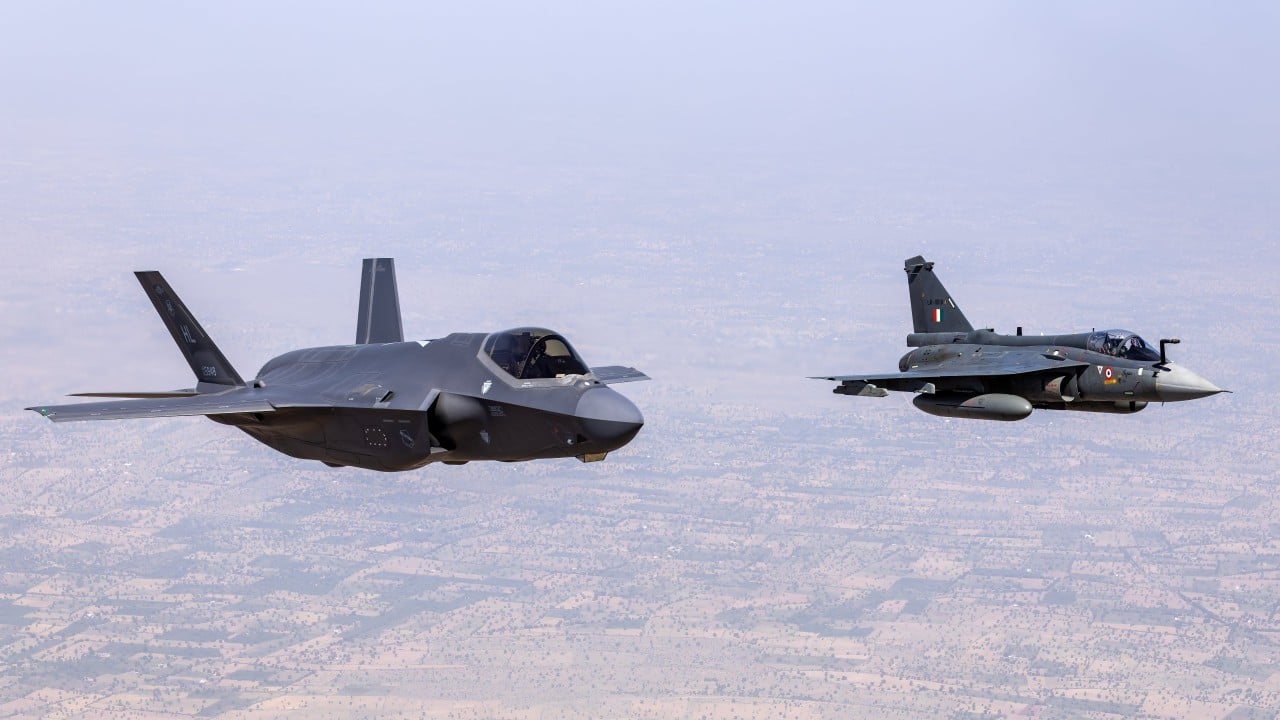
Washington sent its crown jewel to South Asia without firing a shot, yet the arrival of the Lockheed Martin F 35 Lightning II on Indian soil represents a strategic pivot years in the making. For decades, military procurement between Washington and New Delhi moved at the speed of a rusted bureaucratic glacier. Defense acquisitions were bogged down by liability clauses, technology transfer disputes, and a lingering Indian insistence on strategic autonomy. But when two fifth generation stealth fighters touched down at Aero
The Hidden Calculus Behind India Hosting the F-35
technology, news
v>
A generation ago, the notion of an American fifth-generation fighter jet touching down on Indian tarmac for a formal debut would have been treated as diplomatic fiction. Military procurement between New Delhi and Washington was defined by bureaucratic friction, strict licensing controls, and the haunting shadow of Cold War non-alignment. That barrier cracked open when the United States showcased its premier F-35 Lightning II stealth aircraft in India, turning an exhibition into a high-stakes geopolitical signal.
Defense analysts breathlessly termed it a milestone. They pointed to bilateral ties, shifting Indo-Pacific security architectures, and the slow unwinding of India's historical reliance on Soviet and Russian military hardware.
They missed the real story.
This debut was not a sales pitch. It was an intelligence-gathering exercise, a stress test of regional sensitivities, and a calculated gamble by two capitals trying to outpace a changing balance of power in Asia. Beneath the polished flight displays lies a web of strategic anxieties, industrial demands, and profound technological hesitations that neither Washington nor New Delhi wants to discuss in public.
The Operational Reality of Fifth-Generation Air Combat
Air superiority today bears little resemblance to the dogfights of the twentieth century. Modern combat is fought through sensors, networks, and low-observable signatures. The F-35 is less of a traditional airplane and more of a flying supercomputer, integrating radar data, electronic warfare systems, and ground intelligence into a single fused display for the pilot.
When Washington brought these jets to India, it was offering a demonstration of dominance. Yet, military planners in South Block viewed the aircraft through a different lens: cost, control, and compromise.
The architecture of the F-35 is notoriously restrictive. Its maintenance relies on ODIN (Operational Data Integrated Network), a cloud-based logistics system tethered directly to Lockheed Martin and the Pentagon. Every diagnostic check, every software patch, and every structural modification must clear American digital gates. For a military establishment like India's, which fiercely guards its strategic autonomy and operational independence, the thought of an overseas contractor holding a kill switch over its frontline fleet is a non-starter.
India's own indigenous fifth-generation program, the AMCA (Advanced Medium Combat Aircraft), remains years away from serial production. While the domestic aerospace sector crawls toward maturity, the Indian Air Force faces a shrinking squadron strength. Plugging that gap with foreign acquisitions has always been a painful necessity, but the price of admission for American stealth technology goes far beyond financial capital. It demands a surrender of sovereign maintenance control that decades of strategic doctrine have warned against.
The Geopolitical Chessboard and the Russian Factor
To understand why the F-35 matters in New Delhi, one must look toward the northern border and across the western frontier. The Indian Air Force operates a mixed fleet, heavily anchored by Russian-designed airframes like the Su-30MKI. Decades of military-technical cooperation created a supply chain deeply integrated into Indian defense infrastructure.
Washington knows this. For years, the Pentagon has watched with growing unease as New Delhi maintained its reliance on Moscow, culminating in the purchase of the S-400 air defense system. Under American legislation known as CAATSA (Countering America's Adversaries Through Sanctions Act), nations buying major Russian defense assets face the threat of punitive economic penalties.
The appearance of the F-35 in India served as a subtle, multi-directional message. To Beijing, it demonstrated rapidly tightening defense interoperability between the world's largest democracies. To Moscow, it served as a visible reminder that India's defense diversification is real and accelerating. To Washington, it tested whether New Delhi could be tempted away from its traditional defense orbit.
Yet, temptation does not equal commitment. Indian defense procurement has always operated on the principle of strategic hedging. Buying western systems does not mean abandoning eastern dependencies, nor does hosting an American stealth jet mean an eventual order for the aircraft is guaranteed.
The Industrial Offset Trap
Every major defense deal India signs comes with a heavy political anchor: Make in India. The government has made it abundantly clear that foreign original equipment manufacturers can no longer simply dump finished products into the domestic market. They must transfer technology, establish local manufacturing hubs, and integrate Indian firms into global supply chains.
Herein lies the structural contradiction of the F-35.
Lockheed Martin guards the manufacturing secrets of its stealth fighter with a level of security that borders on paranoia. The source code of the jet is among the most heavily guarded intellectual properties in the United States government. The prospect of Washington sharing the core algorithms, composite material formulas, or radar-absorbent skin manufacturing techniques with Indian engineers is close to zero.
Without deep technology transfer, any potential procurement of the F-35 collapses under the weight of India's domestic political economy. No ruling party in New Delhi can afford to purchase hundreds of billions of dollars worth of foreign military hardware without ensuring that local jobs, technical skills, and industrial capabilities are built in return. The competitor narratives gloss over this reality, framing the presence of the jet as the prelude to a landmark purchase contract. History suggests a much more complicated, protracted negotiation that could stretch for a decade without a single signature on a procurement order.
The Quiet Evolution of Regional Air Power
While pundits obsess over whether India will eventually buy American stealth jets, the more immediate transformation is happening in the background. Maintenance protocols are aligning. Communication ciphers are being tested for compatibility. Joint exercises are growing in complexity, shifting from basic maneuvers to complex electronic warfare simulations.
The arrival of the F-35 on Indian soil was an inflection point, but not the one advertised in press releases. It forced both nations to look past the political rhetoric and confront the hard operational limits of their partnership.
The jet represents the pinnacle of modern aerospace engineering. It also represents the ultimate test of whether Washington can share power within a coalition, and whether New Delhi can accept the dependencies that come with high-end technological alignment.
The stealth fighters flew home after the exhibition, leaving behind empty tarmac and a thick cloud of bureaucratic deliberation. The questions they exposed will not leave as quietly. The future of Indian air power hangs in the balance, caught between the urgent need for advanced capabilities and the timeless demand for absolute sovereignty.