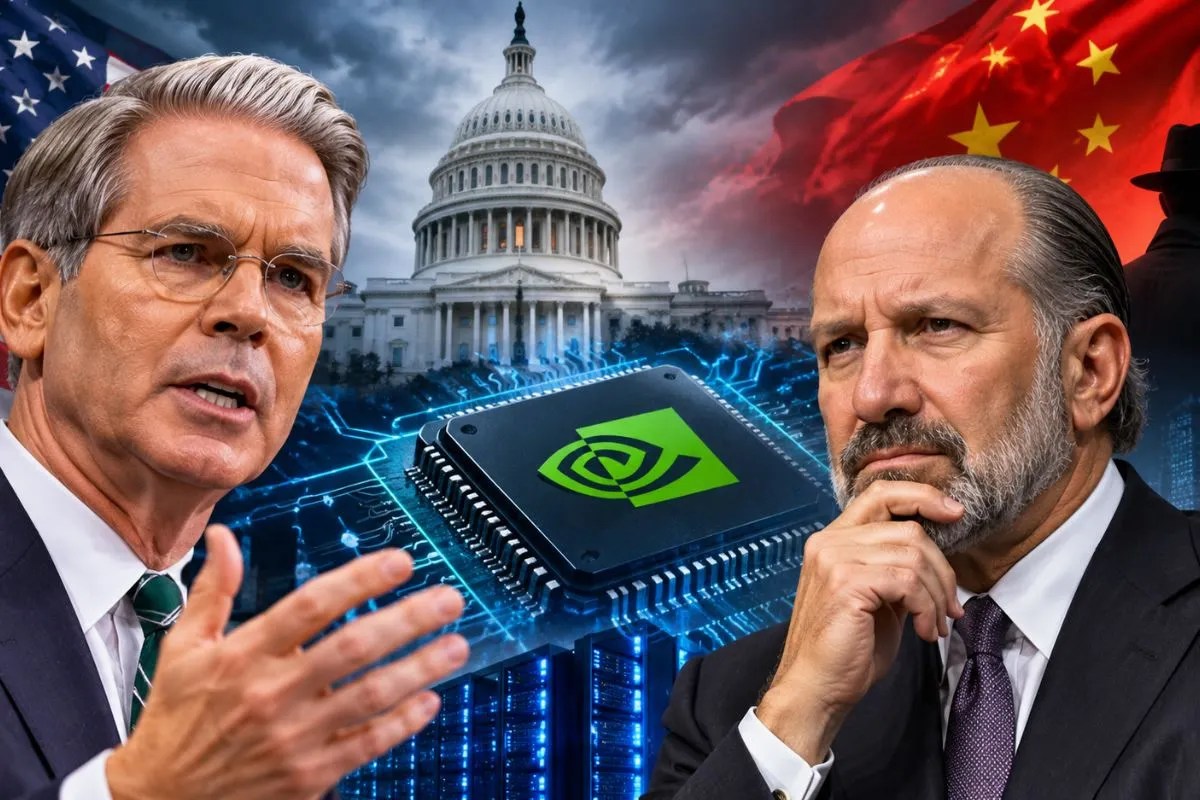
Nvidia’s cult of personality around CEO Jensen Huang turns a complex semiconductor engineering company into a fragile single-point-of-failure investment. When a multi-trillion-dollar enterprise relies on one executive’s leather-jacket mythos to justify stratospheric valuations, any operational stumble, succession question, or architectural shift triggers disproportionate market panic.
Wall Street loves a messiah. It makes spreadsheets easier to sell. For decades, Silicon Valley has traded on the alchemy of founder-worship, transforming ruthless supply-chain operators and sharp electrical engineers into secular prophets. Steve Jobs had the black turtleneck. Elon Musk had the Mars colony. Now, Jensen Huang has the MotoGP-style leather jacket and the rock-star keynote arenas. Yet history shows that when a company’s market capitalization becomes fused to the personal aura of its chief executive, the inevitable correction is brutal, structural, and entirely predictable.
The Anatomy of Silicon Valley Messiah Complex
To understand why the Nvidia cult of personality poses a systemic risk, you have to look at how hardware companies actually survive. Unlike consumer software firms that ride viral network effects, chipmakers live and die by brutal, multi-year capital allocation cycles, wafer allocation negotiations at foundries like TSMC, and low-level compiler stability. None of these things happen on a stage in front of ten thousand cheering developers.
Yet the financial press and retail investors routinely attribute Nvidia’s dominance in accelerated computing to Huang’s singular, almost mystical foresight. This narrative erases the grueling, unglamorous work of thousands of systems engineers who spent nearly twenty years building CUDA, the proprietary software layer that actually locks customers into Nvidia’s silicon.
By collapsing an entire organizational moat into one man’s biography, the market creates a dangerous distortion. Investors stop analyzing gross margin compression, custom silicon threats from hyperscalers, and power-grid bottlenecks in data centers. Instead, they trade on sentiment surrounding a single individual.
It is an old story with a terrible track record.
Consider General Electric under Jack Welch in the late 1990s. Welch was hailed as the manager of the century, a figure so towering that GE’s stock commanded a massive premium simply because he was at the helm. When he retired, the underlying structural rot—an over-reliance on financial engineering through GE Capital and neglected industrial divisions—took nearly two decades to unwind, wiping out hundreds of billions in shareholder value. The cult of personality didn't build the moat; it hid the cracks in the foundation until the water broke through.
How Centralization Hollows Out Corporate Resilience
Huang is famous—or infamous, depending on who you ask in Santa Clara—for his flat organizational structure. Reports over the years have consistently noted that he maintains dozens of direct reports, eschewing traditional vice-presidential hierarchies in favor of direct, granular oversight.
In the early stages of a turnaround or a hyper-growth sprint, this management style is extraordinarily effective. Information travels without middle-management distortion. Decisions happen in hours rather than quarters. If a thermal design on a server rack looks questionable, the CEO hears about it immediately and forces an engineering pivot.
At massive scale, however, extreme centralization becomes a liability.
The Bottleneck of Omniscience
No human being, regardless of stamina or intellect, can effectively audit every architectural trade-off across networking interconnects, sovereign AI data center contracts, automotive chips, and enterprise software licensing simultaneously. When every major strategic thread passes through one desk, two things happen:
- Executive paralysis at the margins: Lower-level leaders stop making bold, autonomous bets because they know final adjudication rests at the top. They optimize for presenting well in front of the boss rather than taking calculated risks that might fail before the next review cycle.
- Succession vacuum: A flat structure with fifty direct reports produces superb functional lieutenants, not battle-tested general managers. Running a massive division with full profit-and-loss responsibility requires learning how to fail in private and recover without parental intervention. When the CEO absorbs all strategic responsibility, nobody else learns how to carry the weight of the entire enterprise.
If you want to see what happens when a founder-led giant fails to cultivate independent operational successors, look at Oracle’s decades-long struggle to establish a clear post-Larry Ellison identity, or the turbulent post-founder years at companies like Yahoo and Twitter. A brilliant founder casts a shadow so wide that nothing tall can grow beneath it.
The Valuation Trap of Founder Worship
Numbers tell a cold story that keynotes try to warm up. When a company reaches the upper echelon of global market capitalization, the math of compounding returns becomes unforgiving. To justify a multi-trillion-dollar valuation, Nvidia cannot merely remain a great chip company. It must continuously invent entirely new, high-margin monopolies every twenty-four months while defending its existing turf against the richest corporations on earth.
The cult of personality acts as a valuation lubricant. It convinces institutional fund managers to suspend normal skepticism about cyclicality.
Semiconductors are historically, notoriously cyclical. Periods of massive capital expenditure—where buyers double-order chips out of fear of missing out—are almost always followed by inventory digestion periods where orders evaporate overnight. We saw this happen to Nvidia during the cryptocurrency mining booms and busts of 2018 and 2022. Each time, management projected confidence right up until the demand cliff arrived, leaving excess inventory sitting in channels.
In the current artificial intelligence infrastructure buildout, the stakes are orders of magnitude higher. Hyperscalers like Microsoft, Alphabet, Meta, and Amazon account for a massive percentage of Nvidia’s data center revenue. Every single one of those customers is actively designing its own internal AI accelerators—such as Google’s TPUs, Amazon’s Trainium, and Microsoft’s Maia—specifically to break Nvidia’s pricing power.
A rational market prices in that inevitable margin erosion. A market intoxicated by a charismatic leader treats the threat as heresy. When investors treat a hardware vendor’s CEO as an infallible oracle, they ignore the basic economic reality that your biggest customers are simultaneously your most motivated future competitors.
Why Competitors Love a Single Point of Failure
In corporate strategy, predictability is fatal. When an entire corporate culture mirrors the instincts, rhetoric, and blind spots of one person, rivals gain a massive intelligence advantage. They do not need to guess how the organization will react to a pricing war or an open-source software threat; they only need to study one man’s psychological profile.
Take the battle over software ecosystems. Nvidia’s true fortress is not its silicon; it is CUDA. For years, Huang championed a closed, vertically integrated stack—selling the chip, the networking gear, the server reference design, and the proprietary software libraries as a single expensive bundle.
This strategy printed money while competitors were disorganized. Yet the uncompromising nature of that closed ecosystem—a direct reflection of Huang’s top-down philosophy—forced the rest of the industry into an unnatural alliance. Rival chipmakers like AMD and Intel, alongside cloud providers and open-source foundations, poured billions into open standards like PyTorch, Triton, and ROCm precisely because they refused to live under one vendor’s permanent tax.
Had Nvidia’s leadership been less wedded to total control, it might have co-opted the open-source movement early on, cementing its dominance through benign ubiquity rather than high-margin extraction. Instead, the top-down mandate for maximum value capture incentivized the entire global tech sector to engineer around Nvidia.
The Key-Man Risk Nobody Prices Properly
Ask any institutional risk officer about key-man risk at Nvidia, and you will get a rehearsed shrug. Corporate filings contain standard boilerplate language acknowledging that the loss of senior executives could adversely affect operations. Everyone reads it; nobody acts on it.
Let us look at a hypothetical example to see how fragile this dynamic actually is. Imagine a scenario where a sudden health event, a regulatory enforcement action, or an unexpected retirement removes Huang from active leadership tomorrow morning.
What happens to the stock in the first forty-eight hours?
Algorithmic trading desks and retail sentiment would trigger a violent sell-off before a single wafer shipment was delayed. Not because the engineers in Santa Clara forgot how to design memory controllers overnight, and not because TSMC stopped running lithography machines in Taiwan, but because the narrative glue holding the valuation multiple together vanished instantly.
Compare that to Apple’s transition from Steve Jobs to Tim Cook. Jobs was the ultimate Silicon Valley icon, yet he spent his final years methodically elevating Cook, Jony Ive, Eddy Cue, and Phil Schiller into visible, distinct pillars of leadership. By the time Cook took over in 2011, Wall Street understood who ran the supply chain, who ran the silicon design, and who ran the retail operation. Even then, Apple traded at a compressed valuation multiple for years until Cook proved the machine could run without its founder.
Nvidia has made almost no visible effort to build a public-facing bench of successors. During two-hour keynotes, Huang stands alone on stage, walking through dense technical slides on networking switches, liquid-cooled server racks, and software microservices. While impressive as an endurance feat, it sends an unmistakable message to the market: There is nobody else.
Separating the Engineering Reality from the Myth
To critique the cult of personality is not to diminish Nvidia’s actual technical achievements. The pivot toward general-purpose GPU computing in the mid-2000s was a genuine masterstroke of long-term corporate strategy. Betting the company’s research budget on parallel processing years before deep learning became commercially viable required rare institutional courage.
Furthermore, Nvidia’s execution on cadence—moving from a two-year product release cycle to an annual rhythm across architectures like Hopper, Blackwell, and Rubin—represents an extraordinary feat of supply-chain choreography and systems engineering.
The tragedy of the personality cult is that it cheapens this institutional brilliance. It reduces a triumph of collective human engineering, materials science, and compiler design into a simplistic hero’s journey.
Real durability in technology comes from institutionalized processes, decentralized decision-making, and cultures that outlive their creators. Bell Labs produced the transistor, information theory, and Unix not because one charismatic boss wore a signature outfit, but because it built an institutional environment where brilliant scientists had the autonomy to solve hard problems. IBM survived the transition from tabulating machines to mainframes to enterprise services because its corporate identity was larger than Thomas Watson.
When a company allows its public identity to become indistinguishable from its CEO’s personal brand, it trades long-term institutional resilience for short-term market adoration.
What Happens When the Narrative Breaks
Every market mania eventually collides with physical and financial constraints. For AI hardware, those constraints are already visible on the horizon. Data center operators are hitting hard limits on electrical power generation, transformer supply, and cooling infrastructure. At the same time, software companies are struggling to generate enough end-user subscription revenue to pay back the hundreds of billions of dollars spent on GPU clusters.
When capital expenditure inevitably slows down—even if it merely decelerates from hyper-growth to normal enterprise growth—the narrative around Nvidia will shift overnight.
In a downturn, the same traits that make a cult-of-personality CEO look visionary suddenly look reckless. Bold, top-down bets look like hubris. Dismissing competitors looks like denial. A lack of visible succession looks like corporate negligence. The financial media, which spent years polishing the legend, will eagerly tear it down to explain why the stock dropped forty percent.
Smart operators and disciplined investors understand that great companies are built on systems, not saviors. Until Nvidia proves that its strategic genius resides in its institutional DNA rather than one executive’s nervous system, its towering valuation rests on a foundation that no single human being is strong enough to hold up forever.