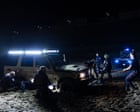
Sirens. That is the first thing you notice when a street turns from a shortcut to class into a bottleneck of fear.
Not the tidy, distant wail of an ambulance threading through morning traffic, but the low, metallic thrum of heavy engines idling at the end of a narrow avenue. You feel it in your ribs before your eyes even register the dark silhouettes blocking the exit. Around you, twenty-year-olds with canvas backpacks and cheap sneakers are suddenly trying to figure out which way is away, while a wall of armored steel rolls forward at walking pace.
When a story breaks about French police using UK-funded 4x4 vehicles to charge student protesters, it is easy to treat it like a filing-cabinet detail. Another line item in a budget report. Another diplomatic footnote between two capitals that share a stretch of cold water and centuries of complicated history. Yet when you trace the arc of a heavy off-road chassis from a ledger in London to a cobblestone intersection in France, the abstraction dissolves. Steel does not care about treaty language. Tires do not read press releases.
I have stood near enough to street clashes over the years to know the smell of tear gas hanging in damp air, sharp enough to sting the back of your throat a block away from the main line. It makes your eyes water before you even see who is running. You watch people lose their footing on wet pavement because everyone is looking backward over their shoulder instead of at the curb in front of them. That sensory memory is why cold headlines about "crowd control equipment" or "bilateral security cooperation" never feel neutral to me. Hardware has weight. Momentum has consequences.
To understand how a British pound or a cross-border security agreement ends up behind a charge at student demonstrators, we have to look past the immediate shock of the image and examine the quiet machinery that makes it possible. Often, governments fund policing, border management, or public-order capacities abroad under banners of stability, shared security, or regional coordination. On paper, those phrases sound orderly. Almost polite. They suggest desks, briefings, and mutual interest.
In practice, public-order policing is a high-friction craft where split-second decisions carry physical weight. A 4x4 vehicle built to clear obstacles, mount rough terrain, and carry heavy gear is engineered for capability. Capability is not a sin on its own; a four-wheel-drive truck can haul supplies up a muddy ridge or get responders through flooded roads. Everything changes when that same rugged chassis is deployed as an instrument of intimidation or kinetic pressure against unarmed students on an urban street.
Consider what happens next: once a heavy vehicle enters a crowd-control line, the geometry of the confrontation shifts. A line of officers on foot has limits—spacing, fatigue, visibility. A four-by-four changes the equation instantly. It projects mass. It can block retreats, channel movement, or press forward with a presence that makes a single person feel small against two tons of metal.
Let us construct a hypothetical scenario to make the mechanics tangible. Suppose a university student named Camille—an invented character standing in for no single real person, though drawn from recognizable patterns of campus mobilization—has spent a gray afternoon marching over tuition hikes or housing costs. She came expecting noise, chants, maybe a tense standoff outside a municipal building. She did not pack for heavy utility vehicles pushing into side streets. When the engines rev and the tires bite into the asphalt, the protest stops feeling like civic debate and starts feeling like survival. Panic spreads faster than any megaphone. A teenager trips over a curb. Someone pulls them up by the hood of a jacket while boots and bumpers keep advancing.
Even in a hypothetical scene, the emotional truth is sharp: fear narrows judgment. When people fear being run down or trapped, crowds surge unpredictably, and the risk of severe injury climbs for everyone on the street, including officers trying to hold a formation.
Where Budgets Meet the Cobblestones
Accountability gets blurry the moment money crosses a border.
When one country helps finance equipment or operational capacity used by another country's security forces, a convenient fog tends to settle over responsibility. Officials in the funding capital can say, We don't direct tactical deployments on the ground; local command decides how assets are used. Officials in the deploying capital can say, These are standard vehicles within our fleet, used to maintain order under national law. Both statements can sound plausible in a committee hearing while leaving the person nursing a bruised rib—or watching a peaceful march scatter—with no clear answer as to who enabled the moment.
History offers plenty of reminders of how easily "security assistance" drifts from its stated purpose. Across decades and continents, governments have supplied vehicles, communications gear, and training to partner states with assurances of oversight and restraint. Sometimes those guardrails hold. Often, once hardware enters a domestic political flashpoint—labor strikes, austerity protests, student demonstrations—the neat categories of "external security" and "internal crowd control" bleed into one another.
I will admit something candidly: untangling international funding streams can feel exhausting, even for people who read policy documents for a living. Grants get bundled. Procurement lines get split. A vehicle might be co-financed, reallocated, or folded into broader operational support that looks benign on a spreadsheet. If you find yourself glazing over at terms like procurement, jurisdiction, or mandate, you are not alone. That confusion is half the reason public scrutiny often arrives late—after the photographs are already circulating and tempers have already flared.
Yet the core question is simple enough for anyone to grasp. If public money from one nation helps put heavy 4x4 vehicles on the streets of another, taxpayers and citizens in both places have a right to ask what kind of policing their money is subsidizing. Is it de-escalation, or escalation? Is it protection, or raw force?
The Analogy of the Heavy Hammer
Think of a heavy framing hammer. In the hands of a carpenter building a roof, it drives spikes cleanly and holds a structure together against wind and rain. Left on a table where people are arguing over a blueprint, its sheer weight changes the tone of the room. Nobody talks quite the same way when a heavy tool is right there within reach.
Vehicles used in public-order operations work a bit like that hammer, scaled up to street size. A standard patrol car signals authority; a heavy 4x4 moving aggressively into a crowd signals dominance. When student protesters—many of them young, loud, idealistic, sometimes reckless, rarely armored—see a rugged four-by-four bearing down on a line of marchers, the message lands immediately. Whether an officer intends a controlled push or a sharp charge, the visual and physical impact on the street is unmistakable.
Students have always sat at an uneasy fault line in democratic politics. They have fewer financial cushions than established workers, more free time to organize, and a long history of testing the limits of state tolerance. From mid-century campus movements to modern street protests over climate, cost of living, or foreign policy, young people frequently collide with the sharpest edge of state power. When heavy vehicles enter that collision, the gap between youthful defiance and state force widens into a chasm.
What about the officers inside those cabs? It is easy to flatten them into villains, just as it is easy to flatten students into statistics. In reality, police assigned to public-order units often spend long shifts in cramped gear under intense stress, following orders from superiors out of sight while rocks, bottles, or insults fly from the crowd. High-stress environments reward aggression and punish hesitation. Yet recognizing human pressure on both sides does not erase accountability. Authority carries a higher standard precisely because the state holds the monopoly on organized force.
Why Quiet Details Matter Loudly
A report revealing that UK-funded 4x4s were used by French police to charge student protesters cuts through the noise because it connects two dots people rarely link: cross-border financing and street-level force.
Most debates over policing stay locked inside national borders. People argue about local budgets, union rules, ministry directives, or protest permits. Bringing international funding into the picture widens the frame. Suddenly, a local street clash becomes a question of foreign policy transparency, democratic oversight, and shared norms around civil liberties.
Look closely at what is at stake when that link comes to light:
- Public trust: Citizens grow skeptical when they suspect money earmarked for broad security or cooperation is helping fund aggressive tactics against protesters.
- Democratic oversight: Parliaments and voters struggle to hold executives accountable when funding mechanisms obscure how equipment is actually deployed.
- Escalation dynamics: Heavy vehicles in dense urban protests raise the stakes of every miscalculation, turning tense standoffs into dangerous stampedes or collisions.
- Cross-border credibility: Governments that lecture others on restraint and accountability risk looking hollow if their own financial footprints point toward heavy-handed crowd control.
None of these stakes are theoretical once you picture a narrow city street filling with smoke and shouting. A student losing a shoe in the rush. A journalist trying to keep a camera steady while backing away from a grille. A bystander stepping into a doorway to catch their breath as engines roar past.
A Question That Refuses to Stay Quiet
Maybe the hardest part of stories like this is the lingering unease they leave behind. You do not have to pick a single side in every political grievance to feel a jolt when heavy 4x4 vehicles charge young people on a city street—especially when public funds from across the Channel helped put them in motion.
Laws can be debated. Budgets can be amended. Press officers can draft careful paragraphs explaining why a maneuver was deemed necessary at the time.
Still, when a heavy four-wheel-drive pushes into a crowd of students and the exhaust drifts over wet stone, the real test isn't what appears on a balance sheet. It is whether the people holding the wheel—and the governments signing the checks—remember that every person in front of that bumper has a name, a family waiting at home, and a voice that belongs in a democracy.
The engine settles. The dust thins. And the silence left behind in the side streets carries a weight no budget line can ever balance.