Sending a $30 million crewed helicopter into a modern contested battlespace is starting to look like a terrible idea. Traditional rotorcraft are big, loud, and incredibly vulnerable to cheap, shoulder-fired missiles. When one goes down, you don't just lose an expensive machine. You lose highly trained pilots. It's a massive tactical and human liability, and military planners know it.
David Mayman, the founder and CEO of Mayman Aerospace, argues that the era of relying on traditional helicopters for dangerous missions is ending. The solution isn't to build tougher helicopters. It's to get rid of the pilots entirely and change the airframe design. Recently making waves in related news: Why Birthright Citizenship Still Matters After the Latest Supreme Court Defeat for Trump.
The defense sector needs to shift toward small, jet-powered autonomous drones that can take off vertically, fly at near-combat-jet speeds, and handle the dirty work without risking human lives.
The Fatal Flaws of Traditional Rotorcraft
Helicopters are too slow for the modern frontline. They max out at around 150 to 180 mph. In an era where air defense networks use AI-driven tracking and hypersonic threats, a slow-moving, massive radar signature is just target practice. Additional information into this topic are covered by NBC News.
Then there's the logistics problem. Maintaining a fleet of traditional helicopters requires a massive footprint. You need specialized mechanics, heavy supply lines for parts, and flawless runways or heavily defended forward operating bases. If a conflict breaks out in a highly contested zone, those bases become immediate targets.
Modern air defense systems have become incredibly cheap and widely distributed. A shoulder-fired surface-to-air missile costs a fraction of a military helicopter. The math doesn't work in favor of the crewed aircraft anymore.
Enter the Air Utility Vehicle
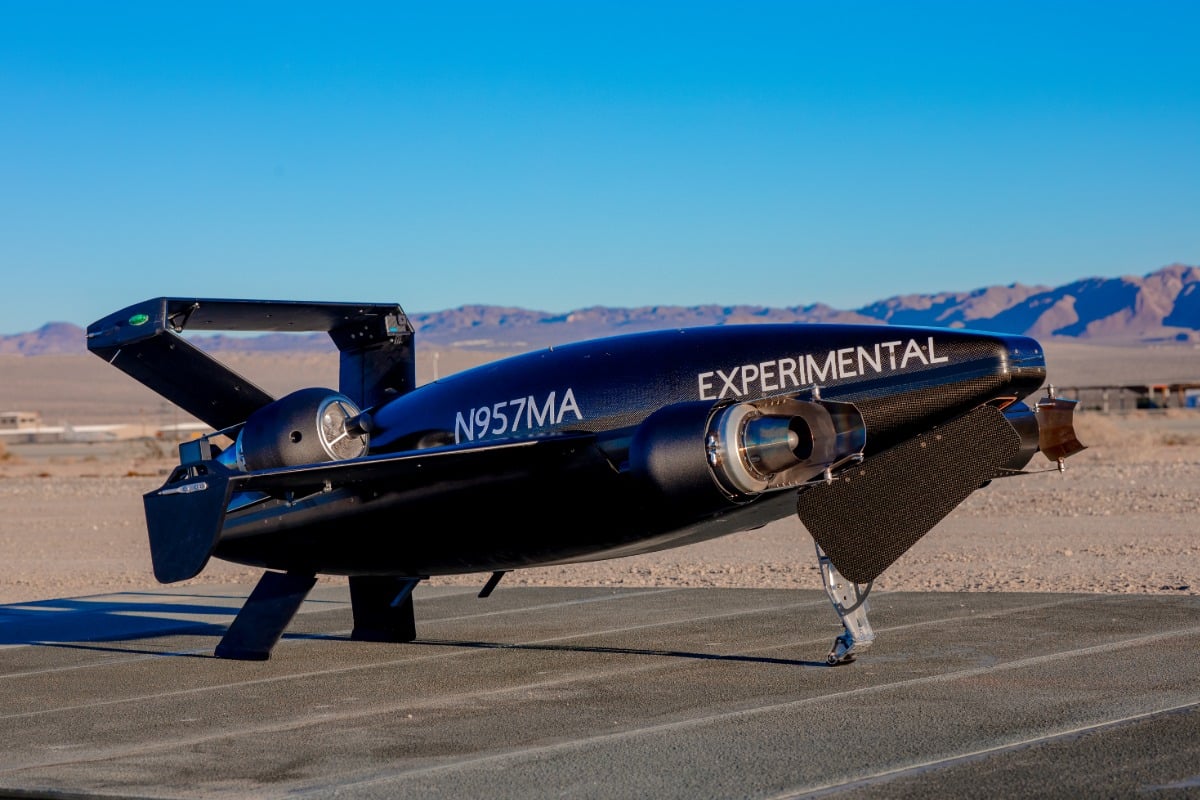
To fix this, the aviation architecture has to change completely. Mayman Aerospace has been flight-testing its answer: the RAZOR P100. They don't call it a drone. They call it an Air Utility Vehicle (AUV).
RAZOR P100 Key Metrics:
- Speed: Approaching Mach 0.75 (roughly 500 mph)
- Payload: 100 lbs (Scalable up to 1,000 lbs in larger variants)
- Propulsion: Vectorable jet engines
- Launch Profile: True Vertical Take-Off and Landing (VTOL)
This machine doesn't look or fly like a quadcopter. It uses vectorable jet engines to blast off vertically from practically anywhere—the back of a truck, a small clearing, or a ship deck. Once in the air, it transitions to high-speed horizontal flight, hitting speeds near 500 mph.
That speed changes everything. It can outrun most typical threats that would easily swat a helicopter out of the sky. If a RAZOR gets shot down, it's a financial hit, not a tragedy. The system is designed to be attritable, meaning it's cheap enough to lose in combat without breaking the strategic bank.
Operating Without GPS
Speed is only half the battle. If a drone relies entirely on a human operator staring at a screen miles away, it will fail in a real fight. Modern adversaries will jam communications and block GPS signals instantly.
That's where autonomous software comes into play. Mayman uses a proprietary operating system called SKYFIELD to run its aircraft. This system doesn't just automate flight paths; it allows the drone to think for itself when the link to headquarters goes dead.
If the drone encounters a GPS-denied environment, the onboard system uses terrain mapping and visual navigation to figure out where it is. If it spots a threat, it can make real-time decisions to reroute, drop its payload, or head back to base.
This isn't sci-fi speculation. The company proved the software works during autonomous flight testing at the US Marine Corps Air Ground Combat Center in Twentynine Palms, California. The aircraft executed complex, un-tethered maneuvers purely on algorithm-driven commands, showing that the system can operate without a human holding its hand.
Replacing the Wildcat and the Apache Wingman Trend
This shift away from traditional rotorcraft isn't isolated to Southern California tech startups. Look at the UK Ministry of Defence. The Royal Navy recently outlined plans in its Defence Investment Plan to eventually phase out its Wildcat maritime helicopters in favor of autonomous uncrewed systems.
Similarly, the British Army is pushing Project NYX, which aims to build autonomous helicopter drones to act as "loyal wingmen" for Apache attack helicopters. The goal is clear: put the uncrewed systems in danger first. Let the autonomous drones scout the contested area, jam enemy radar, or draw fire before you ever send a human pilot into the zone.
Eventually, the goal is to skip the crewed middleman entirely for high-risk transport and strike missions.
Real World Implementation
The market is moving fast. Savback Helicopters, a major European aerospace distributor, signed a deal to procure 300 of these jet-powered RAZOR P100 platforms for European defense forces. They aren't buying them to replace luxury transport; they're buying them because European operators realize that moving cargo, conducting intelligence operations, or launching precision strikes in contested territory requires an entirely new type of speed and expendability.
The scaling plan includes building the P400 and P1000 models, which will carry up to 1,000 pounds of gear or weapons. That moves the technology from simple surveillance into heavy logistics and combat strike roles.
If you are a defense planner or a technology strategist, sitting around waiting for helicopters to magically become stealthy or fast is a losing strategy. The immediate next step is clear: integrate small, high-speed, autonomous VTOL platforms into your existing battlefield management networks. Test them in electronic warfare environments. Shift budget priorities away from fragile, heavy airframes and move them toward modular, jet-powered autonomy. The side that stops risking pilots for routine tactical missions is the side that wins the next major conflict.


