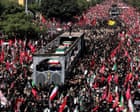
The black cloth did not arrive overnight, but it felt as though it did. By dawn, the heavy wool of mourning hung from every balcony along Enghelab Street, swallowing the usual morning light of Tehran. The air smelled of diesel fuel, rosewater, and the distinct, metallic tang of anxiety.
Millions of boots shuffled against the pavement. It is a specific sound, this collective march of a city in suspension. It is not the sound of a riot, nor is it the sound of a celebration. It is the low, rhythmic thrum of history shifting its weight from one foot to the other.
For decades, one voice anchored the complex, often contradictory machinery of the Iranian state. Now, that voice was gone. The funeral procession for Supreme Leader Ali Khamenei had begun, and with it, an entire nation held its breath, waiting to see which way the wind would blow.
The Architecture of Grief
To understand Tehran on a morning like this, you have to look past the official television broadcasts. The cameras focus on the sea of black chadors, the synchronized chest-beating, and the massive portraits raised toward the smoggy sky. That spectacle is real, orchestrated with the meticulous precision of a state that understands the power of theater.
But the real story lives in the margins.
Consider a shopkeeper named Farid. He does not exist in the official press releases, but he represents thousands like him standing on the sidewalks of the capital. Farid sells electronics in a small stall just off the main avenue. Today, his metal shutters are pulled down three-quarters of the way. He stands in the gap, a cigarette burning down to his knuckles, watching the crowds pour toward the university where the funeral prayers are being read.
Farid remembers the transition in 1989 when Ayatollah Khomeini passed away. He was just a boy then, holding his father’s hand in a similarly suffocating crowd.
"Everyone was terrified of a civil war the next morning," Farid might tell you, his voice dropping to a whisper as a patrol of Revolutionary Guards passes by. "We thought the borders would collapse. The borders stayed. The system stayed. But this time, the world outside is much hungrier."
This is the psychological reality of the Middle East crisis at this exact hour. For the loyalists marching in the center of the street, the death of the Supreme Leader is a profound, spiritual loss. They weep with a raw, unvarnished intensity that unnerves western observers. For the critics and the quiet dissidents watching from behind curtained windows, it is a moment of intense, volatile uncertainty.
Nobody is celebrating. The stakes are far too high for joy. When a pillar of that magnitude falls, everyone worries about the roof collapsing, regardless of how they felt about the pillar itself.
The Invisible Scales of Power
Beyond the emotion of the streets lies the cold arithmetic of geopolitics. A transition of power in Iran is never just a domestic affair. It is an earthquake with a fault line that stretches through Baghdad, Beirut, Damascus, and Sana'a, before vibrating directly into the capitals of the West.
The office of the Supreme Leader—the Vali-e Faqih—is not merely a political position. It is the ultimate arbiter of a vast, interlocking network of religious institutions, military factions, and economic empires. The Islamic Revolutionary Guard Corps (IRGC) answers here. The bonyads, the massive charitable trusts that control billions of dollars in industry, find their direction here.
When the center vanishes, the factions begin to move.
Imagine a grand chessboard where the pieces are suddenly allowed to make their own rules for an hour. The regular army, the hardline clerics in Qom, the technocrats in the parliament, and the commanders of the Quds Force are all watching each other. They march side by side in the procession, their faces frozen in expressions of solemn unity, but their minds are calculating the next move.
The immediate question reverberating through the diplomatic corps is simple: who steps into the vacuum?
The Assembly of Experts, a body of elderly clerics, is tasked with choosing the successor. The process is cloaked in secrecy, resembling the papal conclave but with far higher military stakes. The rumors fly faster than the ambulances clearing paths through the crowds. Will it be a compromise candidate, a quiet mujtahid who will allow the military to run the country from behind the scenes? Or will a fiercely ideological figure emerge, determined to double down on the regional confrontation?
The uncertainty itself is a weapon. Regional adversaries look for signs of weakness, while domestic security forces tighten their grip to prevent even the slightest hint of dissent from blossoming into open protest. The internet slows to a crawl. Satellite signals flicker. The state ensures that the only narrative available is the one being broadcast from the loudspeakers lining the funeral route.
The Soundscape of the Capital
The noise is total. It fills the ears until it becomes a form of silence.
The loudspeakers broadcast the Quranic recitations, the deep, sonorous bass of the reciter vibrating through the soles of your shoes. “Every soul shall taste death,” the verse echoes off the concrete apartment blocks. Between the verses come the slogans, called out by a leader on a flatbed truck and returned by a hundred thousand voices in unison.
Yet, if you step back into the side alleys, into the older neighborhoods where the trees form a canopy over the stone walls, the silence is terrifying.
In these neighborhoods, people are hoarding flatbread and rice. The banks are jammed with individuals trying to check their balances, though many ATM machines ran out of cash hours ago. The price of the US dollar on the open black market—the true thermometer of Iranian public anxiety—has spiked significantly since the announcement.
This is the dual nature of Iran during a crisis. It is a country capable of projecting immense, terrifying solidarity on the global stage while simultaneously experiencing a deep, internal fragmentation.
The younger generation, those born long after the 1979 revolution, look at the funeral procession with a detachment that is almost clinical. They are connected to the global world through VPNs and illicit satellite dishes. For them, the old rhetoric of the revolution feels like a language spoken by ancestors they never knew. They do not join the march, but they do not protest either. They stay inside, checking their feeds, waiting to see if their futures will be decided by men who have never looked at a smartphone.
The Weight of the Tomorrow
By afternoon, the procession moves toward the grand mausoleum on the outskirts of the city. The heat rises, mixing with the dust kicked up by millions of feet. The energy changes from the sharp sting of shock to the heavy, exhausted realization of what comes next.
The funeral will end. The black banners will eventually be taken down, folded, and stored away for the next state mourning. The crowds will disperse, returning to their apartments, their offices, and their half-shuttered shops.
Then, the true crisis begins.
The regional theater does not pause for grief. The proxy conflicts across the borders remain active. The economic sanctions continue to bite into the daily lives of ordinary citizens. The nuclear centrifuges continue to spin. The new leadership will inherit a deck of cards that is already stacked with domestic economic trouble and international isolation.
The international community watches the footage from Tehran with a mixture of apprehension and miscalculation. It is easy to view Iran as a monolith, a single, dark entity moving with a singular purpose. But the reality on the ground on this day of burial is that Iran is a collection of eighty-five million individuals, each trying to navigate an uncertain horizon.
The old man in the coffin carried the weight of an era. His departure closes a long chapter of defiance, resistance, and immense human cost. The new chapter is being written right now, not in the halls of parliament or in the secret chambers of the clerics, but in the anxious calculations of the people walking slowly back to their homes under a darkening Tehran sky.
The sun dips below the Alborz mountains, casting long, sharp shadows across the city. The loudspeakers finally fall silent. In the twilight, the capital feels smaller, fragile, like a ship waiting for the captain to take the wheel in the middle of a storm.