The human body weighs less when it is empty. By the fortieth kilometer, the stomach has long stopped protesting the absence of food, the muscles have consumed their own glycogen stores, and the mind has stripped away every unnecessary thought until only a singular, rhythmic command remains. Move.
For most runners, that command is born of vanity, fitness, or the pursuit of a personal record. For a young man standing on the asphalt of various Chinese cities over the course of four brutal years, the command was much simpler. If he stopped moving, the tuition bill would not get paid.
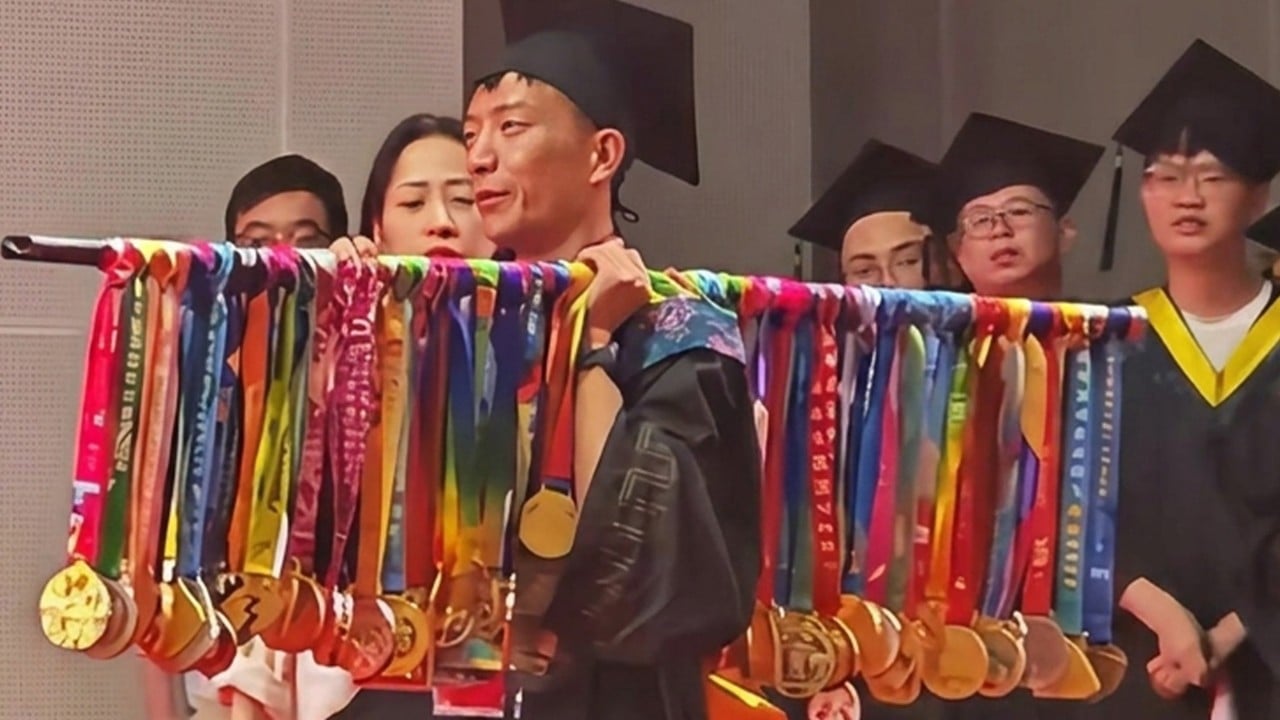
When the graduation ceremony finally arrived, his classmates carried flowers, custom-printed banners, and bright smiles meant for family photo albums. He brought a box. When he opened it, seventy heavy pieces of metal spilled onto the campus lawn, catching the midday sun. Seventy marathon medals. To the casual observer, it looked like an ostentatious display of athletic supremacy. To anyone who looked closer at the worn soles of his shoes and the hollows beneath his cheekbones, it was a ledger. Written in sweat, signed in blisters, and cashed in prize money.
University tuition is a financial wall that millions of young people hit at full speed. Some take out loans that darken their financial horizons for decades. Others work midnight shifts at convenience stores, trading sleep for pennies. This student chose the road. Literally.
The Economics of Endurance
To understand how a person ends up running thousands of miles just to stay in a classroom, you have to understand the sheer mathematics of desperation. The average cost of university tuition and living expenses in China can stretch a rural family past its breaking point. When traditional avenues of funding fail, the human mind searches for any asset it has left.
His asset was a pair of lungs that didn’t quit and a pain threshold that seemed to recede the harder he pushed.
Marathons in major municipal areas offer more than just prestige. They offer cash. For a top-tier amateur runner capable of placing high in regional brackets or age groups, a single race can yield thousands of yuan in prize money, appearance fees, or local sponsorships. It is a highly specific, high-risk economic ecosystem. If you win, you eat. If you twist an ankle at mile three, you lose the registration fee, the train fare, and the ability to pay for next semester's textbooks.
Imagine the pressure of a starting line when the stakes are that high.
The gun goes off. Around you, thousands of hobbyists are laughing, checking their smartwatches, soaking in the high-energy music blaring from the race speakers. They are there to finish. They are there for a personal best. You are there because the registrar's office sent a final notice warning that your enrollment will be canceled by the end of the month. The first few miles are always crowded, a chaotic sea of elbows and shifting paces. You cannot afford to get caught in the pack. Every second wasted behind a slower runner is a fraction of a yuan slipping through your fingers.
The joints begin to ache around the halfway mark. That is when the mental math begins. It is not the math of pace per mile, but the math of survival. If I place fifth, I can buy the engineering textbooks. If I place third, I can pay rent for the next three months. If I drop out, I have to pack my bags and go home.
The Hidden Routine of a Scholar Athlete
Society loves the image of the triumphant finisher crossing the line, arms raised, confetti falling. We rarely look at the Tuesday mornings that make that moment possible.
His life was split into two completely irreconcilable halves. In the mornings, he sat in hushed lecture halls, scribbling notes on advanced mathematics, structural engineering, or literature. He was just another face in a sea of identical desks, quietly absorbing lectures while trying to keep his eyes open. His professors saw a quiet, perhaps slightly detached student who rarely raised his hand.
But when the sun went down and the campus grew quiet, the second life began.
While his peers headed to internet cafes, bars, or dorm rooms to relax, he laced up a pair of running shoes that had long lost their structural integrity. He ran through the smog. He ran through the freezing winter rain that turned the campus paths into sheets of black ice. He ran when his shins felt like they were splintering into fragments under his skin.
There was no coach. There was no high-tech training facility, no sports massages, no carefully calibrated diet of protein shakes and imported supplements. His fuel was cheap rice, steamed buns, and whatever starchy vegetables could be bought in bulk at the local market. It was an exercise in pure biological efficiency. The human body transformed into a machine that converted the cheapest possible calories into the maximum possible mileage.
Consider what happens next when this routine is sustained for four years. The mileage compounds. The fatigue becomes a permanent layer of existence, a heavy blanket that never truly leaves the shoulders. He wasn’t just studying for exams; he was studying while his body was actively trying to repair micro-tears in his muscle tissue from a fifty-kilometer trail race he had run forty-eight hours prior.
The Anatomy of a Medal
A medal is usually a symbol of celebration. It hangs on a wall, a glossy reminder of a weekend achievement. But when you look at seventy of them laid out on a graduation gown, the visual shifts from celebratory to industrial. They look like armor. Or perhaps links in a chain that had to be forged one by one to drag an entire future out of the mud.
Every single one of those seventy medals represents a different city, a different sacrifice, and a different crisis averted.
- The tarnished bronze medal from a rainy autumn race: That was the one that paid for the lab fees when a scholarship unexpectedly fell through.
- The bright gold medallion from a local half-marathon: That covered the emergency dental work after months of neglect caught up with him during midterms.
- The heavy, stylized medal from a mountain ultra-marathon: That paid for the winter coat and the train ticket home to see his parents for the first time in two years.
The sheer physical toll of this lifestyle cannot be overstated. The human skeletal system is not designed to absorb the impact of seventy competitive endurance events within a four-year university window while maintaining a full academic load. The cartilage in the knees thins. The lower back stiffens into a permanent ache. There are mornings when turning over in a twin-sized dorm bed requires a conscious, agonizing effort of the will.
Yet, there is a strange, beautiful clarity in that level of suffering. When your survival depends on your ability to endure physical discomfort, the minor anxieties of university life fade into irrelevance. A difficult exam is nothing compared to the twenty-third mile of a marathon when your lungs feel like they are filled with broken glass. A cold response from a peer means nothing when you have stood on a frozen mountain pass at dawn, waiting for the starting gun with numb toes and a starving stomach.
The Diploma and the Verdict
When his name was finally called across the loudspeaker, he walked up to the stage. He received the same piece of paper that every other graduate received. It was light, rolled up, and tied with a ribbon.
But when he returned to the lawn and laid that light piece of paper next to the seventy heavy medals, the true narrative of his education became clear. He had not just earned a degree; he had literally bought his way into a new social class with his own blood and stamina.
The image of those medals spread across the internet not because people love running, but because people recognize the profound unfairness of a world where a young person must perform minor miracles just to get a seat at the educational table. It strikes a chord that is both deeply inspiring and quietly tragic. We cheer for his resilience, but we must also question the system that required it.
He stood there in his cap and gown, the medals clinking softly against each other like coins in a slot machine that finally paid out. He was exhausted. His knees will likely remind him of these four years every time the weather turns cold for the rest of his life. His feet are permanently scarred, his toes misshapen from years of repeated trauma inside cheap athletic shoes.
He smiled for the camera, a quiet, tired smile. The race was over. The tuition was paid in full. He had crossed the final finish line, not just ahead of the pack, but ahead of the destiny that poverty had tried to write for him.