Winter does not knock. It arrives with a sudden, bone-shuddering silence, stripping the Alaskan wilderness down to bare granite and freezing spray. Long before the first flakes settle into the cracks of the shale, the countdown begins. High above the roaring rapids of Brooks Falls, a drama of colossal proportions unfolds every single autumn, one that transforms thousands of pounds of living, breathing mass into an unforgettable spectacle of endurance.
We call it Fat Bear Week. But to those who watch the live-streamed feeds from Katmai National Park with a cup of cold coffee in hand at three in the morning, it is something much older and much heavier. It is an annual masterclass in the sheer, unyielding will to exist.
Picture a single square inch of Alaskan riverbank. The air smells of wet moss, cold mud, and the unmistakable, rich copper tang of migrating sockeye salmon. For months, these waters have churned with life. Millions of red-scaled fish battle their way upstream, leaping through arcs of white water only to meet an unblinking wall of muscle and curved claws.
To understand what is happening here, you have to let go of human metrics. We spend our lives counting calories down, obsessing over reduction, trimming the edges of our plates in the name of wellness. The brown bear does the exact opposite. Success, for them, is measured in excess. It is measured in the glorious, physics-defying accumulation of blubber that will keep their hearts beating while they spend half a year buried alive in a dark, frozen den.
Consider Bear 747.
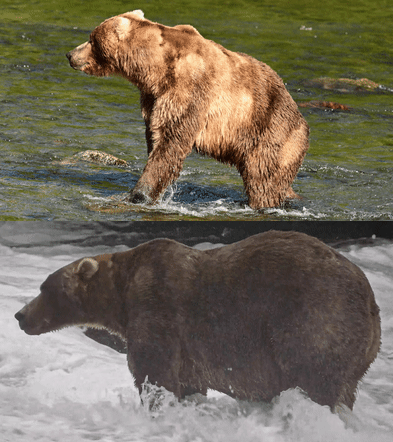
He does not look like an animal; he looks like a boulder with legs. When he lumbers down the embankment, the very earth seems to sigh beneath his weight. He is a titan of the Brooks River, a living monument to successful summer fishing. His belly swings low to the ground, brushing the autumn sedge grass. His fur is dusted with golden highlights, thick and matted from salt and river silt. He is magnificent. And he is terrifying.
Years ago, standing on a wooden viewing platform yards away from these giants, the scale of it hits you in a way photographs never capture. You do not just see the bear. You feel him. When a six-hundred-pound sow exhales, the sound carries across the water like a low bass note from a cathedral organ. When 747 splashes into the riffles, the water displacement hits your shins even from a distance.
There is an invisible stake to all of this gorging. It is life or death, distilled to its most basic biological denominator.
Biologists call it hyperphagia. It is a neurological trigger, a biological command that overrides all other senses, turning a normally solitary and cautious animal into an eating machine. For months, these bears consume up to thirty or forty salmon a day, packing away tens of thousands of calories. They eat the skin, the rich brains, the fatty skin, and the roe. They leave the rest for the gulls and the foxes. They are eating for their very souls.
Because when the snows pack tight over the entrance of their dens in November, their metabolic rate will plummet. Their hearts will slow to a few beats a minute. They will not eat, they will not drink, and they will not move. For six months, they will live entirely off the fat they accumulated during these frantic weeks at the river.
If they are too thin when the snow flies, they do not wake up in the spring. It is that simple. It is that brutal.
This is why millions of people around the globe log onto a bracket-style tournament every October to vote for their favorite bear. It looks like a game from the outside. We treat it with the lighthearted absurdity of March Madness, arguing on social media about whether Chunk or Grazer deserves the crown. We make memes. We design t-shirts.
Yet underneath the internet humor lies a profound, unspoken human yearning. We are drawn to their survival because our own lives feel so precarious in entirely different ways. We watch them transform from lean, desperate shadows in the spring into these glorious, impossibly round mountains of fur by October. We want to witness a system that works. We want to see an investment pay off. When 747 secures his crown, waddling away with a belly full of sockeye and the adoration of the internet, we feel a strange, vicarious triumph. He made it. The winter can come now.
The river does not care about brackets, of course. It does not care about votes or internet fame. It only cares about the current.
As the autumn light fades into a bruised purple over the mountains, the crowds on the wooden platforms pack up their long lenses and head home. The rangers lock the gates. The cameras keep rolling, staring into the dark water where the salmon continue their desperate, beautiful run.
A lone bear stands at the lip of the falls, motionless against the current, waiting for the next shadow to flash beneath the surface.