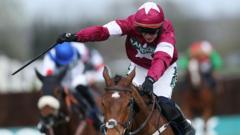
The cheers at Aintree hadn’t even faded before the mood turned. Gold Dancer just won. He crossed the line first in the Alder Hey Handicap Hurdle, securing a hard-fought victory for trainer Willie Mullins and jockey Danny Mullins. It should’ve been a moment of pure celebration for the five-year-old grey. Instead, it became another statistic in the ongoing debate about safety in jump racing.
Gold Dancer was put down shortly after the race.
He didn't fall at a fence. He didn't stumble in a high-speed collision with another horse. He pulled up shortly after the finish line with a significant injury to his off-hind leg. Despite the immediate attention from on-site vets at the Grand National Festival, the damage was too severe. The decision was made to euthanize him on the track. It’s a gut-wrenching irony that a horse’s greatest career achievement happened seconds before his life ended.
Why this tragedy feels different
Most people expect injuries during the heat of the jump. We watch the fences with bated breath, waiting to see if every horse clears the timber. But Gold Dancer finished the job. He jumped every flight. He sprinted home. The fact that he broke down after the physical "danger" was over highlights a terrifying reality of thoroughbred anatomy. These animals are essentially 1,000 pounds of muscle balanced on ankles the size of a human’s.
When a horse wins like that, their adrenaline is through the roof. They often mask pain until the momentum stops. By the time the jockey felt something was wrong and pulled him up, the structural integrity of the limb was gone.
I’ve seen this happen before, and it never gets easier to watch. You have the owner’s joy turning to ash in minutes. You have a trainer like Willie Mullins, who dominates the sport, forced to explain how a winner isn't coming back to the stable. It’s a PR nightmare for the industry, sure, but for the people who spend every morning at 5:00 AM with these animals, it’s a personal blow that stays with them.
The safety measures that didn't save Gold Dancer
Aintree has been under the microscope for years. Following the 2023 protests and several high-profile fatalities, the Jockey Club introduced sweeping changes for the 2024 and 2025 seasons. They moved the start times. They reduced the field size for the Grand National. They softened the fences and added more foam padding to the landing areas.
All of those changes are good. They make sense. But they didn't matter for Gold Dancer.
The injury wasn't about the height of a hurdle or the "burn" of the ground. It was about the sheer physical stress of elite-level racing. We have to be honest about the fact that jump racing carries an inherent risk that no amount of foam padding can fully erase. When you ask a horse to gallop at 30 miles per hour over obstacles, the margin for error is non-existent.
British Horseracing Authority (BHA) data shows that the fatality rate has dropped significantly over the last twenty years. It’s now around 0.2% of all runners. That’s a tiny number until the horse is a winner at a major festival. When it's Gold Dancer, that 0.2% feels like 100%.
What happens in those final moments on the track
There’s a lot of mystery about what happens when the green screens go up. People assume the worst, and they’re right to be upset, but the process is clinical and focused on the horse’s welfare.
As soon as Danny Mullins pulled Gold Dancer up, the "vets on the ground" protocol kicked in. Aintree has a team of expert equine surgeons and vets stationed every few hundred yards. They don't wait for a call; they move as soon as they see a horse favoring a limb.
- Immediate Assessment: The vet checks if the injury is a fracture, a tendon rupture, or a joint luxation.
- Pain Management: High-dose painkillers and sedatives are administered instantly.
- The Decision: If the bone has "shattered" or the blood supply is compromised, a horse cannot be saved. They can't lie in a bed for six months to heal. They have to be able to stand on all four legs to survive.
- Euthanasia: It’s done via a lethal injection or a captive bolt. It’s instantaneous.
Gold Dancer’s injury was a "life-ending" fracture. There was no surgery that could have fixed it. There was no "retirement to a paddock" option. It’s a brutal end, but in the eyes of the veterinary team, it’s the only way to prevent prolonged suffering.
The uncomfortable conversation about jump racing's future
We can’t talk about Gold Dancer without acknowledging the elephant in the room. Every time a horse dies at Aintree, the calls to ban the sport get louder. Organizations like Animal Aid and World Horse Welfare use these moments to point out that "entertainment" shouldn't cost a life.
I think we need to stop pretending the risk isn't there. Fans of the sport often get defensive and talk about how much these horses are loved. They are loved. They live better lives than 99% of the animals on this planet. But that love doesn't change the outcome of a snapped bone.
The industry is leaning heavily into data-driven safety. They're using sensors to track horse gait and identify "pre-fracture" changes before they become catastrophic. They’re analyzing soil moisture levels to ensure the "going" isn't too firm. This is the only way forward. If the sport wants to survive another fifty years, it has to prove that it is doing everything humanly and technologically possible to prevent the Gold Dancer scenario.
What owners and trainers are actually saying
Willie Mullins is a man of few words when things go wrong, but the loss of a horse like Gold Dancer hits the yard's morale. This was a horse with a massive future. He was only five. In the world of jump racing, he was just hitting his prime.
The owners, Red Bloodstock, invested in this horse because they believed in his potential. Seeing him win a Grade 3 race at a major festival confirmed their belief, only to have it snatched away in the cooling-down period. It’s a reminder that in this game, you’re never truly "safe" until the horse is back in the box and the rug is on.
Moving forward from Aintree
If you're a fan of racing, don't just look the other way. Acknowledge the loss. The sport is incredible, but it’s also demanding. The best thing we can do is support the push for even more rigorous pre-race veterinary screenings.
If you want to stay informed on how the BHA is responding to these incidents, keep an eye on their "HorsePWR" initiative. It’s their attempt to be transparent about the data, the deaths, and the welfare standards. It’s not a perfect solution, but it’s better than the silence we used to get.
Don't let the tragedy overshadow the fact that Gold Dancer was a phenomenal athlete. He did his job perfectly. He gave everything to that race. The tragedy isn't that he raced; the tragedy is that his body couldn't keep up with his heart.
Stay updated on the official BHA injury reports for the rest of the festival. Look at the data yourself. Demand better for the horses that give us so much.