Power has a weight to it. It is measured not merely in tons of steel or rows of figures inked onto defense ledgers, but in the quiet, suffocating stillness of a room where two people hold the levers of the world.
Imagine sitting at a long mahogany table in Beijing or Mar-a-Lago. Outside, ordinary people are buying groceries, arguing about traffic, worrying about rent. Inside, a sentence is uttered that has the potential to alter the architecture of global security.
Decades of foreign policy have rested on a rigid, carefully maintained scaffolding. Certain lines are never crossed. Certain arms are never offered to certain rivals. Yet history is rarely a straight line; it is a series of sudden, jagged fractures. When rumors surface—or statements are made—about the possibility of the United States offering advanced military hardware to a nation that has long stood across the strategic divide as the primary economic and geopolitical challenger, the scaffolding shudders.
To understand why this matters, step away from the abstract jargon of international relations. Think about a neighborhood dispute. Imagine lending your sharpest tools to the person who has spent years eyeing your property line. It sounds counterintuitive. It sounds reckless. Why would a superpower entertain the notion of transferring the instruments of war to a competitor?
Diplomacy is rarely about simple affection. It is leverage. It is a high-stakes poker game played across centuries.
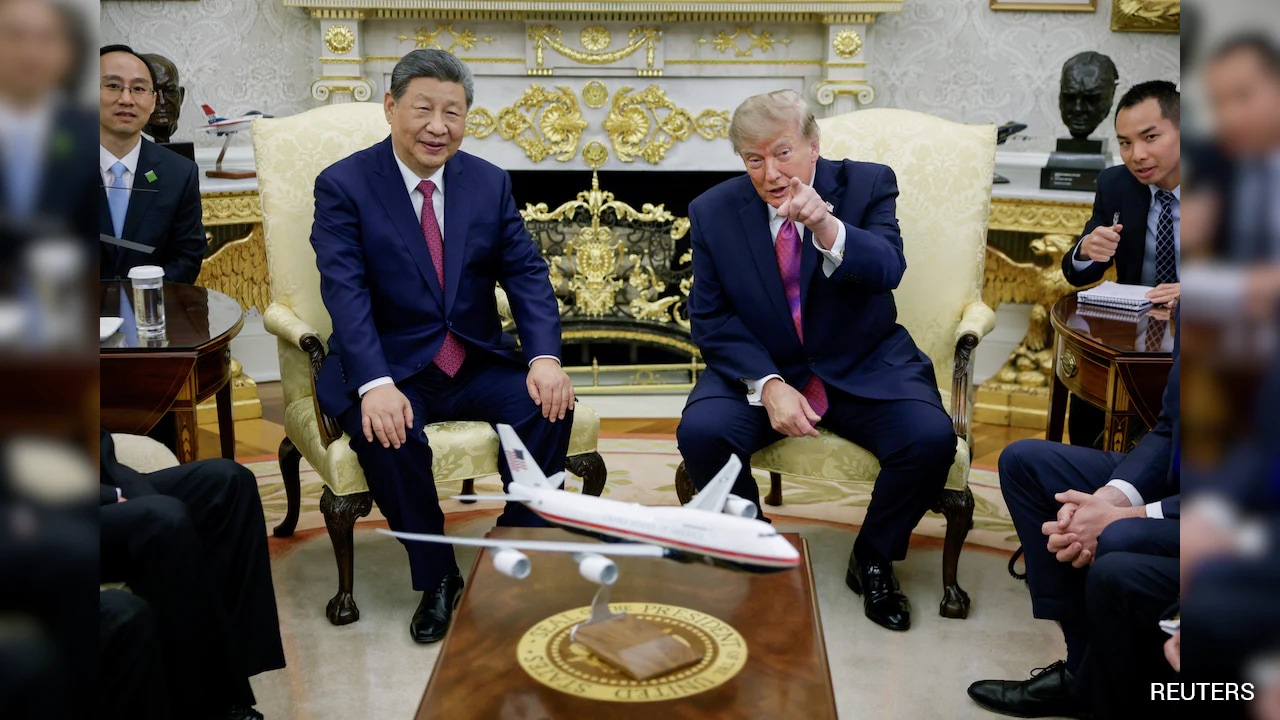
When former President Donald Trump reportedly floated the idea during negotiations with President Xi Jinping—suggesting a shift in how weapons, technology, or strategic alignment might be handled—observers gasped. The immediate instinct of the foreign policy establishment was panic. How could anyone contemplate such a move? Doesn't history teach us to keep our adversaries at arm's length, or better yet, behind a heavily fortified wall?
Yet, statecraft often operates in contradictions.
Consider the perspective of a seasoned negotiator who views alliances not as permanent clubs of friends, but as fluid arrangements of convenience and containment. From this viewpoint, everything is negotiable. If you can bind a rival closer through trade, through shared dependencies, or through shocking concessions that rewrite their strategic calculations, do you take the risk?
Or consider the alternative: the risk of stagnation. When two superpowers stare at each other across an ever-widening technological and military gulf, the tension builds. Without dialogue, without bold, disruptive—and sometimes alarming—proposals, the trajectory leads inevitably to friction. Friction leads to miscalculation. Miscalculation leads to catastrophe.
Critics argue that offering advanced weaponry or defense cooperation is not bold; it is naive. They point to the Taiwan Strait. They point to the South China Sea. They point to cyber espionage and intellectual property theft. To hand over or even discuss the sale of military capabilities to Beijing, they argue, is to hand the keys of the armory to the burglar.
Proponents, on the other hand, might look at the same chessboard and see a different pattern. They see a leader attempting to short-circuit a traditional bureaucratic machine that produces endless stalemates. They see an unorthodox approach designed to force a breakthrough, or at least to test the absolute boundaries of what is possible at the negotiating table.
Was it a serious policy proposal? Or was it a rhetorical grenade tossed into the room to see who would flinch?
In the corridors of power, intentions are obscured by layers of denial and spin. Ambassadors scramble to clarify. Spokespeople issue carefully worded statements designed to calm jittery allies in Tokyo, Seoul, and London. The machinery of government works overtime to patch the holes left by an unpredictable chief executive who prefers disruption over protocol.
And yet, the words remain hanging in the air.
The conversation about weapons sales and strategic trade is never just about iron and explosives. It is about trust. Or, more accurately, the profound lack of it. When two nations possess the capacity to unmake the global economy—or worse—every diplomatic gesture is parsed for hidden daggers.
We live in an era where the old rules are fraying at the edges. Globalization has bound us together in a web of supply chains and financial markets, even as political nationalism pulls us apart. This tension creates bizarre paradoxes. We buy each other's goods while preparing for each other's missiles. We negotiate trade deficits while quietly war-gaming regional conflicts.
When a leader hints at breaking the ultimate taboo—selling the means of defense to the primary adversary—it forces us to look past the talking points and confront the raw, messy reality of how the world actually works. It is transactional. It is unpredictable. And it relies entirely on the fragile psychology of men sitting in high-backed chairs, weighing the pride of nations against the survival of generations.
The headlines fade. The news cycle churns forward to the next scandal, the next summit, the next economic report. But the undercurrents remain. The map of the world is not carved in stone. It is drawn in pencil, easily smeared by a single, unexpected stroke of a pen.
Next time you look at a globe, tracing the vast expanses of oceans and continents, remember the invisible threads connecting them. Remember that peace is often maintained by a delicate, terrifying balance of threats and promises. And remember that the distance between enmity and alliance can sometimes be bridged by a single conversation, whispered behind closed doors, while the rest of the world sleeps.