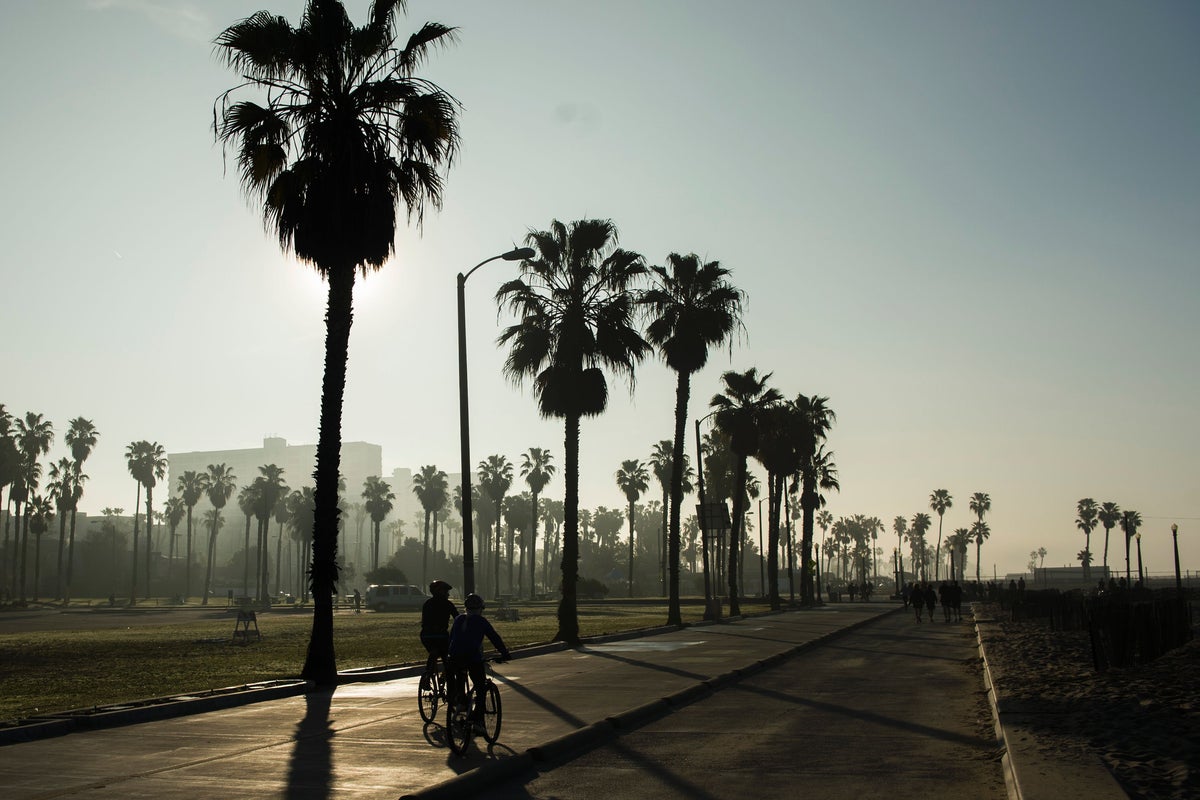
The air along Ocean Avenue smells of salt, roasted coffee, and hot asphalt. On a Tuesday afternoon, as the sun dips low enough to turn the Pacific into a blinding sheet of foil, cycling down this stretch of Santa Monica feels like a cheat code for living. Your legs move in steady rhythms. The ocean breeze cuts through the afternoon heat. Beneath your tires sits a brightly painted green lane—a thin strip of political promises telling you that you belong here, that you are safe.
Then comes the bread truck.
It is parked dead in the center of the green paint, hazard lights blinking with an idle, rhythmic arrogance.
To a driver sitting in air-conditioned glass, a delivery truck in a bike lane is a minor nuisance, an eye-roll, a two-minute delay for someone else. To a cyclist, it is an obstacle course with existential stakes. You check your left mirror. A SUV is roaring up behind you at thirty-five miles per hour. You have roughly two seconds to make a choice: slam on your brakes and hope the driver behind you is paying attention, or swerve left into live traffic and trust that a stranger won't crush your ribs.
Panic is quick. It tastes like copper.
For decades, cities built bike lanes and promptly abandoned them to the whims of double-parked rideshares, oblivious food delivery drivers, and freight trucks operating on brutal corporate deadlines. The painted lines were a illusion of safety. But right now, along the coastal corridors of Santa Monica, a quiet shift is taking place. The city is fighting back, not with more traffic cops or passive rubber bollards, but with cold, unblinking machine vision mounted to the front of public buses.
The Invisible Barricade
Consider a hypothetical commuter named David. David is not a radical transit activist. He is a forty-two-year-old accountant who bought an e-bike to lower his blood pressure and avoid paying six dollars a gallon for gas. Every morning, he rides three miles from his apartment to his office near the pier.
David’s biggest threat isn’t bad weather or steep hills. It’s the sheer density of human impatience.
When a driver pulls into a bike lane "just for a second" to pick up an iced latte or drop off a package, they create what traffic safety engineers call a conflict point. The cyclist is forced out of their protected corridor into the mixing zone of motor traffic. According to national highway safety statistics, a vast percentage of urban bicycle crashes occur not because a driver hit a cyclist from behind in open road, but because the cyclist was forced to make sudden, reactive maneuvers around stationary hazards.
The traditional response to this crisis has been human enforcement. A police officer or parking enforcement officer happens to drive by, notices the violation, pulls over, and writes a paper ticket.
It almost never happens.
Cities simply do not have the manpower to station officers on every block. Worse, human enforcement is inherently inefficient and occasionally fraught with personal confrontation. Drivers watch for parking enforcement vehicles, move their cars for thirty seconds, and slide right back into the green paint the moment the meter maid turns the corner. The cycle repeats. The hazard remains constant.
Santa Monica decided to stop playing hide-and-seek.
Cameras That Never Blink
The solution isn't flashy, nor does it look like something out of a science fiction film. It looks like a small, ruggedized plastic box mounted near the windshield of a Big Blue Bus—the iconic municipal transit fleet that weaves through every artery of the city.
As these buses trundle down Wilshire Boulevard or Santa Monica Boulevard, the mounted cameras scan the street ahead. They aren't recording your face, and they aren't monitoring pedestrian crowds. They are looking at the road geometry.
Here is how the machinery processes the world:
- Spatial Perception: Dual optical sensors measure the exact distance between the bus, the curb, and the vehicle ahead, mapping the street in real-time three-dimensional coordinates.
- Contextual Intelligence: Computer vision models, trained on millions of street images, instantly distinguish between a car stopped at a red light, a vehicle waiting to turn, and a truck parked illegally inside a designated bike lane.
- Evidence Collection: The moment a violation is detected, the system captures a brief video clip along with high-resolution photos of the vehicle's license plate, timestamp, and precise GPS coordinates.
Nothing happens on the spot. No sirens blare. No officer steps out to argue on the curb.
The collected data moves through an encrypted network directly to the city’s parking enforcement department. A human official reviews the video clip to confirm the violation—ensuring that a driver who was briefly stopped to avoid an emergency isn't mistakenly penalized. Once verified, a citation is generated and mailed directly to the registered owner of the vehicle.
It is quiet. It is systematic. It removes the drama from law enforcement entirely.
The Driver on the Other Side
To understand why this technology matters, you have to look past the handlebars and look through the windshield of the delivery van.
Meet another hypothetical actor in this daily drama: Carlos. Carlos drives a commercial freight van fourteen hours a day. He doesn't block bike lanes because he hates cyclists. He blocks bike lanes because his dispatch algorithm tracks his stops down to the second. If he spends fifteen minutes circling the block to find a legal commercial loading zone three streets away, his pay gets docked, or his contract gets terminated.
For drivers like Carlos, parking in the bike lane was a rational economic choice. The risk of getting a ticket from a physical parking officer was roughly one in a thousand. The risk of getting penalized by his employer for being late was one hundred percent.
Automated enforcement flips that math on its head.
When every public transit bus passing by every ten minutes acts as a mobile enforcement camera, the probability of getting caught shifts from a remote lottery to an absolute certainty. A twenty-dollar delivery fee suddenly comes with a hundred-dollar ticket attached.
When the financial equation changes, behavior changes with it. Logistics companies are suddenly forced to re-evaluate their delivery protocols. They begin lobbying cities for more designated loading zones rather than instructing their drivers to double-park illegally. The burden shifts from the vulnerable human on the bicycle back to the systems that created the clutter in the first place.
The Myth of the Surveillance Nightmare
Whenever a city introduces automated cameras, a predictable wave of anxiety follows. People worry about privacy, tracking, and the slow creep of automated state oversight.
These fears are understandable. Nobody wants a city that records their every footstep.
Yet the distinction here lies in purpose and scope. The systems deployed on Santa Monica's transit fleet are engineered with strict boundaries. They operate on a closed loop. The cameras do not use facial recognition software. They do not store data of law-abiding drivers. If a car is parked legally, the footage recorded by the bus as it passes is overwritten automatically within hours.
The software doesn't care who you are, where you are going, or what political sign is stuck to your bumper. It cares only about a single, cold geometric truth: Is a two-ton metal box sitting where a human being on two wheels is supposed to be safe?
By automating this specific task, the city actually reduces awkward, high-friction interactions between armed law enforcement and citizens over minor traffic infractions. The process becomes as impersonal and predictable as a toll booth.
What a City Owes Its People
A city street is not just dirt and concrete. It is an expression of municipal priorities.
When a municipality paints a bike lane on the ground, it is making a moral contract with its citizens. It is telling families, commuters, and kids that they can navigate their neighborhood without risking their lives against multi-ton vehicles. But a painted line without enforcement isn't protection; it is negligence wrapped in good intentions.
Riding a bike through a dense urban grid shouldn't require bravery. It shouldn't require an adrenaline spike every time a delivery driver wants to drop off a package.
As the sun sets over Santa Monica, the Big Blue Buses continue their steady loops, their small glass eyes silently mapping the curbs. The green paint on the street stays clear. A commuter pedals past a delivery van—this time safely pulled into a designated loading bay down the block—and keeps moving toward home, uninterrupted, unharmed, and completely oblivious to the silent algorithm that kept the path open.