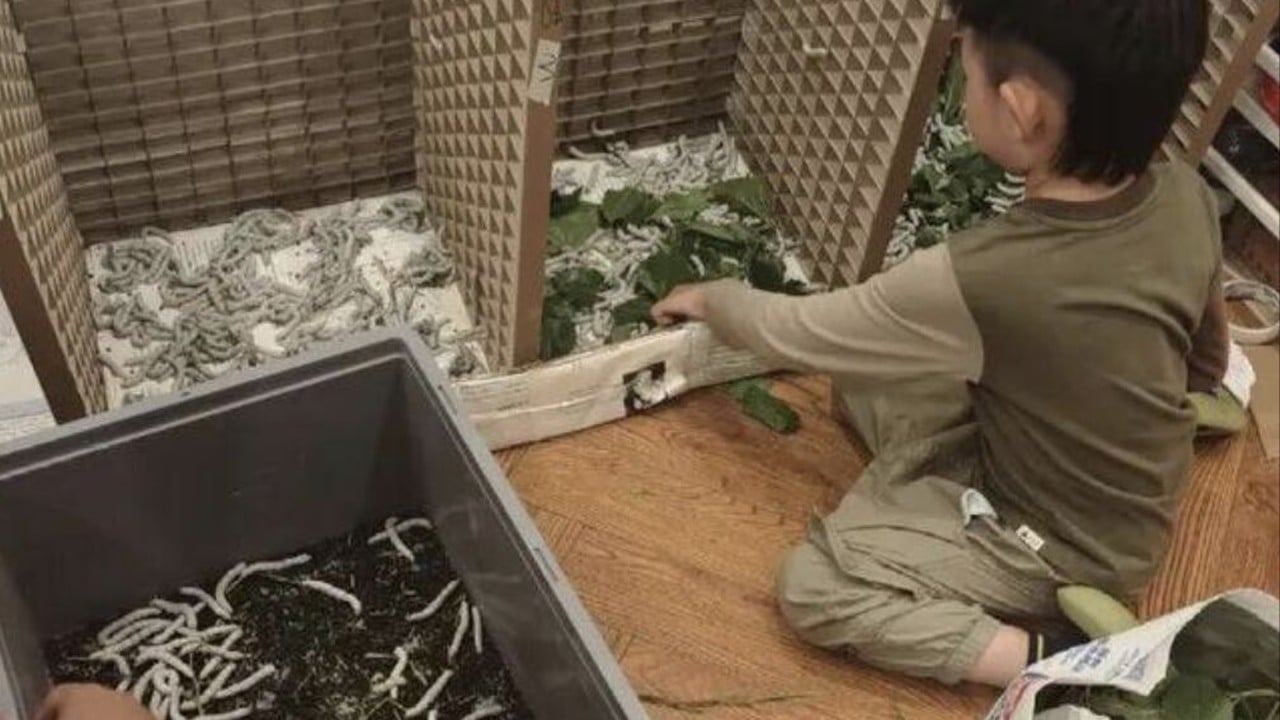
The feel-good media engine loves a viral story about a precocious child and a mountain of parental enabling. A young boy in China decides he wants to make a genuine silk quilt from scratch. His doting parents, instead of buying a standardized bedding set or explaining the brutal realities of textile manufacturing, order 10,000 silkworm eggs. The internet swoons. Commendations pour in for "fostering curiosity" and supporting hands-on education.
It is a heartwarming narrative. It is also a logistical nightmare, an ecological hazard, and a masterclass in the profound ignorance of modern consumer culture regarding how things are actually made.
Mainstream commentary treats this as a triumph of experiential learning. They miss the point entirely. Rearing 10,000 Bombyx mori larvae in a residential apartment is not a cute weekend science project. It is an unmitigated disaster in agricultural scaling. It exposes a deep-seated delusion: the idea that romanticizing pre-industrial labor somehow teaches children the value of production.
Let us dismantle the cozy myth of the backyard silk micro-factory.
The Mathematical Impossibility of the Apartment Silk Farm
Most people have never seen a silkworm, let alone managed an industrial colony. They see a tiny black speck on a leaf and think, "How hard can it be?"
Let us look at the raw biology.
A single silkworm egg hatches into a larva that will increase its body weight by roughly 10,000 times in less than a month. To sustain this exponential growth, 10,000 silkworms require a staggering amount of food. Specifically, they will consume roughly 200 to 250 kilograms of fresh, pesticide-free mulberry leaves during their brief life cycle.
Unless these parents own a commercial orchard, foraging for 500 pounds of pristine mulberry leaves in an urban or suburban environment is a full-time job. Leaves cannot be dry, withered, or contaminated by city pollution. If a single batch of leaves carries trace agricultural runoff, the entire colony dies within hours.
The Spatial Explosion
Then there is the issue of physical space.
- Hatching Phase: 10,000 eggs fit on a small paper tray.
- Third Instar: The larvae grow rapidly, requiring multiple flat trays to prevent overcrowding and suffocation.
- Fifth Instar (Final Week): The worms reach the size of an adult finger. They require roughly 20 to 30 square meters of flat, ventilated surface area.
Unless this family dedicated their entire living room to open-air trays of writhing, defecating larvae, the project was doomed before the first egg cracked. The sheer volume of frass (silkworm droppings) generated by 10,000 mature larvae equals several kilograms a day. The humidity generated by their respiration creates a perfect breeding ground for lethal fungal infections like muscardine or flacherie.
The media celebrates the purchase. They conveniently forget to film the part where the family realizes they live inside a literal, smelling insect factory.
The Myth of the Homemade Quilt
Assume the family beats the biological odds. Assume they forage hundreds of pounds of leaves, keep the temperature strictly between 23°C and 28°C, and successfully bring all 10,000 worms to the pupation stage.
Now they encounter the textile barrier.
A standard double-sized silk quilt requires approximately 1.5 to 2 kilograms of pure silk floss. A single healthy cocoon yields roughly 0.2 to 0.5 grams of usable silk filament after processing. Mathematically, 10,000 cocoons should yield between 2 and 5 kilograms of silk. On paper, the math works.
In reality, amateur processing destroys the yield.
To extract silk, the pupae must be stifled (usually via heat) before they emerge as moths and chew through the continuous filament. Next comes the boiling and degumming process to remove sericin, the natural protein binding the fibers.
Industrial facilities use precise chemical balances and automated reeling machines to draw out the single, unbroken thread—often up to a kilometer long per cocoon.
An amateur doing this at home faces two choices:
- Reeling: Trying to find the microscopic end of a filament in a pot of boiling water 10,000 times over. It is an exercise in pure madness that takes months of manual labor.
- Hand-stretching (Floss Method): Cutting the cocoons open, removing the dead pupae, stretching the wet silk over a U-shaped frame, and layering them.
The hand-stretching method is brutally difficult. Without industrial washing and carding, the resulting silk is lumpy, uneven, and retains a distinct, pungent odor of boiled insects. The child does not end up with a luxury heirloom. They end up with a heavy, smelly, unhygienic mat of matted fibers that shifts and clumps inside its cover.
Micro-Farming is Not Education; It is Performance Art
Why do parents engage in this kind of extreme enabling?
It stems from a modern anxiety about the digital world. Parents worry their children are too disconnected from nature, so they overcompensate by swinging wildly into absurd DIY agricultural projects.
But buying 10,000 living organisms on an e-commerce platform with the click of a button is not a connection to nature. It is the ultimate expression of consumer entitlement. It treats living creatures as disposable educational props.
True respect for craft and agriculture means understanding why specialization exists. Silk production became an industry because doing it manually at a small scale is a miserable, inefficient grind that yields an inferior product.
If you want a child to appreciate a silk quilt, do not force them to manage a biological sweatshop in their bedroom. Take them to a textile museum. Show them the history of the Silk Road. Explain the engineering behind industrial looms. Teach them the economics of supply chains.
Buying 10,000 silkworm seeds is not teaching a child how a quilt is made. It is teaching them that their whims can command an entire ecosystem to appear at their doorstep, regardless of the ecological or practical cost. It is an exercise in vanity, designed for social media sharing rather than genuine intellectual development.
Stop romanticizing the primitive. The modern textile industry is a marvel of human ingenuity. Turning your home into a biohazard zone does not make you a better parent; it just means you do not know how to say no to your kid.