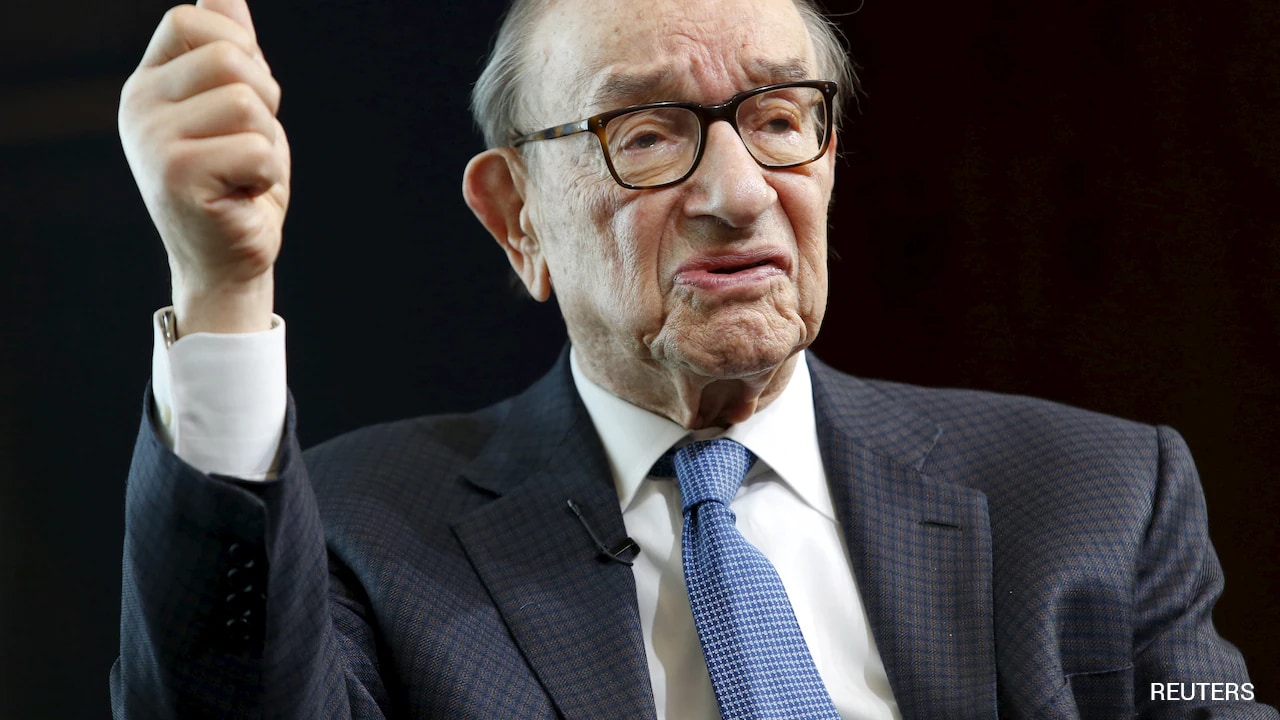
The financial press is doing what it always does when a central banking titan passes away: polishing a legacy built on sand.
With the passing of former Federal Reserve Chair Alan Greenspan, the obituaries are already rolling off the assembly line. They call him the "Maestro." They credit him with steering the American economy through the 1987 crash, the dot-com bubble, and a historic decade of uninterrupted growth. They paint a picture of a wizard who stared into the data soup, tweaked interest rates by 25 basis points, and magically stabilized the globe.
It is a comforting narrative. It is also completely wrong.
The lazy consensus among economic journalists is that Greenspan was a stabilizing force. In reality, he was the architect of the ultimate moral hazard. By treating the central bank as an emergency backstop for reckless financial speculation, he didn't save the system—he broke its internal compass. The structural vulnerabilities we face today are the direct inheritance of the Greenspan Put.
To understand why the financial system remains perpetually fragile, we have to dismantle the myth of the monetary savior.
The Birth of the Bailout Culture
Let’s look at the data standard history ignores. On October 19, 1987—Black Monday—the Dow Jones Industrial Average dropped 22.6% in a single day. The newly appointed Greenspan reacted by flooding the banking system with liquidity, declaring the Fed’s "readiness to serve as a source of liquidity to support the economic and financial system."
Wall Street learned a dangerous lesson that morning. If you take massive risks and win, you pocket the upside. If you take massive risks and the market implodes, the Fed will slash rates and print a floor underneath your asset values.
This policy distortion became known as the Greenspan Put. In options trading, a put option grants the right to sell an asset at a predetermined price, capping losses. By consistently lowering the federal funds rate whenever markets threw a tantrum—as he did during the 1997 Asian financial crisis, the 1998 Long-Term Capital Management collapse, and the 2000 tech bust—Greenspan effectively granted a free insurance policy to investment banks.
Imagine an insurance company that charges zero premiums and covers 100% of the damages when you drag-race your car. You wouldn't drive safer. You would drive faster, take sharper corners, and eventually cause a multi-car pileup. That is precisely what happened to the credit markets.
Dismantling the Premium Questions
Whenever you criticize central banking orthodoxy, defenders of the establishment run to the same list of defensive, flawed questions. Let’s answer them directly.
Didn't Greenspan's low interest rates create the great wealth boom of the 1990s?
No. The economic expansion of the 1990s was driven by structural forces that monetary policy had nothing to do with: the commercialization of the internet, the entry of hundreds of millions of workers into the global supply chain following the collapse of the Soviet bloc, and massive corporate efficiency gains.
Greenspan merely sat on top of a secular wave of disinflation and claimed credit for the weather. By keeping interest rates artificially lower than the natural rate of interest—the rate where savings and investment find equilibrium without causing inflation—he fueled a massive misallocation of capital into speculative dot-com entities that possessed zero revenue.
How can you blame Greenspan for the 2008 Financial Crisis when he left office in 2006?
This is the most common timeline defense, and it betrays a deep ignorance of how monetary policy lags operate. Changes in interest rates take 12 to 18 months to filter into the real economy, but structural shifts in credit underwriting take years to mature and rot.
Following the 2001 recession, Greenspan slashed the federal funds rate from 6.5% down to an unprecedented 1.0%, holding it there for a year. This didn't just stimulate the economy; it starved income investors, savers, and pension funds of yield.
When safe government bonds pay 1%, capital is forced to migrate down the credit quality spectrum to survive. Wall Street accommodated this desperate hunt for yield by engineering structured credit products: mortgage-backed securities, collateralized debt obligations (CDOs), and synthetic credit default swaps.
Greenspan ignored explicit warnings about these derivatives. In 1998, Brooksley Born, head of the Commodity Futures Trading Commission, pushed to regulate the over-the-counter derivatives market. Greenspan, alongside Treasury Secretaries Robert Rubin and Larry Summers, aggressively blocked her. He argued that Wall Street institutions were self-regulating entities that would never destroy their own balance sheets. That ideological blindness directly set the stage for Lehman Brothers.
The Flaw in the Inflation Metrics
The core mistake of the Greenspan era—and the one that central banks are still repeating—is the mismeasurement of inflation.
For decades, the Federal Reserve has obsessed over consumer price inflation (CPI) and core personal consumption expenditures (PCE). Because cheap manufactured goods from China kept consumer electronics and clothing inexpensive, Greenspan assumed that his loose monetary policy wasn't causing harm.
But money printing doesn't distribute itself evenly. If the newly created credit goes into the banking sector rather than the supermarket, you don't get inflation in the price of milk; you get inflation in the price of homes, commercial real estate, and equities.
By ignoring asset price inflation, Greenspan allowed massive valuation bubbles to form while declaring victory over consumer price volatility. He famously used the phrase "irrational exuberance" in a 1996 speech to describe the stock market, yet he lacked the institutional courage to raise rates to pop the bubble. Instead, he waited for it to burst on its own, then flooded the zone with liquidity again, blowing an even bigger bubble in subprime housing to paper over the damage.
The View from the Trading Desk
I have spent decades watching how institutional desks react to central bank announcements. The reality on the ground is completely detached from the academic models taught at universities. Traders do not look at Federal Reserve chairs as economic scientists; they look at them as liquidity providers who can be bullied into action.
When Greenspan adjusted rates based on market volatility, he destroyed price discovery. Price discovery is the vital mechanism by which a market determines the true value of an asset based on supply, demand, and risk. When you distort the cost of capital—the baseline price of money from which all other assets are priced—you make accurate risk calculation impossible.
The cost of this approach is borne entirely by ordinary citizens.
- Savers are penalized for fiscal prudence because their bank deposits earn less than the rate of inflation.
- Working-class families are priced out of homeownership because cheap debt drives housing valuations into the stratosphere.
- Corporations use ultra-cheap credit to execute stock buybacks to pump executive compensation rather than investing in research, development, or employee wages.
The alternative approach—allowing mismanaged firms to fail, allowing asset bubbles to correct, and keeping interest rates aligned with real savings—carries short-term pain. But it prevents the systemic rot that occurs when you permanently immunize the financial sector from its own mistakes.
The Unconventional Directive
If you want to protect your capital from the compounding effects of this multi-decade monetary experiment, you must stop operating under the assumption that the financial system is stable or that the authorities have a coherent plan. They are using the same playbook Greenspan wrote forty years ago: patch every liquidity crack with more printed money.
First, stop benchmarking your long-term wealth solely to fiat-denominated assets. When central banks act as lenders of last resort to the entire financial system, the purchasing power of the currency is the ultimate release valve. Diversify out of the paper ecosystem into hard, scarce assets that cannot be devalued by a committee meeting in Washington.
Second, avoid long-term fixed-income products. Buying long-dated bonds in an environment where central banks must structurally maintain low real interest rates to service massive mountains of sovereign debt is a guaranteed way to lose purchasing power over time.
Alan Greenspan was not an economic oracle. He was an incredibly adept political actor who managed to exit the stage right before the theater caught fire from the faulty wiring he installed. Stop worshiping the magicians who break the machine. Start building financial strategies that assume the machine is designed to fail.