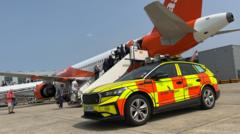
The tarmac at midnight looks like a circuit board glowing in the rain. From the departure lounge window, you can see a Boeing 787 drinking thousands of gallons of kerosene through a thick black hose. It is a scene repeated thousands of times a day all over the planet. We want to fly. We want to see our families, seal the business deals, and lie on beaches three thousand miles away.
But there is a quiet panic humming beneath the concrete.
Airports around the globe are making a grand promise. They are pinning "Net Zero" badges to their marketing materials and plastering terminal walls with images of wind turbines and lush green forests. They claim that your journey can become completely carbon neutral.
It sounds comforting. It feels like a free pass.
Then you look out the window again and see the bulldozers breaking ground on a new runway extension.
This is the central contradiction of modern aviation. Can an industry truly erase its carbon footprint while actively inviting millions of more passengers to take to the skies? To understand the sheer scale of this illusion, we have to look past the corporate press releases and stand on the tarmac itself.
The Illusion of the Green Terminal
Let us construct a hypothetical, yet highly accurate, composite airport to understand how the math works. We will call it Meridian International.
Meridian has just announced that its operations are officially carbon neutral. The CEO cuts a ribbon in front of a new solar array sprawling next to the cargo bays. The terminal buildings use smart LED lighting. The shuttle buses running between the long-stay parking lots and the departures hall are entirely electric.
These are genuine improvements. They represent real engineering effort and significant financial investment.
They also account for less than five percent of the airport’s total environmental footprint.
In the language of carbon accounting, these belong to Scope 1 and Scope 2 emissions. They are the gases emitted directly by the buildings, the ground vehicles, and the electricity purchased to keep the air conditioning humming. If an airport switches its energy provider to a hydro-electric plant and replaces its baggage tractors with electric models, it can legitimately claim to have neutralized its own footprint.
But everyone in the room is ignoring the elephant roaring at ten thousand feet.
The moment that Boeing 787 spools up its engines, releases its brakes, and climbs into the clouds, it enters the territory of Scope 3 emissions. These are the indirect consequences of the airport's existence. The fuel burned by the aircraft. The emissions from the thousands of cars idling in the drop-off lanes. The supply chains delivering plastic cups and pre-packaged sandwiches.
By focusing entirely on the terminal buildings, aviation hubs are essentially claiming a house is sustainable because the doorbell runs on solar power, even while the furnace in the basement burns coal twenty-four hours a day.
The Math That Does Not Add Up
Let us look at the cold numbers that drive this expansion. Aviation currently contributes roughly 2.5 percent of global carbon dioxide emissions. That sounds manageable until you factor in the high-altitude effects. When planes emit nitrogen oxides, water vapor, and soot into the thin air of the upper atmosphere, they create contrails that trap heat. The true warming impact is closer to double that percentage.
Now, overlay the expansion plans.
Major transit hubs from London to New York, and across rapidly developing networks in Asia, are locked in a race to build. They are adding third runways, doubling terminal sizes, and upgrading logistics to handle a projected doubling of global air passengers over the next two decades.
To bridge the gap between expansion and environmental pledges, the industry relies heavily on carbon offsets.
Offsets are the ultimate financial magic trick. The logic is simple: an airport pays a broker to plant trees in a distant continent or fund a wind farm in a developing nation. The carbon absorbed or prevented by that project is subtracted from the airport’s ledger.
On paper, the balance hits zero. In reality, the atmosphere does not care about ledgers.
Planting a sapling today does not instantly cancel out the five tons of carbon pumped into the stratosphere during a transatlantic flight. That sapling takes decades to grow, assuming it survives droughts, wildfires, and illegal logging. More profoundly, offsetting creates a dangerous psychological buffer. It convinces us that our habits do not need to change, so long as we can pay a small premium at the checkout counter to buy peace of mind.
The Liquid Hope of Tomorrow
Talk to any aerospace engineer, and they will point toward Sustainable Aviation Fuel, commonly known as SAF.
SAF is the industry’s holy grail. It is produced from waste oils, agricultural residues, or synthetic carbon captured directly from the air. Because it is chemically identical to conventional jet fuel, it can be dropped straight into existing aircraft engines without modifying the planes or the airport refueling infrastructure. When burned, it releases carbon that was already present in the biosphere, rather than digging up ancient carbon from fossil reserves.
It represents a brilliant technological achievement.
But walk into the refinery warehouses, and the scale of the challenge becomes stark. Today, SAF accounts for less than one percent of the total jet fuel consumed globally. The facilities required to produce it at scale do not exist yet.
To replace even half of the world’s conventional jet fuel with SAF would require an astronomical amount of agricultural land or an unprecedented quantity of clean renewable electricity to create synthetic options. If we use crops to feed planes, we risk driving up food prices and clearing forests for agriculture, creating a whole new ecological crisis.
We are trying to build a bridge across a chasm while already walking mid-air, hoping the planks materialize beneath our feet before we fall.
The Human Weight of the Horizon
This is not a dry debate about chemistry and economics. It is a deeply human dilemma.
Consider a traveler named Sarah. She lives thousands of miles away from her aging parents. Flying is not a luxury for her; it is the physical thread that holds her family together. When she steps onto a flight, she feels the nagging guilt that many of us carry. She chooses the "offset your flight" option at checkout, hoping it means something.
On the other side of the equation is Marcus, who lives in a neighborhood just two miles from a major metropolitan runway expansion project. For him, the growth of the airport means more than abstract global warming statistics. It means the low-frequency rattle of his windows at dawn. It means particulate matter settling on the playground down the street.
We cannot simply tell Sarah she can never see her family again. We cannot tell Marcus his peace of mind is the necessary price of global commerce.
Airports are trapped in this exact friction point. They are businesses designed to grow, operating within a global economic system that demands constant expansion. Yet they are trying to function on a planet with absolute physical limits.
The Uncomfortable Path Forward
True neutrality requires a level of honesty that corporate marketing departments are rarely equipped to deliver.
It means admitting that technological fixes are decades away from matching the sheer volume of our desire to fly. It means acknowledging that if we expand the number of flights, we are increasing the total amount of warming, no matter how clean the terminal floor is swept.
Some regional governments are beginning to face this reality by banning short-haul domestic flights where high-speed rail alternatives exist. Engineers are experimenting with hydrogen-powered regional planes and battery-electric commuters for short hops. These are promising avenues, but they do not solve the massive, long-haul journeys that generate the bulk of aviation's emissions.
Until those breakthrough technologies arrive at scale, the only reliable way to emit less carbon from aviation is to fly less.
That is the one sentence no airport executive wants to speak aloud. It challenges the fundamental assumption that progress must always mean more, bigger, and faster.
The rain continues to fall on the tarmac at Meridian International. The ground crew disconnects the fuel hose from the belly of the Boeing 787. The engines whine to life, a low, powerful roar that vibrates through the glass of the terminal. The passengers line up at the gate, passports in hand, looking out at the dark sky. We are all on board this flight, hurtling toward a destination we have not yet figured out how to reach safely.