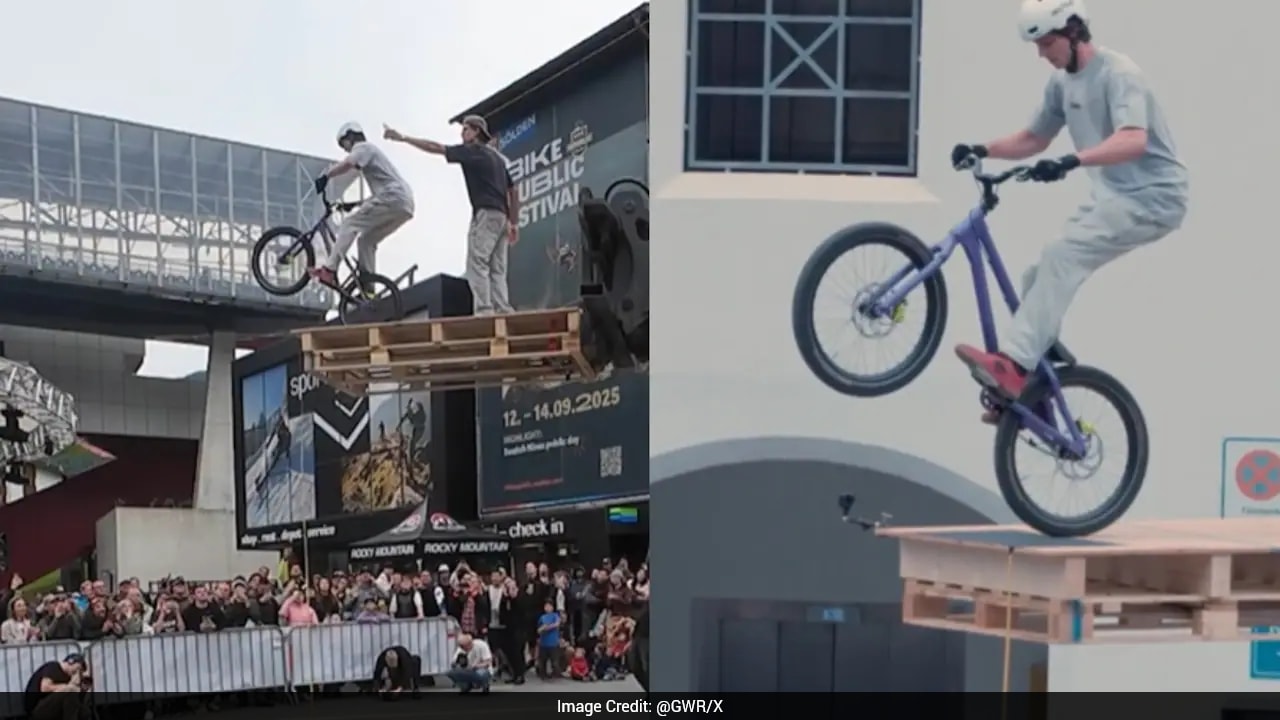
The highest vertical drop on a bicycle onto a target stands at 3.80 meters, a mark set by Austrian rider Mario Neurauter. When viewed through a standard lens, sports achievements of this nature are often filed away as simple stunts. They are packaged for social media algorithms, stripped of context, and consumed as brief flashes of adrenaline. Yet, looking past the digital noise reveals a complex intersection of kinetic energy, biomechanical timing, and material science.
Gravity does not negotiate. Falling from a height of nearly four meters onto a localized target turns a bicycle into an instrument of severe mechanical stress. The primary challenge of such a drop is not the act of leaving the platform, but the management of sudden deceleration. Human bone and carbon fiber share a common enemy: sudden spikes in G-force.
To understand why this specific metric matters, one must examine the evolution of precision bike handling. Traditional extreme mountain biking favors sprawling transition slopes where impact forces are dissipated over a ramped landing zone. Dropping straight down onto a flat or confined target eliminates that transition entirely. The rider becomes the primary shock absorber. Every millimeter of error in body positioning multiplies the load transferred to the lumbar spine and wrists.
Physics dictates that an object falling from 3.80 meters hits the ground with a velocity driven entirely by acceleration and distance, minus nominal air resistance. At that scale, the margin for error shrinks to zero. The rider must compress their body mass before impact, timing an explosive extension to match the exact moment the tires meet the surface. This active absorption mimics the landing mechanics of professional parkour athletes or elite gymnastic dismounts.
The hardware itself undergoes an invisible transformation under these loads. Modern bicycle frames are engineered to withstand multidirectional forces, but vertical impact introduces crushing loads to the bottom bracket and head tube. Wheels are built with high spoke counts and reinforced rims to prevent catastrophic taco failures upon contact. When a rider drops onto a target, lateral stability matters just as much as vertical strength. A single degree of wheel yaw at the moment of impact creates a rotational torque that can rip the handlebars from the rider's grip.
Beyond the numbers lie the psychological dimensions of modern extreme sports. Athletes operating at this level train their nervous systems to override basic self-preservation instincts. Fear is a physical response that causes muscle tension; tension destroys the fluid movement required to absorb high impacts. Achieving a record requires suppressing that tension until the wheels touch the deck.
The industry surrounding these feats often chases bigger numbers, higher cliffs, and flashier headlines. True mastery, however, lives in the micro-adjustments. It lives in the exact placement of a rear tire on a designated mark, millimeters away from mechanical failure. The pursuit of height on a bicycle is ultimately an exercise in controlled physics, where gravity is managed rather than conquered.
The video above demonstrates the exact technique and execution required to manage impact forces during a precision drop.