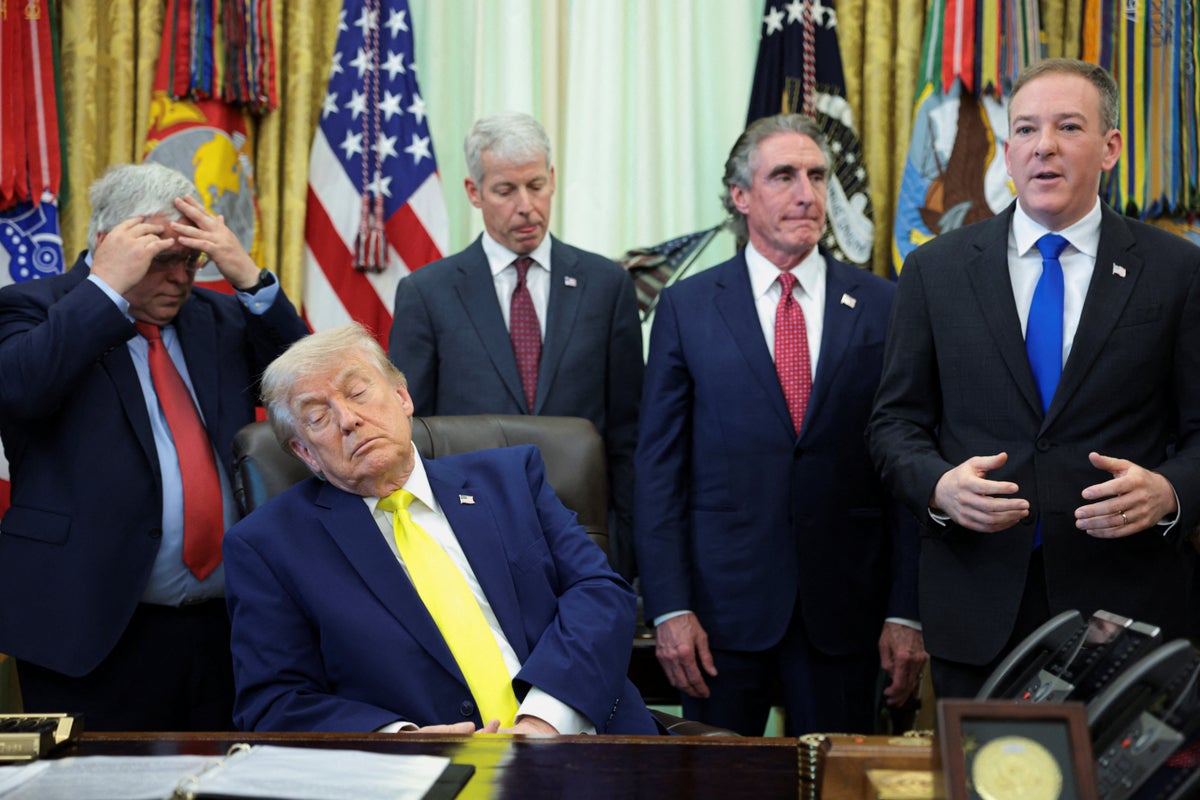
The room was heated to exactly sixty-eight degrees, but under the heavy television lights, it felt like a greenhouse. Cameras clicked in a rhythmic, mechanical chorus. It is a sound every politician hears in their sleep—a constant, buzzing reminder that every twitch, every sigh, and every momentary lapse of focus is being recorded for posterity.
Donald Trump sat at the center of the briefing room. Around him, aides whispered and reporters shifted their weight, waiting for the next statement. Then, it happened. It lasted only a few seconds. His eyelids fluttered, grew heavy, and closed. His head tilted forward, just a fraction of an inch, fighting the invisible downward pull of exhaustion. You might also find this related coverage interesting: The Gilgit-Baltistan Outrage Cycle is a Diplomatic Illusion.
In that fleeting sliver of time, the policy objectives and political grandstanding vanished. The optics shifted instantly from a display of executive power to a raw, deeply human moment of fatigue.
Within minutes, the digital machinery of modern politics seized upon the moment. The internet does not allow for tiredness. It does not recognize the crushing weight of a relentless public schedule or the simple, biological reality of a man nearing eighty fighting the mid-afternoon slump. To his detractors, those closed eyes were not a sign of exhaustion. They were ammunition. As extensively documented in recent articles by Reuters, the results are worth noting.
The Anatomy of a Political Meme
Before the briefing had even concluded, the nicknames were circulating online. The most potent among them, coined by opposing strategists and amplified by a chorus of social media critics, was "the Commander-in-Sleep."
It was a swift, calculated inversion of the traditional wartime title. It was designed to hurt. Political warfare in the modern era relies entirely on these hyper-compressed narratives. A complex debate about economic policy or foreign diplomacy requires time, nuance, and an attention span that the public square rarely possesses anymore. A video clip of a man nodding off, however, requires no explanation. It communicates an idea instantly, bypassing the brain and striking directly at the gut.
Opposing politicians flooded the airwaves. They seized microphones with the eager energy of prosecutors who had just discovered a smoking gun. They painted a picture of a White House adrift, helmed by a leader unable to keep his eyes open during critical briefings.
But this reaction tells us far less about the man in the chair than it does about the culture that judges him.
We live in a society that treats rest as a defect. We have built a world where constant visibility is equated with competence, and where any sign of physical vulnerability is treated as a disqualifying flaw. When a public figure blinks for too long, we do not see a tired human being. We see an opening.
The Fiction of the Endless Day
Consider what happens behind the scenes of any major political campaign or presidency. The schedule is not human. It is a grueling, multi-city conveyor belt of early morning strategy sessions, late-night donor dinners, endless travel, and the constant, crushing pressure of performance.
Imagine a hypothetical executive—let's call him Thomas—working at the highest level of corporate architecture. Thomas is seventy-eight years old. He flies across the country three times a week. He speaks to stadium-sized crowds, manages internal crises, and spends hours under high-intensity studio lighting designed to look like natural sun but which actually bakes the skin and drains the eyes. If Thomas nods off during a long budget meeting at three in the afternoon, his colleagues might offer him a coffee. They might whisper about the brutal quarterly travel schedule.
In Washington, however, that afternoon slump is treated as a national security crisis.
The weaponization of fatigue is not a new tactic, nor is it exclusive to any one political party. For years, the political landscape has been defined by an obsession with stamina. We watched candidates hike, jog, and power through bouts of pneumonia, all to avoid the fatal perception of weakness. The human body is treated as a machine that must never need maintenance, oiling, or rest.
This expectation is a collective delusion. The biological clock does not care about polling data. The circadian rhythm does not adjust itself because a major policy announcement is scheduled for 2:00 PM.
When we mock a leader for showing fatigue, we are reinforcing a dangerous standard for ourselves. We are validating the idea that to be successful, to be powerful, and to be worthy of respect, one must transcend the limitations of flesh and blood.
The Language of the Eyes
There is a distinct irony in the fact that this specific incident caused such a furor. The modern political apparatus is built entirely on artifice. Speeches are written by committees. Wardrobes are selected by stylists. Answers to difficult questions are rehearsed in mock studios until they lose all semblance of spontaneity.
A moment of sleep, however, cannot be faked. It is perhaps the only entirely authentic thing to happen in a press briefing room in the last decade. It is a moment where the persona drops away, leaving only the reality of an aging body dealing with the consequences of an extraordinary workload.
The reaction from opponents was predictable, filled with the specific, sharp glee of a rival who has found a vulnerability. But the public response was more complicated. Beneath the partisan bickering and the endless parade of memes, there was a quieter, more reflective undercurrent.
Some looked at the footage and felt a sudden, unexpected flash of empathy. They recognized that specific heaviness in the eyelids. They remembered the feeling of sitting in a warm room, listening to a monotone presentation, desperate to stay awake but finding the gravity of sleep entirely too strong to resist.
Others saw something more troubling—a metaphor for a political system that is itself tired, repetitive, and desperately in need of awakening.
The Stakes of the Stare
The true danger of these moments is not that a leader missed a few seconds of a briefing. The danger lies in how these incidents skew our collective priorities.
When a presidency is judged by its stamina rather than its substance, the nature of governance changes. Leadership becomes a test of endurance theater. It rewards the performative over the profound. The leader who stays awake for twenty hours a day signing flawed executive orders is praised, while the leader who takes an afternoon nap to ensure clarity of mind before making a critical decision is condemned.
We have elevated the appearance of alertness above the quality of thought.
The cameras in that briefing room eventually stopped clicking. The lights were turned off, cooling down in the dark. The reporters went back to their desks to file stories about a three-second clip, translating a basic biological function into a narrative of political decline.
The news cycle moved on to the next outrage, the next phrase, the next conflict. But the image of those closed eyes remained, hanging in the digital ether. It stands as a quiet monument to a truth we consistently try to ignore: that no matter how much power a person accumulates, no matter how many titles they hold or how many crowds cheer their name, they remain bound by the simple, fragile laws of being human.
The lights will always be too bright. The days will always be too long. And eventually, the eyes will always demand to close.