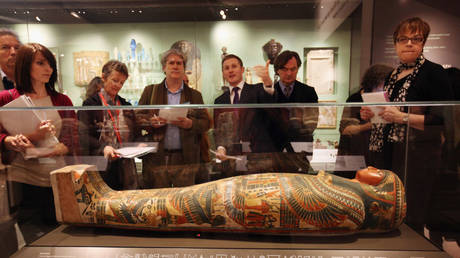
Silence. In a museum gallery, silence usually smells like floor wax, ancient cedar, and cool air pushed gently through ceiling vents.
I have stood in rooms like that for hours, my shoes squeaking faintly on limestone, watching strangers lean toward glass cases where bodies wrapped in linen or tucked inside painted wood rest under bright spotlights. For a long time, I treated that silence as reverence. We lower our voices. We read the little white cards. We tell ourselves we are honoring the past by looking closely at what survived it.
Then I started asking a question that ruined the quiet for me. Who gave us permission to look?
When word spreads that a UK museum has removed Egyptian mummies from public view over questions of consent, the reaction can snap into two camps faster than a shutter closing. On one side are people who feel a jolt of recognition—a sense that keeping human remains behind glass for casual curiosity crosses a line we shouldn't have drawn in the first place. On the other side are people who feel irritated, confused, or guarded: They've been there for generations. Nobody asked them then, and nobody can ask them now. Aren't we erasing history if we pull the curtains shut?
I get that confusion. Honestly, it is disorienting to watch familiar fixtures of public culture vanish behind closed doors, especially when headlines arrive in short, punchy bursts that make a complicated ethical shift sound like a sudden fad.
To understand what is actually happening beneath those headlines, we have to step past the glass and look at how those bodies got there, what "consent" even means across thousands of years, and what happens to a society when it decides that not everything old belongs on display.
The Long Road from Tomb to Display Case
To feel the weight of this decision, picture a young woman—let's call her Nadia, a hypothetical museum curator in her late thirties who grew up loving ancient history and still gets a thrill when a lamp flickers on in an archive room. This is a hypothetical scenario meant to trace the tension inside modern museums, though the dilemmas she faces mirror real debates across Britain and beyond.
Nadia arrives before the doors open. Her job involves cataloging artifacts, checking humidity levels, and talking with visiting scholars. One morning, she stands in front of a display case holding human remains from ancient Egypt—a person who lived, breathed, ate bread baked over hot ash, and was buried with prayers meant to carry them safely into an afterlife.
For over a century, European museums treated Egyptian mummies differently from many other human remains. That history is worth facing plainly. In the nineteenth and early twentieth centuries, European fascination with Egypt—often called Egyptomania—mixed genuine scholarship with colonial power, souvenir hunting, and spectacle. Tombs were opened. Bodies were unwrapped at parties or placed in civic collections as trophies of empire and curiosity. Even when early archaeologists worked with care by the standards of their day, the power imbalance was stark: foreign collectors and institutions decided what was valuable, where it went, and who got to gaze upon it.
Nadia looks at the plaque outside the case. It was written decades ago in calm, detached prose. It tells visitors about embalming resins, natron salts, and burial customs. What it leaves out is the story of removal—the choices made by outsiders who never knew the person inside the wraps.
Consent, in the modern sense of an informed, freely given "yes" between equals, did not exist in the way a nineteenth-century collector took a body from a burial site.
That gap is where the friction lives. People sometimes ask: Why apply today's rules to people from ancient Egypt or Victorian Britain? Fair question. We cannot go back in time and hand a clipboard to someone buried three thousand years ago.
Yet when we talk about consent around human remains today, we aren't pretending we can send a time-traveling notary back to the Nile. We are talking about our consent—how a living society chooses to treat the dead right now, and whether display for public curiosity honors human dignity or flattens a person into an object.
Think of it like this—a metaphor to make the shift clearer: imagine finding an old, unlocked photo album left in a hallway by someone who has passed away, and setting it on a coffee table for every guest who walks through the front door to flip through, point at, and discuss. Even if nobody means harm, even if guests say they find the pictures fascinating, there is a quiet point where looking stops feeling like paying respects and starts feeling like intrusion.
A human body is not a photo album. It was once someone's child, sibling, neighbor, or beloved.
Why "Consent" Sounds Simple Until You Pull the Thread
Once you start pulling on the word consent, the room gets complicated fast.
Visitors often ask a sharp follow-up: If the person died thousands of years ago and doesn't have direct living descendants who can speak up, whose consent is missing?
That is where standard news summaries often leave readers hanging. In ethics and museum practice, consent around ancestral or ancient human remains rarely means a single living relative stepping forward with a signature. Sometimes there are no clear direct descendants. Sometimes cultural ties are broad, contested, or shaped by centuries of migration and changing borders.
So museums and ethicists weigh several overlapping questions instead:
- Bodily dignity: Should human remains be treated as specimens or spectacles, or do they carry an enduring claim to respect simply because they belonged to a human being?
- Purpose of access: Is a body being kept for sensationalism and casual viewing, or is there a specific, respectful, culturally sensitive purpose—such as care, study, or return—agreed upon with relevant communities or authorities?
- Historical context: How did the remains leave their place of burial, and does keeping them on public show perpetuate a legacy of unequal power?
Consider what happens next when a museum chooses to remove mummies from public display. It is rarely a single dramatic midnight heist with velvet ropes dropping to the floor. More often, it follows years of quiet review, consultation, and internal debate among curators, conservators, ethicists, and community voices.
Still, doubt creeps in. I have felt it myself when reading about collections being pulled back. If we hide things away, do people learn less? Will young visitors miss the spark that once made them fall in love with history?
That doubt deserves a straight answer, because it isn't frivolous. Curiosity is how many of us first fell in love with the wider world. Standing in front of something ancient can make time feel vast and strange in a way a textbook never quite manages.
But curiosity has limits. We don't put every historical object or every piece of human history on open show just because someone wants to look. A museum is not just a warehouse of things people stare at; it is a place where a society signals what it values.
What Is Actually at Stake Behind Closed Doors
Let's return to Nadia (our hypothetical curator) a few weeks after the display case is cleared.
The glass is still clean. The spotlight is off. Inside the storage room behind the gallery, the wrapped remains are kept in stable, respectful conditions—not tossed in a crate, not forgotten, and not turned into a circus act. Out in the public gallery, curators are wrestling with a harder task than putting a mummy in a box: how do you tell the story of ancient Egypt—its beliefs about death, memory, craft, and daily life—without putting human bodies on parade for passersby?
This is where the real work begins. Taking something off display is the visible step; rethinking how we honor the dead is the deeper one.
Let's look closely at the two main paths museums navigate when confronting these questions, and what each path looks like in practice:
| Approach | What It Looks Like in Practice | Key Tension or Trade-Off |
|---|---|---|
| Removing from public display | Human remains are taken out of open galleries, placed in respectful storage or care, and interpreted through objects, art, and context instead. | Some visitors feel a loss of direct visual connection or worry about reduced public awareness. |
| Reframing or returning | Remains are either kept out of casual view while worked through with heritage authorities, or returned/reburied where appropriate and possible. | Requires careful research, diplomatic or community dialogue, and patience over quick answers. |
Notice what neither path is: neither is a dismissal of ancient Egypt's brilliance. Ancient Egyptian civilization built monuments, wrote poetry, practiced medicine, and shaped human history in ways that still amaze us. Removing a human body from a display case does not erase the pyramids, the hieroglyphs, the jewelry, the coffins, or the ideas people held about life after death.
If anything, it forces us to pay closer attention to how we tell those stories. A painted coffin, a shabti figure, a funerary text, or an explanation of embalming and belief can teach visitors plenty about ancient customs without turning a human being into a focal point of gawking.
Consider what happens next in a crowded gallery when a child stops in front of a sign explaining why human remains aren't on display. Instead of a quick glance and a whisper—"Ew, look at the teeth"—there is room for a real conversation between parent and child about respect, mortality, and how people across time have cared for their dead.
That shift is subtle. It doesn't make a noisy headline. Yet over years, it changes the emotional weather inside a room.
Living with Uncertainty Without Looking Away
If you feel torn about this issue, you are in good company. Ethical reckonings rarely arrive with neat bows tied around them. They arrive messy, slow, and full of gray areas.
Part of what makes this moment unsettling is that it asks us to look at traditions we grew up thinking were harmless and ask who felt the cost. For a long time, the default assumption in Western museums was simple: If we have it, and people want to see it, we show it. That assumption felt natural to people inside that system because they were the ones holding the keys.
Stepping back from that default doesn't mean everyone agrees on every detail. Reasonable people still debate where to draw lines around ancient remains versus more recent ones, how to balance public education with dignity, and how institutions should handle collections acquired under complicated circumstances.
What matters is that the question is no longer treated as off-limits.
When we stop treating human remains as mere curiosities behind glass, we also have to face our own relationship with death and memory. Modern life often pushes death out of sight until grief hits us hard and sudden. Walking into a museum and seeing a preserved body can feel strangely familiar—a reminder that every single person who ever lived once had ordinary mornings, worries, hopes, and people who loved them.
Perhaps true reverence isn't staring harder through thicker glass. Perhaps it is knowing when to step back, lower our voices for real, and let the dead rest with a measure of peace we would want for ourselves.
The gallery lights dim at dusk, leaving the empty case dark and quiet, while just beyond the wall the story of an ancient life goes on being told—without needing a body on show to prove it was real.


