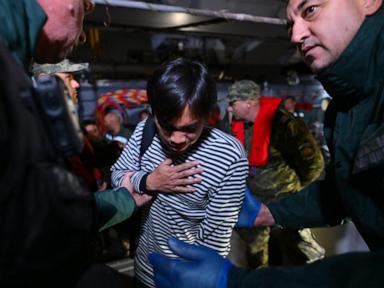
The passport photo shows a face caught between childhood and whatever comes after. Soft cheeks. Dark hair. Eyes that look straight into the camera at a New York City processing center, unblinking, entirely certain of a future that no one else in the room could possibly comprehend.
She was nineteen. She had a boarding pass for Istanbul, a suitcase packed with winter clothes, and an encrypted messaging app humming with instructions from a man she had never met in person.
When a federal jury in Brooklyn finally delivered its verdict years later—convicting a New York woman of receiving military-style training from the Islamic State after traveling to Syria to become a teenage bride to one of its fighters—the headlines treated the case like a tidy moral arithmetic. Crime committed. Justice served. Case closed.
Read those headlines closely and you feel nothing. You see a mugshot, a statutory citation, a sentence length. What you do not see is the bedroom in Queens where the algorithm first found her, the slow erosion of every normal teenage anchor, or the terrifying question that still hangs over every parent who has ever watched a child disappear behind a glowing screen at two in the morning.
How does a girl raised among corner bodegas and subway rumblings decide that Paradise lies in a bombed-out stronghold in Raqqa?
The Architecture of a Quiet Radicalization
To understand how an American teenager boards a commercial flight toward a war zone, you have to abandon the Hollywood caricature of terrorism. There were no shadowy recruiters lurking outside her high school in trench coats. No secret basement meetings.
Instead, there was a bedroom door that stayed shut a little longer each week.
Picture a hypothetical teenager—let us call her Maya, though the psychological blueprint applies to dozens of young Western recruits documented by counterterrorism researchers over the past decade. Maya is not a monster. She is bored, restless, aching for significance in a sprawling city that makes most nineteen-year-olds feel entirely invisible. She scrolls through her phone late at night, searching for belonging the way hungry people search for salt.
An algorithm notices what makes her pause. A video about global injustice. A post about sisterhood. A slickly produced clip showing women in Syria carrying rifles, framed not as victims or villains, but as pioneers building a pure society from the ashes of a corrupt world.
Within weeks, the digital current pulls her into private chat rooms. Here, the tone shifts from political grievance to intoxicating intimacy. Recruiters—many of them young women themselves—shower her with attention. They call her sister. They tell her she is chosen. They introduce her, through pixelated video calls and poetic text messages, to a fighter on the front lines who speaks of devotion, martyrdom, and a love that transcends ordinary life.
Grooming.
That is the word child psychologists use when predators isolate minors online, and counterterrorism experts have spent years proving that extremist recruitment operates on the exact same neurological wiring. Strip away the ideological vocabulary and the mechanism is indistinguishable from any predatory romance: flatter the target, alienate her from her family, convince her that outsiders will never understand her purity, and demand a dramatic act of loyalty to prove her devotion.
By the time she walks through security at John F. Kennedy International Airport, the trap has already snapped shut. She believes she is running toward freedom. In reality, she is walking into a cage with barbed wire on the outside and armed guards at every gate.
Inside the Fortress of Sand and Concrete
The border crossing between southern Turkey and northern Syria in the mid-2010s was a jagged scar of dust, smugglers, and nervous silence. Once across, the romantic filters evaporated within hours.
According to court testimony, declassified intelligence assessments, and the accounts of women who survived the caliphate's collapse, new female arrivals were immediately separated from their luggage, their phones, and their illusions. They were placed in guarded guesthouses—madafas—run by stern older women who enforced strict rules on dress, movement, and speech. Unmarried women could not step onto the street without a male guardian. Within days, marriages were arranged, often to fighters who viewed foreign brides as trophies of status.
The Brooklyn trial centered on a specific, crucial distinction under American law. Simply marrying a member of a designated terrorist organization, or living under its rule, presents complex prosecutorial hurdles. Receiving military-style training from that organization crosses a bright statutory line.
Prosecutors laid out the evidence piece by piece. In Syria, the defendant did not merely keep house. She learned how to handle an assault rifle. She trained with firearms and explosives, absorbing tactical instruction designed to turn wives into a secondary line of defense if coalition forces breached the city limits. Photographs and digital communications recovered from devices in the conflict zone—alongside testimony from cooperating witnesses—painted a portrait of a young woman who had crossed from passive follower into active participant.
Think about the sensory whiplash of that transformation.
Less than two years earlier, her biggest daily decisions involved subway transfers and takeout menus. Now, the air smelled of diesel exhaust, pulverized concrete, and cordite. The sky buzzed constantly with the low, mechanical whine of surveillance drones. When airstrikes hit nearby blocks, the dust sifted down through ceiling cracks like gray snow, coating tea glasses and prayer rugs alike.
Yet even amid the rubble, the propaganda machine demanded performance. Women were encouraged to post photos online—a gloved hand resting on an AK-47, a sunset over the Euphrates framed with verses about glorious struggle—to lure the next wave of restless teenagers from London, Paris, Toronto, and New York. The victim had become part of the bait.
The Reckoning in Courtroom 4D
Years pass. Empires built on terror do not last; they rot from the inside while being crushed from the outside.
When the territorial caliphate finally crumbled in the dust of eastern Syria, tens of thousands of women and children poured out of the last besieged pockets into sprawling detention camps like al-Hol and Roj. Stripped of electricity, triumphalism, and protection, the survivors faced a grim purgatory in the desert heat. Some remained fiercely loyal to the black flag. Others wept, begging their home governments to remember who they were before they got on the plane.
Repatriation became one of the most agonizing moral puzzles of the post-9/11 era.
Many European nations refused to bring their citizens back, stripping them of citizenship or leaving them to languish in Kurdish-run camps indefinitely. The United States took a starkly different approach: bring them home, put them in front of federal judges, and let the constitutional machinery grind through the evidence.
In a quiet courtroom in the Eastern District of New York, the distance between Queens and Raqqa collapsed into exhibits labeled with white stickers.
Jurors sat mere feet from a woman who looked nothing like a hardened insurgent. She wore civilian clothes, her posture small and guarded at the defense table. Defense attorneys argued that she had been a naive teenager—manipulated by older, sophisticated operatives, trapped in an abusive marriage in a war zone where refusal meant imprisonment or death. How much free will does a nineteen-year-old bride possess inside a totalitarian enclave where men carry rifles and women cannot walk to a bakery alone?
It is a question that twists the stomach because both halves of the answer are true.
She was groomed. She was young, vulnerable, and exploited by a multi-million-dollar digital propaganda apparatus specifically engineered to hijack adolescent insecurity.
And she pulled the trigger on a firing range in Syria. She accepted training from an organization that beheaded journalists, enslaved Yazidi girls, and burned prisoners alive in cages.
The federal jury had to hold both realities in their hands without dropping either one. Under Title 18 of the United States Code, providing material support or receiving military training from a foreign terrorist organization does not require proof that the defendant personally carried out an attack on American soil. It requires proof of knowing participation.
When the foreperson stood to read the verdict—guilty—there were no cheers in the gallery. Only the heavy, airless silence that follows a tragedy where everyone involved lost something irrecoverable.
What the Headlines Miss About Who Comes Next
It is comforting to believe that this story belongs to a closed chapter of history—that because the Islamic State no longer holds cities in Iraq and Syria, the vulnerability that carried a New York teenager across an ocean has been neutralized.
That belief is dangerous.
Walk into any security briefing today and ask analysts what keeps them awake at night. They will tell you that the physical territory was only ever a stage set. The real engine of recruitment was never the desert; it was the architecture of isolation.
Today, the tools of radicalization are faster, more intimate, and harder to detect than anything that existed ten years ago. Encrypted platforms vanish messages in seconds. Artificial intelligence generates tailored grievance narratives in dozens of languages, testing which emotional hook keeps a lonely teenager scrolling for five extra minutes. Extremist groups—whether jihadist networks, violent white supremacist cells, or nihilistic online accelerationist cults—all fish in the exact same waters.
They look for the same thing every time:
- Identity hunger: Young people who feel untethered from family, community, or a coherent sense of purpose.
- Moral certainty: A black-and-white worldview that promises to replace messy, painful adulthood with absolute clarity.
- Secret belonging: An exclusive tribe that validates their anger and tells them they are heroes in a world of sleepwalkers.
When we reduce cases like the New York teen bride to simple caricatures of evil, we blind ourselves to the warning signs happening in plain sight. A child does not wake up on a Tuesday morning and decide to join a death cult. They arrive there through a thousand tiny, invisible steps—each one feeling like relief from loneliness, each one applauded by strangers on a screen who never once have to look them in the eye.
The Weight of a Boarding Pass
Think back to that passport photo taken in New York before the flight.
At nineteen, every choice feels reversible. You dye your hair, you change your major, you move to a new city, and if it goes wrong, you call home and someone wires you money for a bus ticket. American adolescence is built on the quiet assumption that mistakes come with safety nets.
Except some doors only open in one direction.
In the quiet years inside a federal prison cell—where fluorescent lights hum on a strict schedule and every letter is read before it is delivered—time moves differently than it did in the frantic blur of encrypted chats. There is no algorithm curating the walls. There are no distant fighters promising eternal glory. There is only the memory of an ordinary life in New York, traded away before she was old enough to know what it was worth, and the cold realization that the people who promised her paradise never cared whether she survived the trip.