Far out past the choppy blue of the Gulf of Oman, where the sea meets a heavy, salt-blurred horizon, a quiet metropolis of steel is taking shape.
Look closely at the water near Sohar. You will not see flags snapping proudly in the wind or bright corporate insignias painted on hulls. Instead, you see silhouettes. Giant supertankers—Very Large Crude Carriers, or VLCCs—sit motionless, their engines idling softly against the current. They are waiting. Dozens of them. Sometimes upwards of 150 vessels anchor here in a sprawling offshore holding pattern, a floating city born of necessity and quiet calculation.
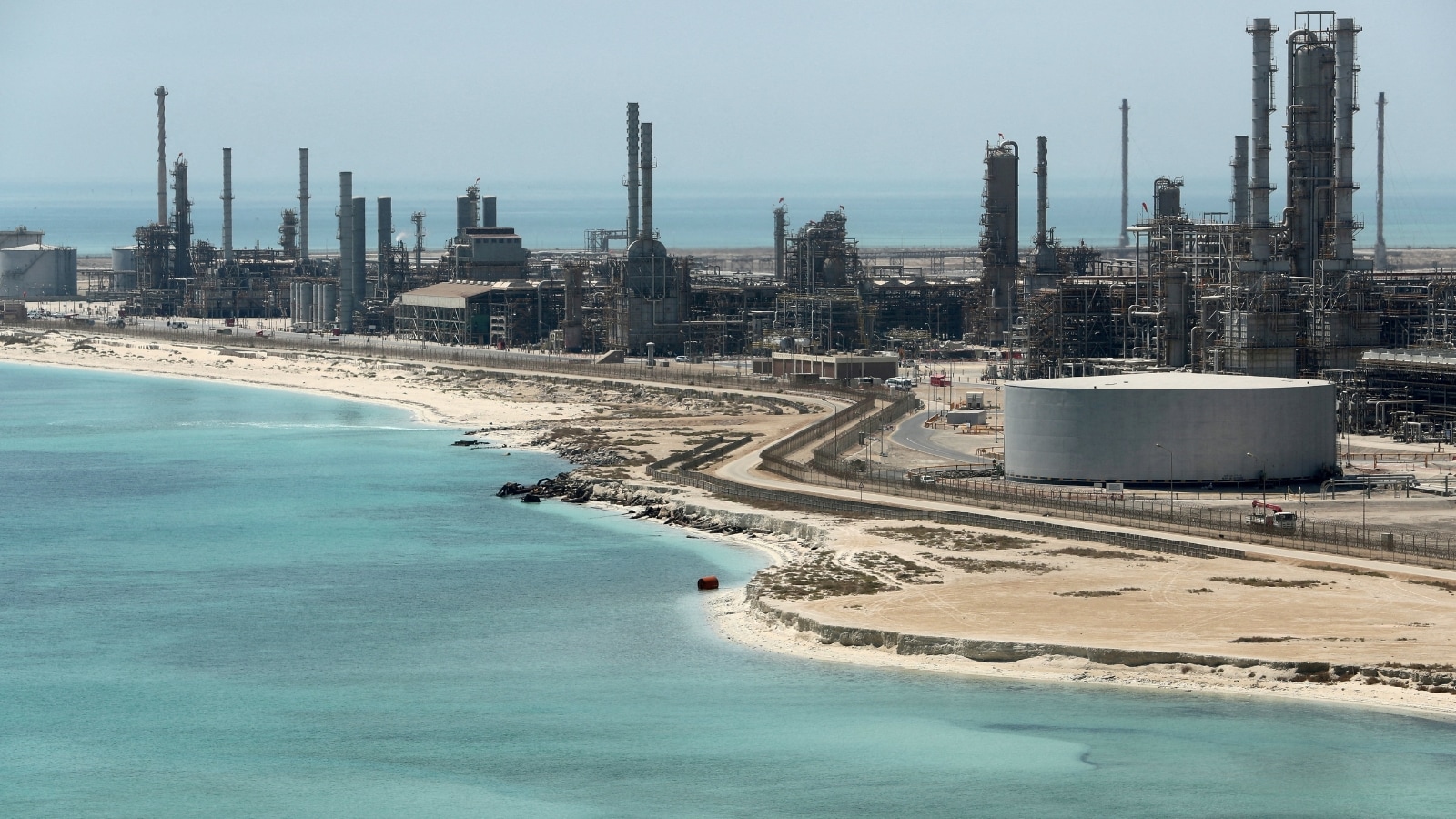
For decades, the geography of global energy was simple, brutal, and rigid. Oil came out of the earth in the Persian Gulf, loaded into massive tankers at terminals like Ras Tanura, and threaded its way through the narrow choke point of the Strait of Hormuz. It was a fragile bottleneck. Everyone knew it. Yet for generations, the system held because the water stayed open.
Then the world changed.
Consider what happens when a vital artery gets pinched. Geopolitical friction in the Middle East and mounting security pressures along alternative overland arteries—such as the East-West pipeline leading to the Red Sea port of Yanbu, now squeezed by regional blockades—forced energy planners back to the drawing board. Saudi Arabia, a kingdom whose economic heartbeat pulses through its massive crude exports, faced a formidable logistical puzzle. How do you keep millions of barrels of oil moving to international markets when the traditional pathways grow hazardous?
The answer is happening right now, written in code and executed on the open sea.
State oil giant Saudi Aramco has begun offering crude cargoes—specifically heavier grades like Arab Medium and Arab Heavy that originate deep inside the Persian Gulf—on a ship-to-ship transfer basis off the coast of Oman.
Imagine the choreography. A smaller shuttle tanker loads up inside the Gulf. It navigates the Strait of Hormuz, sometimes slipping through the waterway with its transponders switched off—a practice widely known in maritime circles as sailing "dark". It is a high-risk, pragmatic maneuver designed to minimize exposure in a contested corridor. Once safely past the chokepoint and into the open waters near Oman, the shuttle pulls alongside a waiting supertanker. Heavy rubber hoses are hoisted across the gap. Millions of gallons of crude flow from one vessel to the other in a delicate, high-stakes ballet of fluid dynamics.
Once the transfer is complete, the massive long-haul carrier heads off to global refineries, while the shuttle turns back toward the horizon to do it all over again.
This is not an entirely new invention. Neighboring producers like the United Arab Emirates and others have relied on similar offshore choreography for years. But seeing Saudi Arabia—traditionally reliant on its direct port terminals and mainland pipeline networks—lean heavily into this Omani-waters transfer model marks a profound evolution in modern energy logistics. It reflects a resilient, two-tier operational system where risk-tolerant local operators manage the treacherous inside leg, and mainstream vessels handle the secure open-ocean journey.
The implications stretch far beyond maritime strategy.
When energy markets look at a tightening supply chain, they panic. Price spikes follow uncertainty the way thunder follows lightning. Yet, despite ongoing regional tensions, global benchmark crude has hovered relatively steady, recently trading around $85 to $91 a barrel. Why? Because the invisible plumbing of the oil trade is adapting in real time. Satellite data reveals that tankers with a combined transport capacity of at least nine million barrels have been loading up at Saudi terminals, feeding this offshore relay race.
By decentralizing their export points and utilizing Omani waters as a secondary commercial staging ground, producers are preventing a catastrophic supply shock. They are proving that modern supply chains are remarkably elastic. When one door closes, the industry finds a way to pump oil across a floating bridge.
Standing on the deck of a ship looking out at the gathering fleet near Sohar, you realize you are watching history bend to circumstance. These ghost ships, riding low in the water and heavy with energy, are the physical manifestation of adaptation. They do not make headlines every day, but they are the reason manufacturing plants keep running overseas, why cargo planes stay fueled, and why global commerce avoids grinding to a halt.
The geography of oil will always be perilous. The tension points will remain. But as long as the pumps turn and the tankers meet in the quiet, open waters beyond the gulf, the world's invisible engine keeps turning.