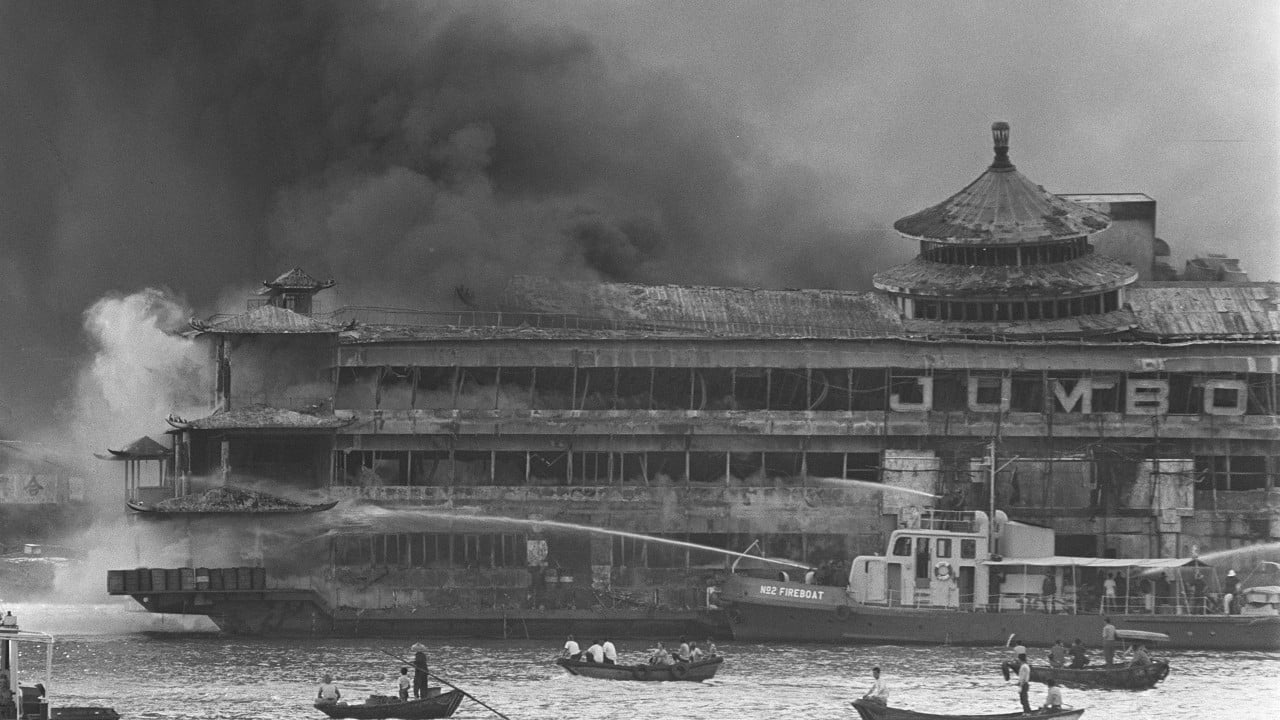
Smoke.
Before the gold leaf ever caught the neon reflection of Aberdeen Harbour, before tourists ever leaned over the ornate railings to snap photographs of twin dragon thrones, there was only the thick, suffocating smell of burning lacquer and trapped sea air.
We remember the Jumbo Floating Restaurant as a postcard. For nearly half a century, it sat anchored in the waters of southern Hong Kong like a floating imperial palace—a dazzling monument to post-war ambition, Cantonese dim sum, and the kind of unapologetic extravagance that made the city feel invincible. When the vessel finally capsized in the South China Sea in June 2022, the world mourned the sinking of a cultural icon. Headlines eulogized the end of an era.
Almost nobody remembered how that era began.
In October 1971, five years before the Jumbo ever served a single plate of steamed shrimp dumplings, the unfinished vessel became the site of one of Hong Kong’s deadliest maritime fires. Thirty-four people died inside its hull. Over forty more were injured. The tragedy didn't happen during a packed banquet or a typhoon; it happened quietly, violently, in the final frantic sprint to meet an opening deadline.
The Architecture of Ambition
To understand why thirty-four people walked into a floating furnace in 1971, you have to understand the fever pitch of Hong Kong at the turn of that decade.
The city was transforming from a manufacturing hub into a global spectacle. Wong Lo-kat, the merchant behind the project, wasn't merely building a seafood restaurant; he was constructing a floating temple meant to eclipse every rival in Aberdeen Typhoon Shelter. Three stories high. Seventy-six meters long. Designed in the style of a Ming Dynasty imperial palace, complete with hand-carved murals, jade-colored tiles, and thousands of lightbulbs meant to turn the dark harbor water into liquid gold.
Ambition, however, has a specific kind of blindness. When a project becomes a symbol of prestige, the calendar turns into a tyrant.
Consider a hypothetical composite of the men who worked those final shifts—let’s call him Chan, a twenty-six-year-old interior decorator hired through a subcontractor in the autumn of 1971. Chan wouldn't have been a sailor. He wouldn't have known the layout of a marine bulkhead or the way fire behaves inside a steel-hulled barge with sealed lower decks. He was a craftsman, paid by the day, working in a maze of freshly painted wood, hanging silk lanterns, and cans of volatile thinner stacked near the stairwells because there was nowhere else to put them.
For men like Chan, the Jumbo wasn't a historical landmark. It was overtime pay. It was a rush job.
October 30, 1971
The fire broke out on a Saturday afternoon, just days before the restaurant was scheduled to welcome its first official guests.
Picture the interior of a ship that looks like a palace on the outside but functions like a factory floor on the inside. Hundreds of workers—carpenters, painters, electricians, welders—were crammed into the three decks simultaneously. There were no dining tables yet, only scaffolding, exposed wiring, sawdust, and gallons of industrial varnish drying in the humid October heat.
A spark hit the wrong surface.
Accounts from the 1971 disaster point to welding work taking place near flammable interior decorations—the classic, lethal collision of heavy industry and delicate ornamentation. In a standard building on land, fire moves upward and outward, giving people street-level exits and open windows. On a floating barge anchored offshore in Aberdeen Harbour, water surrounds every exit.
And inside the Jumbo, the very things meant to enchant future diners became traps.
The ornate wooden paneling, lacquered to a high gloss, ignited almost instantly. Thick, black, toxic smoke—fed by synthetic resins, paint thinners, and foam padding—filled the narrow corridors in seconds. Visibility dropped to zero. Workers on the upper decks scrambled toward the railings and leaped into the harbor, where sampan operators and nearby fishermen rushed in to pull them from the water.
Those below the main deck had nowhere to go.
I have stood on the shore of Aberdeen Harbour decades later, looking out at the water where the Jumbo once sat, and the distance between the pier and the anchorage looks deceptively small—a two-minute ride on a wooden ferry. When you look at that narrow stretch of water, the horror of October 1971 becomes sharply physical. Rescue boats were right there. The city was right there. Yet the steel hull held the heat like an oven, turning the lower compartments into chambers from which no one could hear the shouts from the shore.
Fireboats pumped water into the super-structure for hours, their hoses arcing against a sky choked with grease-black smoke visible across Hong Kong Island. By the time the flames were beaten back and firefighters breached the warped, blistered interior, the scale of the loss was staggering.
Thirty-four bodies were recovered from the charred remains of the floating palace.
The Price of Moving On
What happens after a tragedy reveals what a society truly values.
In the wake of the 1971 fire, the Jumbo was a gutted, blackened ruin—an eight-million-Hong-Kong-dollar liability floating in the harbor. Wong Lo-kat could no longer afford to rebuild it. For a brief moment, the charred hulk sat as an unintended monument to rushed labor and lax industrial safety, a stark reminder of the human cost hidden behind Hong Kong’s breakneck economic miracle.
Then came Stanley Ho.
In 1972, the Macau casino magnate stepped in, bought the ruined vessel, and poured more than thirty million Hong Kong dollars into resurrecting it from the ashes. Ho understood the power of spectacle better than almost anyone in Asia. When the Jumbo Kingdom finally opened in October 1976—five years after the fire—the tragedy had been scrubbed away beneath fresh gold leaf, red pillars, and dazzling floodlights.
The gamble worked. Over the next four decades, more than thirty million guests boarded the Jumbo. Queen Elizabeth II dined there. Tom Cruise filmed there. Tourists from every continent posed beneath its glowing archways, entirely unaware that the floor beneath their velvet chairs had been rebuilt over the site of one of the city's worst workplace disasters.
This is the strange psychology of iconic places: beauty erases memory. We are wired to admire the finished monument and ignore the scaffolding—and the casualties—that made it possible.
What the Water Remembers
When you look closely at the full arc of the Jumbo Floating Restaurant, from the 1971 fire to its eventual financial collapse during the pandemic and its mysterious sinking near the Paracel Islands in 2022, a different story emerges. It isn't a fairy tale about a beloved restaurant that met an untimely end at sea.
It is a story about how quickly we sanitize our own history.
Every city has its Jumbo—a bridge, a stadium, a skyline tower whose brilliance blinds us to the workers who paid for its speed with their lives. In Hong Kong, the 1971 fire helped spur incremental reforms in marine and construction safety, forcing regulators to confront the lethal reality of subcontractors welding next to open drums of lacquer on floating vessels. Those thirty-four workers didn't die in vain, even if their names rarely appeared in the glossy travel brochures that followed.
Yet every time a nostalgic tribute to the Jumbo circulates online—showing the neon dragon glowing against the night sky of Aberdeen—it offers only half the truth.
The real Jumbo wasn't just the palace of banquets and movie stars. It was also the dark, smoke-filled hull on a Saturday afternoon in 1971, where thirty-four ordinary people went to work to finish a dream they would never be invited to enjoy, trapped just meters away from the open sea.