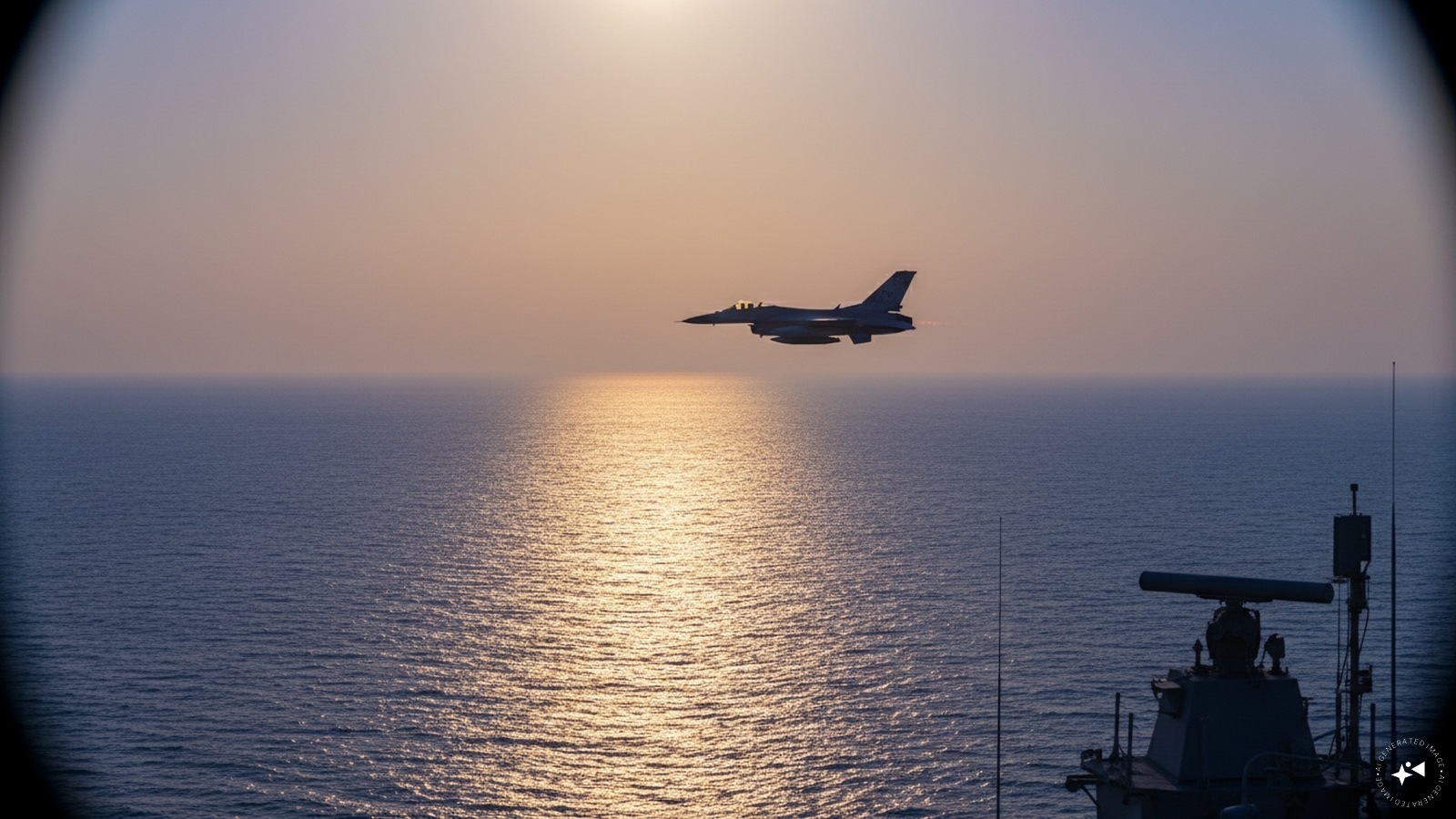
Thirty thousand feet above the Persian Gulf, the air outside the canopy does not care about press releases.
It is forty degrees below zero. The wind screams past reinforced acrylic at six hundred miles an hour, a relentless, vibrating roar that presses into a pilot’s ribs through an anti-gravity suit and an oxygen mask. Inside the cockpit of an American F-16 Fighting Falcon, the world shrinks to green phosphor lines on a heads-up display, the rhythmic hiss of regulated air, and the cold, pulsing geometry of radar sweeps. For another perspective, read: this related article.
Down below, through thin ribbons of marine haze, the water looks like hammered pewter. Oil tankers crawl across the Strait of Hormuz like toy boats dragged by invisible threads. Everything looks quiet. Everything looks small.
Then a headline breaks across three continents, and suddenly that quiet stretch of sky is crowded with ghosts. Similar analysis on the subject has been shared by BBC News.
Tehran claims an Iranian missile struck and damaged an American F-16 over the Gulf. Washington replies within hours, flat and categorical: false. No aircraft hit. No damage sustained. Every pilot accounted for, every airframe intact.
Two governments. Two incompatible realities. One patch of saltwater and sky.
If you have ever stood on the flight deck of a carrier or listened to the static-choked chatter of a combat air patrol frequency at three in the morning, you know how quickly a single sentence on a wire service can make your stomach drop. You do not read a headline like that as geopolitics. You read it as a checklist of names. You read it as the long, agonizing silence between a radar blip flickering and a radio call coming back clear.
And then, once the immediate pulse slows, a second realization settles in. Whether steel met warhead over the Gulf or never left a launch rail at all, a shot was still fired. The real battlefield was never just the airspace above the water. It was the space between what happened and what the world could be made to believe.
The Anatomy of a Four-Second Eternity
To understand why a dispute over a single fighter jet carries the weight of a potential regional war, strip away the diplomatic phrasing and look at the physics.
Consider a hypothetical scenario grounded in standard Gulf patrol doctrine: a single-seat F-16 flying a routine deterrent orbit in international airspace, miles off the Iranian coast. Call the pilot Captain Miller—not a real callsign, just one of the hundreds of men and women who rotate through forward bases in the Middle East on six-month deployments, living out of shipping containers and drinking lukewarm coffee before dawn briefings.
In that cockpit, combat is not cinematic. It is compressed time.
A modern surface-to-air missile does not lumber across the horizon like an artillery shell in an old war movie. It accelerates off its launcher at three to four times the speed of sound. Against a target flying at medium altitude over open water, the entire engagement—from the first sharp spike on a cockpit radar warning receiver to the moment a proximity warhead detonates—can unfold in less than twenty seconds. Sometimes less than ten.
When a missile locks onto an F-16, the jet does not wait for human intuition. Embedded sensors detect the specific radio-frequency signature of the tracking radar, classify the threat in milliseconds, and trigger an automated symphony of survival. Chaff cartridges—millions of microscopic aluminum-coated glass fibers—burst from the tail to bloom into a false radar cloud. Magnesium flares ignite behind the exhaust plume to seduce infrared seekers. The pilot slams the side-stick controller into a nine-G break turn, feeling blood drain toward his boots while his vision narrows to a gray tunnel, trying to put the beam of the enemy radar perpendicular to his wings so the Doppler filter loses him against the clutter of the waves below.
If a missile actually hits—even a near-miss where a fragmentation warhead shreds hydraulic lines or peppers an intake—you cannot hide it for long in the modern Gulf.
That body of water is one of the most densely watched corridors on earth. Commercial marine transponders track hundreds of vessels every hour. Civilian airliners cruise along established airways just miles away, their crews monitoring emergency guard frequencies. Overhead, commercial imaging satellites pass on predictable orbits, while military reconnaissance platforms—American, allied, Russian, Iranian—drink in every electronic emission from the coastline to the Arabian peninsula.
A crippled fighter jet limping toward an emergency divert field leaves a trail. It dumps fuel. It declares an in-flight emergency on open channels. Tanker aircraft scramble to meet it. Rescue helicopters spin up their rotors. Base fire crews roll out onto the tarmac with foam trucks flashing red against the desert dark.
Nothing like that vanished into the quiet of the Gulf. Washington’s denial was not hedged with the usual bureaucratic fog—no "we are investigating reports," no "an incident occurred." Pentagon officials stated plainly that no U.S. aircraft had been struck or damaged by Iranian fire.
So why say it happened at all?
Why a Phantom Hit Still Draws Blood
Think of information warfare like throwing a pebble into a darkened room full of people holding loaded weapons. Nobody needs to be hit by the pebble for someone to flinch.
For decades, military strategists measured power in tonnage, sorties, and kinetic destruction. If you wanted to deter an adversary, you sank a ship, downed a plane, or fortified a border. Today, in the gray zone between uneasy peace and open conflict, the claim of a strike often does the political work of the strike itself—without triggering the catastrophic retaliation that an actual shoot-down would guarantee.
Look closely at the asymmetry.
If Iranian forces genuinely fired a missile and damaged a U.S. fighter jet over the Persian Gulf, the calculus in Washington shifts overnight. History offers a clear, unforgiving precedent. In June 2019, when Iran shot down an unmanned U.S. Navy RQ-4A Global Hawk surveillance drone over the Strait of Hormuz, the United States came within minutes of launching retaliatory strikes against Iranian radar and missile batteries—aborted only at the last moment when commanders weighed the projected casualty toll. And that was for an aircraft with nobody inside it.
An F-16 carries a human being. Damaging or downing a manned American fighter crosses a bright, unmistakable threshold. It forces the hand of any commander-in-chief, invites immediate strikes on coastal air defenses, and risks spiraling into a wider war that neither Tehran nor Washington can easily contain once the first salvage ships enter the water.
By claiming a hit that Washington flatly denies, an actor captures a specific kind of strategic dividend while dodging the immediate bill.
First, there is the domestic audience. In moments of heightened tension, populations watching state media want proof of strength, deterrence, and technological parity. A narrative in which local air defenses bloodied the nose of the world’s premier air force projects defiance at home without a single radar site being reduced to rubble in return.
Second, there is the psychological tax levied on the opposing side. Every time a dramatic claim circulates through social feeds and regional newsrooms, military spokespeople are forced onto the defensive. You cannot prove a negative with a photograph of an intact airplane sitting in a hangar—critics will immediately ask when the photo was taken, whether it is a different tail number, or what happened to the rest of the squadron. Denial always sounds smaller, drier, and less visceral than an accusation.
It is an old trick dressed in twenty-first-century speed. During the Cold War, radio broadcasts and state newspapers routinely inflated border skirmishes into decisive victories. What has changed is velocity. A claim born in a regional newsroom travels through encrypted messaging channels, automated translation bots, and algorithmic feeds before a flight leader has even unstrapped from a parachute harness and walked into a debriefing room.
By the time the truth puts its boots on, the rumor has already moved markets, rattled diplomats, and hardened assumptions on both sides of the water.
Inside the Fog Where Mistakes Happen
I will admit something that anyone who follows defense reporting honestly has to confront: from the outside, watching these exchanges unfold in real time is deeply unsettling, precisely because absolute certainty rarely arrives on schedule.
When a flash alert hits a phone screen claiming a missile struck an American jet, your mind immediately reaches for history’s worst misunderstandings.
In July 1988, in the very same waters of the Persian Gulf, the guided-missile cruiser USS Vincennes misidentified an ascending civilian airliner—Iran Air Flight 655—as an attacking Iranian F-14 fighter jet. Two hundred and ninety innocent people died in seconds because stressed human beings inside a darkened combat information center misread electronic returns under the weight of recent skirmishes and relentless tension.
Four years earlier, in the Gulf of Sidra, and decades later in the skies over Ukraine and eastern Syria, false alarms, spoofed radar signals, and hair-trigger doctrines repeatedly demonstrated how fragile human judgment becomes when lethal machines sit seconds apart.
That is the invisible danger hiding beneath a headline like "US denies Iranian account that missile damaged F-16 over Gulf."
The danger is not just whether one side is lying. The danger is what happens when two militaries operate nose-to-nose inside a dense electromagnetic storm where both sides know a single miscalculation could ignite a region.
Think of the Persian Gulf as a crowded hallway where two rivals walk past each other carrying open cans of gasoline while someone in the back yells that a match has just been struck. Even if nobody lit anything, everybody’s grip tightens. Fingers move closer to triggers. Radar operators stop giving ambiguous contacts the benefit of the doubt.
In the air over the Gulf, American and Iranian forces routinely test each other’s reflexes. Iranian fast-attack craft shadow naval vessels. Drones orbit near carrier strike groups. Coastal fire-control radars occasionally illuminate coalition aircraft—a silent electronic glare known in cockpit slang as being "painted" or "spiked."
To a pilot, a search radar sweeping past your jet is routine background noise, like headlights flashing across a highway divider. A fire-control lock is different. A fire-control lock means someone has narrowed their beam onto your specific airframe, calculated your altitude, heading, and closure rate, and prepared a weapon solution. Even without a launch, it is the electronic equivalent of someone resting a finger inside a trigger guard.
In that environment, electronic warfare blurs reality even further. Modern jammers can generate phantom targets on an enemy screen—hundreds of false echoes blooming across a display like static snow. Conversely, a technician misinterpreting an anomalous radar return, a weather inversion over warm Gulf water, or a routine chaff release can genuinely convince themselves they watched a target break apart on glass.
Fog of war is not a poetic phrase. It is a technical condition caused by heat ducts over saltwater, overlapping frequencies, sleep-deprived operators, and the sheer speed of modern sensors.
The Machine That Keeps Flying
Look again at the aircraft at the center of this storm.
The F-16 Fighting Falcon first flew in 1974, designed by a group of engineers and fighter pilots—the self-styled "Fighter Mafia"—who rebelled against the bloated, heavy interceptors of the Vietnam era. They wanted something stripped down, agile, and lethal: a bubble canopy with unobstructed 360-degree vision, a reclined seat to help pilots withstand crushing G-forces, and the world’s first fly-by-wire flight control system, where computers constantly make microscopic adjustments to unstable wings so the jet turns like a thought rather than a truck.
Half a century later, heavily upgraded versions of that same airframe still patrol the world’s sharpest fault lines.
Every time an F-16 launches from a desert runway toward the Gulf, an entire unseen ecosystem lifts off with it. Behind that single pilot stands a nineteen-year-old crew chief who spent four hours in hundred-degree heat inspecting turbine blades with a borescope. Behind them sit intelligence analysts parsing signal intercepts, tanker crews flying lazy racetracks thirty thousand feet up so fighters can drink fuel through a flying boom, and radar controllers watching glowing tracks cross a glass table in an air operations center.
When a claim spreads that one of those jets took a missile hit, it ripples through every link in that chain—and straight into living rooms thousands of miles away in Ohio, Texas, and Virginia, where spouses and parents suddenly stare at cable news chyrons wondering which squadron is flying tonight.
That human cost is what dry wire-service dispatches erase.
A three-paragraph military denial tells you what did not happen. It does not tell you about the silence at a base gate when rumors outrun official cables. It does not capture the discipline required of a twenty-eight-year-old pilot who gets spiked by a coastal radar, executes an evasive maneuver, verifies all systems green, and chooses restraint over escalation because the rules of engagement demand absolute confirmation before returning fire.
Restraint leaves no wreckage behind for cameras to photograph. It generates no dramatic satellite imagery. It rarely trends online. Yet in narrow waters where the shoreline is less than thirty miles away, restraint is often the only thing keeping a tactical incident from becoming a historical catastrophe.
Reading the Static Between the Lines
So how do you read the next headline when two nations offer irreconcilable versions of an event in contested airspace?
You look for the physical signatures that propaganda cannot fake.
In modern air warfare, a damaged fighter jet leaves an unmistakable footprint across independent systems. Look for sudden spikes in emergency transponder squawks—specifically code 7700, the international beacon for an in-flight emergency. Watch for unscheduled tanker orbits clustering near a single sector, sudden airspace closures issued via civil aviation notices, or rescue aircraft departing forward bases along low-altitude search grids.
When none of those signatures appear—when commercial shipping continues uninterrupted through the Strait, civilian airliners keep their corridors, and coalition flight schedules proceed without an emergency diversion—the physical world has already cast its vote, regardless of what any press statement claims.
Still, the episode leaves a mark that no denial can fully scrub away.
Because each time a phantom strike is announced and refuted, the baseline of public trust erodes a little further. People grow numb to alerts. Skepticism hardens into cynicism. And worst of all, decision-makers on both sides begin accounting not just for what the other military is doing, but for what the other military might pretend happened tomorrow morning.
Out over the Persian Gulf tonight, the wind is still screaming past reinforced acrylic at forty below zero. Down below, tankers are still crawling across dark water, their navigation lights blinking red and green against the tide. High above them, a pilot checks fuel flow, scans the green geometry of a heads-up display, and listens to the steady hiss of oxygen—knowing that in a sky wired to a hair trigger, the most dangerous thing in the dark is not always the missile that launches, but the story someone tells before the radar screen even clears.