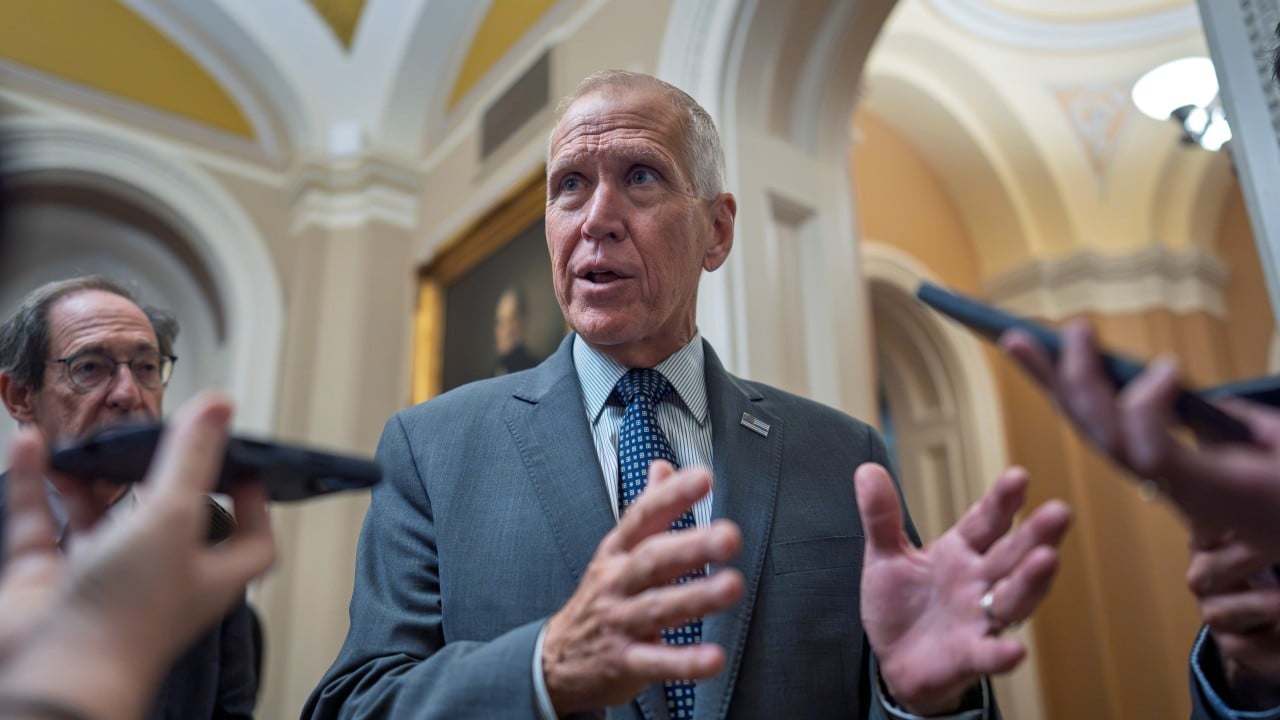
The air inside a Capitol Hill office building smells faintly of old carpet, wet wool, and the peculiar metallic tang of perpetual anxiety. It is late afternoon, and the light slanting through the tall, nineteenth-century windows hits a stack of classified memos sitting squarely on a mahogany desk. Senator Thom Tillis is reading. He is not smiling.
To the casual observer passing by on the street below, the machinery of government hums along at its usual, predictable cadence. Bills are introduced, committees convene, press releases are fired off into the digital ether like flares shot into a foggy night. But inside this room, the temperature is different. A quiet alarm has been pulled.
At the center of the alarm is something invisible, heavy, and slick: Russian diesel.
It smells of sulphur and combustion. It arrives not with a cinematic explosion, but through the dull, relentless clank of tanker hulls, the quiet shuffling of shell corporations in tax havens, and the clever re-routing of paperwork across international borders. For months, a shadow trade has operated in the background of global sanctions, slipping refined petroleum products through the back doors of international commerce. And now, a prominent Republican senator has stood up to say the quiet part out loud.
This deal might just be illegal.
To understand why this matters, you have to look past the dense fog of geopolitical acronyms and think about how a gallon of fuel actually moves across the earth. Imagine sitting on a cargo ship in the middle of a dark, salt-crusted sea. Beneath your feet sit millions of gallons of dark, amber liquid pumped from Siberian wells, refined in obscure ports, and then rebranded on paper until its passport says something completely different.
Sanctions are supposed to be walls. Solid, unyielding, heavy masonry designed to starve an aggressor of the hard currency needed to fund a war machine. But sanctions, as it turns out, are often written by humans who live in a world of words, while the people moving the oil live in a world of loopholes.
When a nation faces total economic isolation, its financial blood seeks out capillaries. It finds intermediaries in third-party countries—nations that smile politely at Western diplomats by day while stamping shipping manifests by night. The diesel is blended. The origin certificates are shuffled. By the time the fuel reaches a terminal where it can be burned by heavy machinery or trucks, its Russian DNA has been scrubbed clean by a dozen layers of legal fiction.
Or so the brokers hoped.
Senator Tillis did not pull the fire alarm because of a sudden bureaucratic hunch. He did it because the architecture of American foreign policy rests on a fragile, sacred trust: that when Congress draws a red line, the executive branch—regardless of who sits in the Oval Office—cannot simply look the other way while commercial convenience redraws the map.
There is a human cost to these paper transactions that never shows up on a stock ticker.
Consider a farmer in eastern Europe or a factory worker in an industrial town whose livelihood is directly tethered to the price of energy. Every time a tanker slips through the net of sanctions, it depresses the market price through illicit supply, undercutting legitimate producers who are playing by the rules. It rewards the clever accountant over the honest competitor. Worse still, every barrel of fuel that finds a clandestine buyer keeps the lights on for a state budget that relies entirely on extraction and conflict.
The mechanics of this evasion rely on what financial investigators call laundering origin. It is not unlike washing cash, except instead of moving dirty money through a chain of fraudulent real estate purchases, you are moving physical hydrocarbons through a daisy chain of intermediaries.
Ship A picks up diesel in a Russian port. In the middle of international waters, it executes a ship-to-ship transfer with Ship B. Or perhaps the fuel is offloaded into coastal tanks in a neutral nation, mixed with a ten percent splash of locally refined product, and certified as a new blend. Legally, under certain poorly drafted statutes, the mixture is no longer strictly Russian. Economically, it still lines the same pockets.
It is a shell game played with billions of dollars of combustible liquid.
When a senior lawmaker steps forward to challenge this arrangement, it creates a fascinating friction between two competing forces in modern governance: the cold logic of global supply chains that demand efficiency at any moral cost, and the rigid, unyielding demands of national security law.
The administration caught in the middle of this controversy faces an agonizing choice. Crack down too hard on every complex maritime trade route, and you risk choking global energy supplies, sending prices soaring at the neighborhood gas pump right before an election cycle. Look the other way, and you signal to every adversary on the planet that American sanctions are merely suggestions, written in disappearing ink.
This is the invisible tightrope of modern superpower politics. Every policy decision is a compromise between what is ethically pure and what is physically survivable for an energy-dependent electorate.
Yet, history suggests that ignoring the cracks in the foundation never works out in the long run. When illegal trade routes are normalized because they are too difficult or too politically costly to close, the rule of law slowly hollows out from the inside. It stops being a shield and starts being a hurdle for the unsophisticated while remaining an open door for the well-connected.
The memos on the mahogany desk in Washington will eventually be filed away. New crises will crowd the headlines tomorrow morning—a banking collapse, a diplomatic spat, a sudden shift in public outrage.
Yet out on the dark water, far from the polished marble floors of the Capitol, the tankers keep moving. Their engines thrum a deep, mechanical bass note against the hull. The pumps hiss as millions of gallons of contested fuel flow quietly from one containment cell to another, waiting for the paperwork to catch up, or to be rewritten entirely.