The coffee in the Tanjong Pagar district still smells of roasted beans and ambition, but the conversation at the corner tables has shifted. It used to be about property prices or the next vacation to Hokkaido. Now, it is about the "Ghost."
This ghost doesn't haunt hallways; it haunts hard drives. It is the silent, efficient specter of Generative AI. For a mid-level analyst named Wei—a hypothetical but very real representation of thousands in Singapore’s financial heart—the anxiety isn't a sudden explosion. It’s a slow leak. He watches a software demo that does in six seconds what used to take him six hours. He feels the floor tilting. He wonders if he is the last of a species. Read more on a similar issue: this related article.
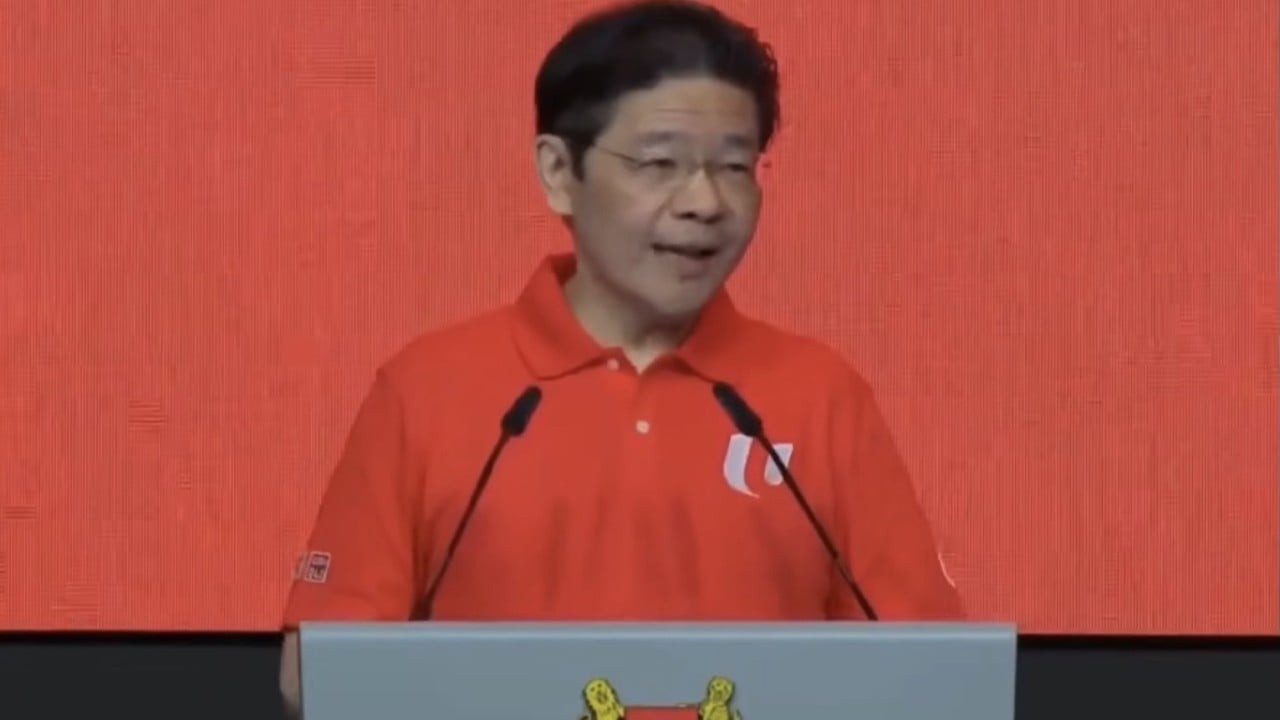
This is the visceral backdrop against which Prime Minister Lawrence Wong recently stepped to the podium. He wasn't just delivering a policy update; he was attempting to steady the heart rate of a nation.
The Architecture of Anxiety
Fear is rarely about the present. It is almost always a debt we settle with a future that hasn't happened yet. In Singapore, a city-state that built its entire identity on being the most efficient human machine on earth, the arrival of a more efficient digital machine feels like a personal affront. Additional analysis by USA Today delves into similar perspectives on the subject.
When Lawrence Wong spoke at the recent Singapore National Trades Union Congress (NTUC) delegates’ conference, he addressed this directly. He didn't offer the usual platitudes. He acknowledged a hard truth: the era of "learn once, work forever" is dead. It isn't just coming to an end; it has been buried.
The Prime Minister’s message was anchored in a specific, staggering reality. We are looking at a world where task automation could impact 40% of global employment. In a compact, hyper-connected hub like Singapore, that percentage feels less like a statistic and more like a weather warning.
Consider the "Wei" in this story again. If his value is based on his ability to aggregate data, he is obsolete. If his value is based on his ability to judge that data, to navigate the office politics of its implementation, and to apply a uniquely Singaporean cultural lens to a global problem, he is indispensable.
The Safety Net is Now a Trampoline
Government intervention usually sounds like a dull thud of bureaucracy. But the strategy outlined by Wong is an attempt to turn a safety net into something kinetic.
The centerpiece is the SkillsFuture Level-Up Programme. It’s a dry name for a radical idea. The government is essentially betting billions of dollars that a forty-year-old accountant can be "re-coded" as successfully as a piece of software. They are providing a $4,000 credit for mid-career workers to pivot.
But money is the easy part. The psychological hurdle is much higher.
Imagine being fifty years old. You have spent three decades mastering the nuances of logistics. You are the master of the port, the wizard of the warehouse. Suddenly, you are told to go back to a classroom. You are sitting next to a twenty-two-year-old who speaks the language of Python and Large Language Models as if it were their mother tongue.
The Prime Minister’s promise is that the state will shoulder the risk of this vulnerability. He spoke of temporary financial support for those who are involuntarily unemployed—a significant shift for a government that has historically been wary of anything resembling a traditional welfare check. This is "Train-and-Place," a deliberate attempt to bridge the gap between the job that died yesterday and the one that will be born tomorrow.
The Human Premium
The real tension lies in what AI cannot do. It cannot care. It cannot feel the weight of a high-stakes negotiation. It cannot understand the subtle "low-context" communication required in a multicultural boardroom.
Wong’s narrative is that Singapore must double down on the "Human Premium." By leaning into AI, the country isn't trying to out-calculate the machines. It is trying to automate the mundane so that the citizenry can focus on the "high-touch" sectors: healthcare, specialized education, and complex strategic leadership.
But there is a catch. There is always a catch.
The transition is messy. It involves what economists call "frictional unemployment," but what a family man calls "not being able to pay the mortgage for six months." The Prime Minister’s vow is to shorten that friction. The government is working with the NTUC to ensure that the workers aren't just retrained, but matched. It is a massive, nationwide game of musical chairs where the government is trying to add chairs faster than the music stops.
The Invisible Stakes
If Singapore fails at this, it isn't just an economic hiccup. It is an existential crisis. Without natural resources, the "Resource" has always been the people. If the people become mismatched with the global economy, the city-state's engine stalls.
Wong is navigating a paradox. He must encourage the adoption of AI to keep Singapore competitive on the world stage, while simultaneously protecting the people who might be crushed by that very adoption. It is a tightrope walk over a digital abyss.
He pointed to the "Majulah Package" and other social supports as evidence that the government isn't leaving the "Weis" of the world behind. But he was also clear: the government can provide the map and the boots, but the worker has to do the hiking.
The strategy is a mix of paternalism and rugged individualism. It says: We will not let you fall, but we will demand that you change.
The New Social Contract
We often think of progress as a straight line. It’s actually a series of breaks and repairs.
In the 1970s, Singaporean workers had to learn how to operate heavy machinery. In the 1990s, they had to learn how to use desktop computers. Today, they have to learn how to coexist with an intelligence that doesn't sleep, doesn't eat, and doesn't ask for a raise.
The fear in the coffee shops is real because the change is fundamental. But the Prime Minister’s stance suggests that the most valuable asset in the age of AI isn't technical skill—it’s adaptability.
He is betting that the same grit that turned a swampy outpost into a global financial hub can be repurposed. He is betting on the resilience of the auntie in the marketing department and the uncle in the logistics firm.
The Ghost in the Cubicle is only terrifying if you are trying to do what the ghost does. If you do what only a human can—empathize, create, and lead—the ghost becomes a tool. A very powerful, very fast tool.
As the sun sets over the Marina Bay skyline, the lights in the office towers flicker on. Thousands of people are still at their desks, typing, thinking, and worrying. The promise from the podium is that those lights will stay on, not because the machines have taken over, but because the people have found a new way to shine.
The transition isn't a glitch in the system. It is the new system.
The floor isn't tilting; it's just being rebuilt while we stand on it.