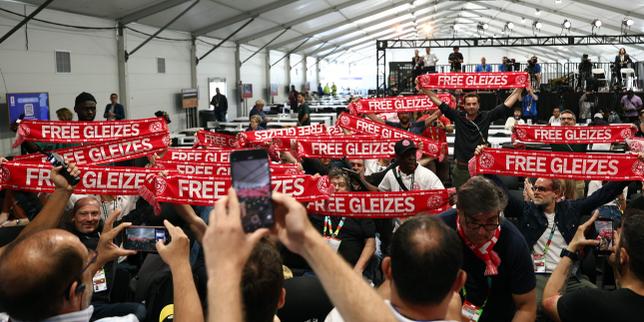
The intersection of international sports administration and state-level judicial actions creates a highly volatile leverage dynamic. When France National Football Team Manager Didier Deschamps publicly addresses the detention of journalist Christophe Gleizes in Algeria on the eve of the 2026 World Cup, the statement cannot be evaluated merely as an act of personal solidarity. It operates as a calculated deployment of soft power capital designed to alter the strategic calculus of a sovereign state.
Understanding this friction requires breaking down the structural mechanisms that govern international sports diplomacy, state sovereignty, and the operational boundaries of global media during major athletic tournaments. The tension between FIFA’s regulatory framework and state-level judicial autonomy creates predictable bottlenecks that sports federations and national governments must navigate.
The Three Pillars of Soft Power Leverage
The efficacy of a high-profile sports figure intervening in a diplomatic dispute rests on three distinct variables. When these variables align, they exert specific, quantifiable pressure on state actors.
The Audience Reach Multiplier
National team managers during a World Cup cycle possess a direct communication channel to global demographics that standard diplomatic cables cannot replicate. A press conference statement bypasses traditional, slow-moving diplomatic protocols, forcing an immediate public relations assessment by the hosting or detaining state.The Institutional Shield
Governing bodies like FIFA operate on principles of non-interference, yet their commercial success depends on the unhindered operations of the press. When a prominent figure aligns with a detained journalist, it forces the sporting institution to choose between protecting its corporate partnerships (media rights holders) and maintaining its neutrality posture with host or partner nations.The Nationalist Sentiment Feedback Loop
In the home nation (in this case, France), domestic pressure intensifies on elected officials to escalate bilateral talks. What began as a judicial or journalistic dispute rapidly converts into a core component of bilateral foreign policy.
The Judicial Cost Function of Sovereign Detentions
States that detain foreign journalists during high-profile sporting events operate under a specific cost function. The decision to maintain detention vs. releasing the individual is a calculation of diminishing returns.
The cost to the detaining state scales according to the formula of international scrutiny:
$$C = I \cdot (T + S)$$
Where:
- $C$ is the total political cost to the detaining nation.
- $I$ is the intensity of global media coverage (amplified by figures like Deschamps).
- $T$ is the proximity to the sporting event's peak viewership window.
- $S$ is the strategic value of the bilateral agreements currently under negotiation between the two nations.
When $C$ exceeds the domestic political utility of holding the journalist, the state typically transitions to a face-saving exit strategy, such as expedited deportations or conditional pardons. However, if the state perceives the public intervention as a direct threat to its internal sovereignty, the domestic utility increases, leading to a prolonged judicial stalemate. This creates a strategic bottleneck where public statements can unintentionally lengthen detention periods if they are framed as foreign interference.
Structural Vulnerabilities in Global Sports Journalism
The detention of a journalist like Christophe Gleizes highlights a structural flaw in how international sporting events are organized and covered. Media accreditation processes are managed by sporting federations, but physical safety and legal protections remain entirely under the jurisdiction of host or transit nations.
- The Accreditation Paradox: FIFA or UEFA credentials grant access to stadiums and mixed zones, but offer zero legal immunity or fast-track diplomatic assistance outside the venue perimeter.
- Jurisdictional Dissociation: Media corporations send staff into regions based on sporting schedules rather than geopolitical risk assessments, leaving journalists exposed to local legal frameworks that may view investigative journalism as espionage or state destabilization.
The second limitation is the lack of a standardized escalation protocol within sports federations. When a journalist is detained, federations typically issue generic statements regarding press freedom rather than utilizing their ultimate lever: the threat of revoking hosting rights or canceling commercial broadcasts within the offending nation.
Strategic Implications for the 2026 World Cup Cycle
The timing of this diplomatic friction, coinciding with the 2026 World Cup cycle, alters the risk matrix for all participating federations. It establishes a precedent where sporting figures are increasingly expected to act as geopolitical proxies. This shift forces a reorganization of how national teams prepare for international tournaments.
Federations must now incorporate geopolitical risk management into their operational blueprints. This involves establishing direct lines of communication with embassies prior to team deployments, creating crisis management protocols for media cohorts, and training staff on the precise legal boundaries of the host nations.
The tactical response to these crises requires a dual-track approach. While public figures like team managers apply external pressure via the media to raise the political cost of detention, background diplomatic channels must simultaneously offer the detaining state a viable mechanism for de-escalation that does not signal domestic weakness. The failure to coordinate these two tracks results in prolonged legal gridlock, neutralizing the efficacy of the initial public intervention.