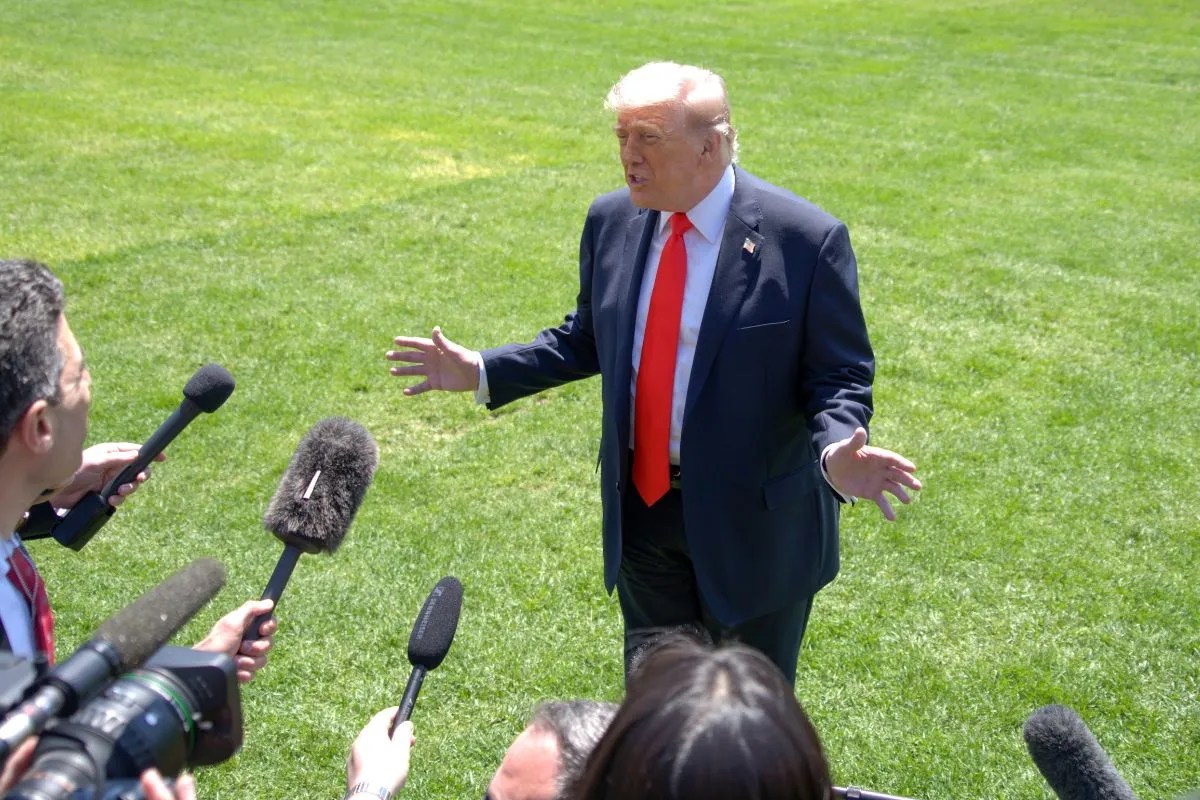
Donald Trump has broken his silence on the sudden resignation of British Prime Minister Keir Starmer, delivering a characteristically blunt assessment that exposes deep-seated fractures within the North Atlantic Treaty Organization (NATO). Speaking from his Mar-a-Lago resort shortly after Downing Street announced Starmer’s departure, Trump stated plainly that the British leader "was not good with us on NATO," signalling a rocky road ahead for Anglo-American defense relations. This sharp critique goes far beyond standard political posturing. It reveals how the Trump team views European defense contributions, defense spending thresholds, and the future of transatlantic security agreements.
The immediate reaction from Washington underscores a fundamental shift in how American leadership evaluates its closest allies. Starmer’s brief tenure as Prime Minister was marked by mounting domestic economic pressures and a cautious approach to defense modernization, choices that clearly drew the ire of the former U.S. President. By explicitly linking Starmer's political exit to a failure of cooperation within NATO, Trump is setting a clear benchmark for any future British administration.
The Real Numbers Driving the Transatlantic Rift
Defense spending has become the ultimate metric of loyalty in modern geopolitics. For decades, American administrations have quietly grumbled about European nations free-riding on the U.S. military umbrella. Trump merely brought this grievance into the open, transforming a bureaucratic dispute into a core foreign policy test.
The baseline requirement for NATO members is a defense budget of at least 2% of their Gross Domestic Product (GDP). While the United Kingdom has historically met this threshold, the internal composition of its spending tells a very different story. Starmer's government faced severe budgetary constraints, leading to delays in upgrading heavy armor capabilities and cutting back on personnel numbers to balance the books.
From the perspective of Trump's defense advisors, a nation meeting the 2% target on paper while hollowing out its actual fighting force is insufficient. The U.S. military establishment measures capability in deployable battalions, advanced logistics, and ready stockpiles, not creative accounting in London.
How the Strategic Divergence Widened
The friction between Trump's inner circle and Starmer’s administration did not happen overnight. It was forged over months of differing priorities regarding global flashpoints, particularly the allocation of resources between Eastern Europe and the Indo-Pacific theatre.
Starmer prioritized regional European stability, advocating for sustained, conventional financial aid packages to counter Russian gray-zone warfare. Conversely, Trump's geopolitical strategy demands that European powers take primary ownership of their own continent's defense, freeing up American naval and air assets to counter industrial and military expansion in Asia.
This is where the breakdown occurred. When Washington looked for London to lead a massive, independent European defense coalition, Starmer’s team hesitated, preferring to act only under the explicit cover of broader, U.S.-led initiatives. That hesitation was interpreted by Trump as a lack of resolve, a sign that the UK was unwilling to carry its weight as a top-tier global power.
The Myth of the Special Relationship
The phrase "Special Relationship" has long been used by British politicians as a security blanket to comfort voters. It is mostly a illusion. Outside of deep intelligence sharing through the Five Eyes framework and shared nuclear propulsion technology, the relationship is entirely transactional.
When a British Prime Minister fails to align with Washington's primary strategic objectives, the warmth evaporates instantly. Trump’s public dismissal of Starmer’s legacy proves that historical sentimentality offers no protection against perceived strategic weakness.
UK Defense Spending vs. NATO Commitments
--------------------------------------------------
Official Budget Status: Above 2% GDP Threshold
Actual Status: Delayed procurement, reduced troop counts
U.S. Expectation: Independent, deployable expeditionary forces
The British political class often misreads American political rhetoric as mere theater. It is a dangerous mistake. The demand for structural reform within NATO is a bipartisan reality in Washington, even if Trump delivers the message with a sledgehammer rather than a diplomatic note.
The Burden of Choice for Downing Street's Next Tenant
Starmer’s successor inherits a broken economy and a deeply skeptical American ally. The next British Prime Minister cannot simply repeat old talking points about shared values and historical bonds forged in the twentieth century.
To repair the bridge with a potential second Trump administration, London must make hard, politically unpopular choices.
- Accelerate procurement timelines for conventional naval vessels capable of autonomous deployment.
- End the reduction of regular army personnel, stabilizing troop numbers to ensure credible deterrence.
- Shift industrial policy to rapidly produce artillery ammunition and drone systems independent of American supply chains.
These actions require capital that the British state currently struggles to find. Yet, the alternative is strategic irrelevance. If the UK is viewed as an ineffective military partner, its influence over American foreign policy drops to zero.
Reality Check on the Nuclear Deterrent
The ultimate test of British sovereignty remains its independent nuclear deterrent, which is entirely reliant on American-made Trident missiles. This dependency creates a massive vulnerability that Washington can exploit whenever it feels London is drifting off course.
While no U.S. president would openly cut off access to these weapons systems, subtle bureaucratic delays in technical support or component upgrades can send a chilling message through the Ministry of Defence. Trump’s public critique of Starmer serves as a reminder of this asymmetric power dynamic.
European security cannot be sustained on the assumption that American taxpayers will indefinitely fund the frontline defense of wealthy democracies. The era of strategic ambiguity is over. By targeting Starmer’s NATO track record so swiftly after his fall, Trump has signaled that the price of American partnership has gone up, and the invoice must be paid in hard military capability, not diplomatic platitudes.

/https://tf-cmsv2-smithsonianmag-media.s3.amazonaws.com/filer/c6/97/c697b065-e0bd-4970-81ea-819779296b91/u765404inp.jpg)
