The domestic consolidation of executive power in an contested state is directly proportional to its structural vulnerability to external architecture. Prime Minister Nikol Pashinyan’s declaration of a "historic victory" in the June 2026 Armenian parliamentary elections—where the ruling Civil Contract party secured approximately 51% of the vote across early counting thresholds—cannot be evaluated as a standard democratic endorsement. It is a strategic calculation executed by an electorate operating under conditions of asymmetric security options. By defeating the pro-Russian infrastructure led by billionaire Samvel Karapetyan's Strong Armenia coalition (23%) and former President Robert Kocharyan's Armenia Alliance, the Armenian electorate has formally approved an institutional shift away from the Russian federation toward a Western security framework.
This outcome maps out a critical baseline for small-state survival strategies in the post-Soviet space. The structural reality of this election is not a domestic preference for economic liberalization, but an explicit attempt to recalculate Armenia's security cost function following the total collapse of its legacy security architecture between 2020 and 2023.
The Dual-Driver Model of Voter Preferences
The voting behavior observed in the 2026 legislative elections operates on two distinct analytical tracks, which mainstream media accounts often conflate into a single narrative of democratic resilience.
The Security Deterrence Variable
The primary driver of the Civil Contract party’s performance is the institutionalization of fear regarding an existential conflict renewal with Azerbaijan. During the campaign cycle, the executive branch framed the choices through a binary matrix: compliance with the 2025 Western-mediated peace protocol or a return to hot warfare under conditions where regional allies offer zero military deterrence. By voting for the incumbent administration, the electorate opted for a controlled diplomatic retreat and territorial stabilization over the high-risk, revisionist security promises offered by the pro-Russian opposition.
The Sovereign Realignment Premium
The second variable is the systemic disillusionment with the Collective Security Treaty Organization (CSTO). The failure of legacy treaties to protect sovereign Armenian borders during cross-border incursions shifted the public's perception of Russian alignment from an asset into an active strategic liability. Pashinyan’s pivot—characterized by joint military exercises with Western forces, the suspension of active CSTO participation, and the signing of the 2025 peace protocol under United States auspices—was validated by voters who view European and American diplomatic integration as the sole viable counterweight to regional isolation.
Structural Bottlenecks in the Opposition's Counter-Strategy
The failure of the opposition coalitions to capture the legislative majority, despite widespread national trauma following the loss of Nagorno-Karabakh in 2023, stems from a fundamental structural flaw in their value proposition. The opposition failed to solve the collective action problem due to two primary vulnerabilities:
- The Oligarchical Trust Deficit: Strong Armenia, under Samvel Karapetyan, and the Armenia Alliance, under Robert Kocharyan, relied heavily on legacy political machinery and elite economic networks. This created a credibility bottleneck. The electorate perceived their platform not as a genuine security alternative, but as a mechanism designed to restore pre-2018 oligarchic monopolies and subvert sovereign decision-making back to Moscow.
- The Absence of a Viable Alternative Security Blueprint: The opposition’s core thesis rested on the assumption that a pro-Russian realignment would instantly restore Armenia's defensive capabilities. However, this argument ignored Russia's long-term geopolitical commitments elsewhere and its shifting strategic partnerships in the South Caucasus. Because the opposition could not guarantee that Moscow would actively deploy military power to defend Armenian borders against future incursions, their policy platform dissolved into unquantifiable rhetoric.
The Strategic Trilemma of Post-Election Yerevan
The absolute legislative majority won by Civil Contract provides Pashinyan with the legal mechanisms required to execute deep institutional changes, potentially including the constitutional amendments necessary to finalize the peace treaty with Azerbaijan. However, the administration now faces a classic strategic trilemma, where it can simultaneously optimize for only two of the following three policy objectives:
- Rapid Western Security Integration: Accelerating deeper diplomatic, economic, and institutional alignment with the European Union and the United States.
- Mitigation of Russian Asymmetric Retaliation: Preventing Moscow from utilizing its massive economic levers within Armenia to destabilize the state.
- Domestic Political Stability: Maintaining internal cohesion and managing a highly polarized populace, along with state institutions like the judiciary and security apparatus that retain legacy elements.
The Mechanics of Economic Interdependence
The structural limitation of Pashinyan’s pro-Western pivot is found in the economic plumbing of the Armenian state. Western alignment cannot immediately substitute for the physical and financial dependencies currently managed by the Russian Federation. The vulnerability profile includes three critical sectors:
- Energy Infrastructure: Armenia’s domestic energy grid remains deeply dependent on Russian fuel supplies and state-backed management networks, including the Metsamor nuclear power plant and natural gas imports.
- Trade Integration: The country remains a formal member of the Eurasian Economic Union (EAEU). A abrupt severance of trade ties would immediately jeopardize Armenia's export markets and trigger severe inflationary shocks within the domestic consumer base.
- Remittance Flows: Financial transfers from the Armenian diaspora residing in Russia form a significant pillar of the domestic liquidity engine. Disruptions to these banking channels would depress household consumption levels.
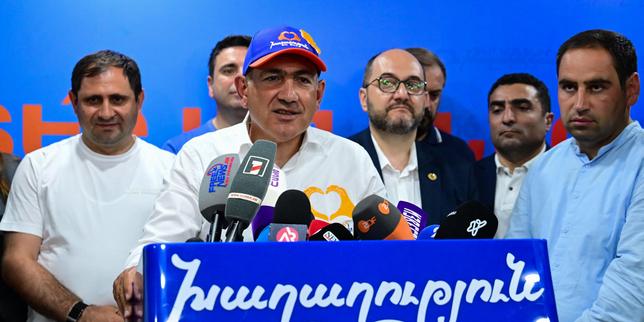
Pashinyan explicitly acknowledged these structural dependencies during his victory press conference, noting that his administration intends to pursue European rapprochement while paradoxically maintaining EAEU membership and regular relations with Russia. This dual-track stance represents an attempt to manage a highly volatile transitional phase, rather than a permanent grand strategy.
Tactical Implementation and Risk Mitigation
To convert this electoral mandate into durable state stability, the executive branch must shift from campaign rhetoric to institutional engineering. The strategic play requires a systematic diversification of the state's vulnerability profile.
Rather than attempting an immediate, high-risk exit from regional trade blocs, the administration must quietly build parallel economic and regulatory architectures. This involves upgrading transport infrastructure to align with the Middle Corridor initiatives, harmonizing domestic customs protocols with European Union frameworks to attract non-aligned foreign direct investment, and securing Western technical assistance to modernize the defensive capabilities of the armed forces.
Simultaneously, the administration must utilize its legislative dominance to implement strict transparency and anti-corruption standards across the state apparatus. This institutional hardening is vital to reduce the leverage points that external actors can exploit to trigger domestic political crises. The survival of the state depends entirely on its capacity to manage its structural dependencies while incrementally shifting its geopolitical weight to a more balanced equilibrium.