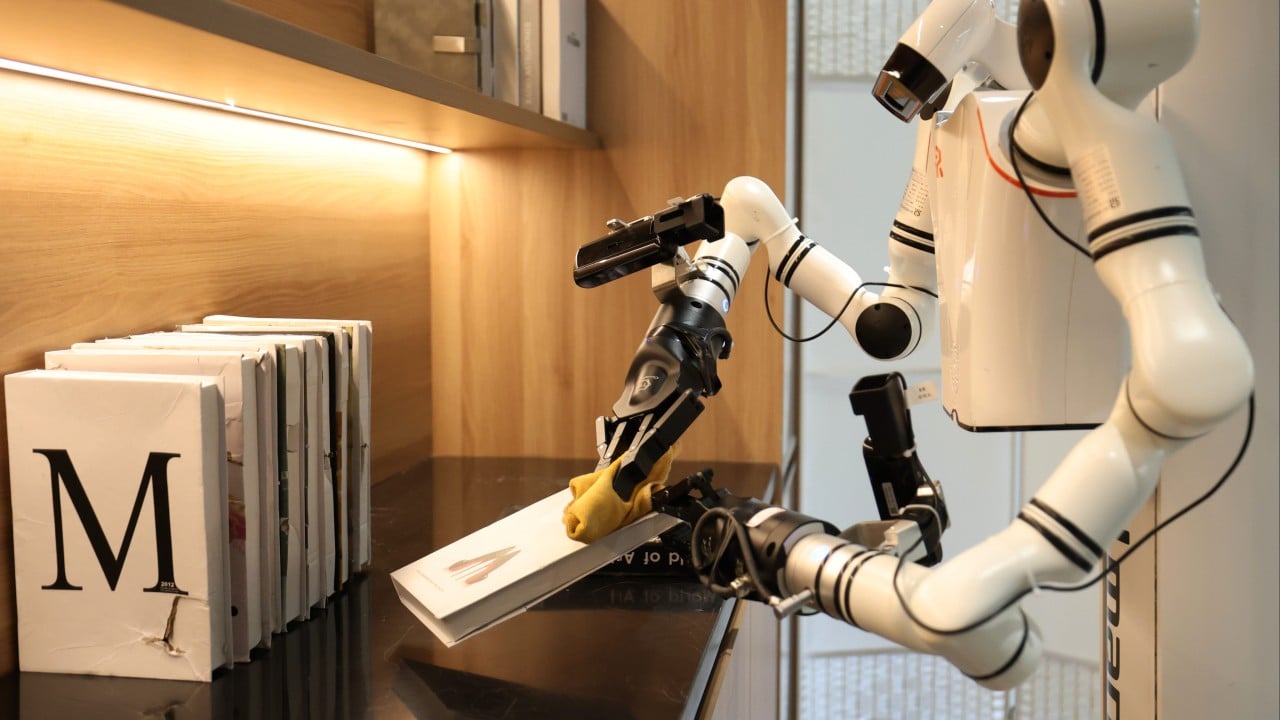
You want a humanoid robot to clean your kitchen, fold your laundry, and make your bed. It sounds amazing. But here is the problem: your house is an absolute nightmare for artificial intelligence.
Unlike a predictable car factory floor where everything stays in exact, pre-measured spots, a family home is pure, unadulterated chaos. Toys move. Someone leaves a coffee mug on the edge of a counter. The dog falls asleep in the hallway. For a robot, navigating this changing environment without breaking a glass or stepping on a cat is an incredibly complex engineering challenge.
Building a physical test house and buying thousands of different couches, blenders, and clothing items to train a bot is far too expensive. Testing them in real families right away leads to smashed plates and injured pets.
That is why a major shift just happened. Researchers from ACE ROBOTICS, partnering with the Multimedia Laboratory at The Chinese University of Hong Kong and the Shenzhen Loop Area Institute, just released a massive platform called Kairos-HomeWorld. They built a system that generates entire, simulated 3D houses from simple text prompts, giving embodied AI a safe, infinite digital playground to learn how to be a useful butler before ever stepping foot into a real living room.
The Problem With Training Bots in Single Rooms
Until now, simulating a home for a robot looked like a video game with terrible loading screens. Software could render a pretty good kitchen or a realistic bedroom, but it struggled with a whole house. The layout lacked global consistency. The robot would learn how to pick up a plate in an isolated digital kitchen, but it had no idea how to navigate from that kitchen, down a tight hallway, and into the dining room while carrying the dish.
Worse yet, most digital training spaces were static. The robot could look at a cabinet, but it could not open the door, pull out a frying pan, or feel the weight of a heavy iron.
Kairos-HomeWorld changes this by focusing on whole-home simulation. Every single object inside these AI-generated structures can be manipulated. We are talking about physics-enabled assets. When the robot grabs a bottle of laundry detergent in the virtual world, the simulation calculates the fluid dynamics of pouring it. When it pulls a curtain, the digital fabric bends and bunches realistically.
The researchers did not just build a clever engine; they open-sourced a massive dataset tailored to actual, messy living conditions. It includes 300,000 real residential floor plans sourced from actual real estate listings. They turned these into 5,000 fully furnished, simulation-ready homes containing 50,000 interactive object assets.
Real Data Beats Laboratory Perfection
A common mistake Western robotics companies make is training models in sterile, spacious, American-style suburban layouts. The Chinese research team took a highly localized approach. The 300,000 floor plans map out tight studio apartments of 30 square meters up to larger 200-square-meter flats.
They deliberately included tight architectural quirks common in regional housing stock: north-south cross-ventilated layouts, cramped enclosed kitchens, dedicated service balconies, wet-and-dry-separated bathrooms, and irregular room configurations found in older buildings.
Why does this matter? Because a robot trained in a wide-open, minimalist lab will fail the second you put it in a real apartment where an entryway storage bin blocks half the door frame.
Through this system, a single natural-language instruction like "tidy the whole home" gets broken down by the robot's brain into a massive sequence of smaller tasks. The bot plans an efficient route across multiple rooms, opens the fridge, avoids a misplaced chair, and handles irregular objects without a human programmer writing a single line of step-by-step code.
Training For Near Zero Dollars
If you train a physical prototype robot in a physical building, the costs are staggering. The bot trips over a rug, breaks an expensive television, and suddenly you are out thousands of dollars. The site operation, maintenance, and constant furniture replacement slow down development to a crawl.
Virtual training drops the marginal cost of creating a new training scenario to basically zero. If a robot drops a virtual glass or smash-drives into a digital wall while trying to figure out its own arm strength, you just hit reset.
This virtual rehearsal significantly shortens what engineers call the simulation-to-reality transfer cycle. The robot refines its neural network over millions of virtual repetitions in a fraction of the time it would take in the physical world. Once it hits an 87% or 90% success rate in the brutal digital environments, the software gets flashed onto a physical machine like the wheeled, two-armed humanoids currently popping up in pilot programs across cities like Wuhan and Shanghai.
What You Should Do Next
If you are building software for automation, hardware systems, or simply trying to understand where the future of domestic labor is heading, stop ignoring simulation data. The era of manual robot programming is dead.
Go to GitHub and look directly at the open-source Kairos-HomeWorld repository. Download the floor plan datasets and analyze how the multi-stage automated pipeline structures spatial data. If you are developing embodied AI, start testing your models against dense object layouts rather than empty digital rooms. The companies that scale their training virtual environments the fastest will be the ones delivering functioning, safe robotic help to your doorstep before the end of the decade.
To see how these virtual training concepts translate into actual physical hardware being tested on the streets and in households today, check out this breakdown of China's Two-Brain AI Robot Development. It explains how companies are combining AI reasoning with physical sensors to build stable, real-world systems.