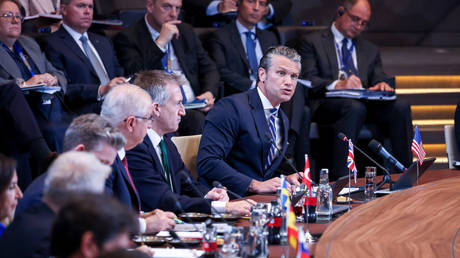
The media is treating the US Secretary of War’s leaked, profanity-laced tirade against NATO’s European allies like a diplomatic catastrophe. They call it "shameful." They call it a "unilateral fracturing of the Western alliance." They spin it as a terrifying sign that the American security umbrella is about to fold.
They are entirely wrong.
The lazy consensus among foreign policy talking heads is that NATO functions best when everyone is smiling, shaking hands, and signing vague communiqués about "shared values." That is a dangerous fairy tale. NATO is not a book club. It is a treaty of mutual defense, and right now, Washington's public fury is the only mechanism left that can actually force Europe to defend itself.
The outrage over the Secretary's comments misses the underlying mechanics of modern geopolitics. For three decades, Western Europe has treated American military might as a free public utility. The explosive rhetoric coming out of the Pentagon isn't a breakdown of the alliance; it is a long-overdue market correction.
The Free-Rider Delusion
Let’s dismantle the foundational myth of modern transatlantic relations: the idea that European defense spending is a matter of polite domestic policy.
In 2014, NATO members pledged to spend at least 2% of their Gross Domestic Product (GDP) on defense within a decade. Ten years later, a staggering number of European nations are still playing accounting tricks to hit that bare-minimum threshold. They count pensions, border security, and civil defense assets just to make their spreadsheets look palatable to Washington.
I have spent years sitting in rooms with defense procurement officials in Brussels and Berlin. The open secret is always the same: European capitals intentionally underfund their conventional militaries because they know the US taxpayer will always foot the bill for the heavy logistics, the satellite intelligence, and the strategic airlift capacity.
Imagine a scenario where a corporate subsidiary refuses to pay its share of the infrastructure costs, relies entirely on the parent company's capital, and then acts shocked when the CEO screams at them during an annual review. That is NATO today.
When the US Secretary of War calls out this behavior as "shameful," he isn't destroying the alliance. He is injecting reality into an echo chamber. The threat of American abandonment is the only leverage Washington possesses to break Europe's addiction to strategic laziness.
The False Premium of Diplomatic Politeness
Mainstream commentators love to ask: Why couldn't this be handled behind closed doors? Doesn't public infighting embolden adversaries?
This question fundamentally misunderstands how European domestic politics operates. Private warnings from American diplomats do not move the needle in European parliaments. If a US general quietly tells a European defense minister that their ammunition stockpiles are depleted, that minister files the report away. Why? Because spending billions on artillery shells means cutting spending on social programs or infrastructure—actions that alienate voters.
Public humiliation changes the political calculus.
When Washington publicly berates its allies, it forces the defense debate onto the front pages of European newspapers. It makes it impossible for prime ministers to pretend everything is fine. It transforms defense spending from an abstract foreign policy debate into a critical domestic crisis.
Consider the alternative. For decades, successive US administrations tried the "polite" approach. They coaxed, they nudged, they expressed "gentle concern." The result? European readiness plummeted to historic lows, leaving fleets of fighter jets grounded for lack of spare parts and submarine crews unable to deploy. Politeness failed. Raw, unvarnished pressure is the only tool that has ever yielded results.
The Mechanical Reality of Deterrence
True deterrence requires raw, operational capability—not diplomatic harmony.
Our adversaries do not look at NATO and wonder if the leaders like each other. They look at the order of battle. They count the number of combat-ready brigades, the readiness rate of fifth-generation fighters, and the depth of precision-guided munition stockpiles.
Right now, if the United States removed its logistical spine from Europe, the continent would struggle to sustain a high-intensity conventional conflict for more than a few weeks. European defense networks are a mismatched jigsaw puzzle of competing industrial interests. France wants to protect its domestic aerospace sector; Germany wants to shield its tank manufacturers; smaller nations just want to buy off-the-shelf American hardware to save a buck.
This fragmentation creates massive inefficiencies. NATO Europe spends over 100 billion dollars annually on defense, yet it possesses a fraction of the deployable combat power of the United States because of redundant supply chains and national protectionism.
Washington’s anger acts as a brutal forcing function. By threatening to pull the plug, the US is forcing European states to consider joint procurement, standardized ammunition stocks, and genuine military integration. The fear of an angry America is a far more powerful unifying force than the love of a shared democratic ideology.
The Risk of the Status Quo
There is a distinct downside to this high-stakes strategy. If Washington pushes too hard, it risks triggering a nationalist backlash where European publics demand a complete decoupling from American leadership before their own militaries are equipped to handle the fallout. It is a knife-edge walk.
But staying the course with the old, polite consensus is a guaranteed path to obsolescence. A NATO where America does 80% of the heavy lifting while Europe offers thoughts and prayers is a paper tiger.
Stop hand-wringing over a video of a cabinet secretary losing his temper. The anger is real, it is justified, and it is the only thing standing between the Western alliance and total strategic decay.
Europe needs to buy its own bullets. Washington needs to keep screaming until they do.