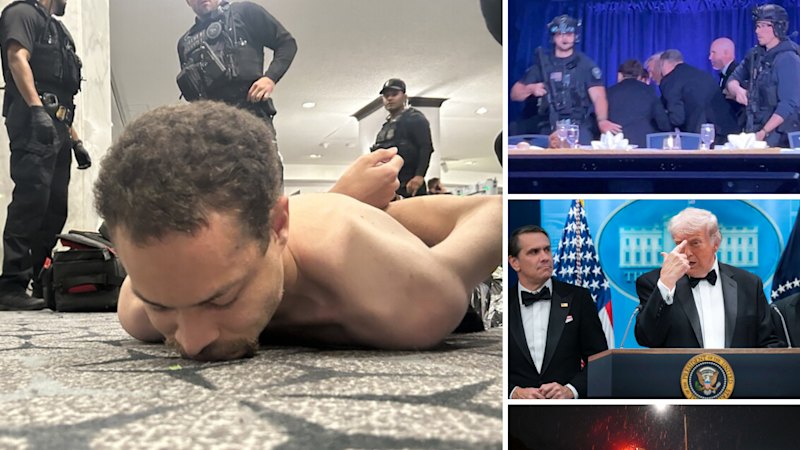
The arrest of a man identifying himself as the "Friendly Federal Assassin" has exposed a terrifying breach in the psychological and physical defenses surrounding the American executive branch. This was not a random act of chaotic violence. According to the recovered 132-page manifesto, the individual systematically planned a campaign to liquidate high-ranking officials from the Trump administration. The document outlines a chillingly methodical approach to political violence, suggesting the suspect spent months tracking the movements of former cabinet members and advisors. This development represents more than just a single criminal case. It is a siren for an era where the lines between political dissent and targeted insurgency have blurred into a bloody smear.
The manifesto, which authorities are currently scrubbed for mentions of accomplices, reveals a mind convinced that extrajudicial killing was a civic duty. It is a document rooted in a twisted sense of altruism. The suspect believed that by removing specific "architects of policy," he would be saving the Republic from itself. This "friendly" moniker is the most disturbing element. It points to a shooter who viewed himself not as a villain, but as a surgeon performing a necessary, if gruesome, operation on the body politic.
Beyond the Lone Wolf Myth
Law enforcement has a habit of using the "lone wolf" label to soothe public anxiety. It implies that the threat begins and ends with one broken individual. That is a lie. While the suspect may have acted alone in the tactical sense, his motivations were fed by a vast, interconnected ecosystem of radicalization. We are looking at a decentralized radicalization process that requires no formal command structure.
The "Friendly Federal Assassin" manifesto reads like a curated collection of the most vitriolic corners of the internet. It borrows rhetoric from across the ideological spectrum, blending anti-authoritarianism with specific grievances against the previous administration's border and economic policies. This isn't the work of a man who snapped. This is the work of a man who was built, piece by piece, by a digital environment that rewards escalation.
When we examine the "how" behind this plot, the failures of the intelligence community become glaring. The suspect reportedly used encrypted platforms to document his surveillance of targets. He frequented public events where former officials appeared, blending into the crowd with a mundane appearance that defied the traditional profile of a threat. He was hiding in plain sight because the criteria for "suspicious behavior" have become outdated in an age where the enemy looks exactly like the neighbor who mows your lawn.
The Architecture of a Manifesto
The document itself is divided into sections that mimic military field manuals. This was a deliberate choice to provide the suspect with a sense of professional legitimacy.
- Target Selection Criteria: The suspect prioritized officials based on their perceived proximity to "core policy decisions." He didn't just want famous names; he wanted the people who wrote the memos.
- Tactical Logistics: Detailed notes on the response times of the Secret Service and private security details. He understood the "bubble" better than most analysts.
- The Moral Justification: A repetitive, circular logic arguing that because "the system" failed to provide accountability, the individual must become the judge, jury, and executioner.
This third point is where the real danger lies. When a segment of the population decides that the judiciary is no longer a viable path for justice, violence becomes the only remaining currency. The "Friendly Federal Assassin" saw himself as a debt collector for a bankrupt political system.
The Secret Service at a Breaking Point
We have to talk about the resources. Protecting a former president is a massive undertaking, but protecting an entire constellation of former cabinet members and high-level staffers is a logistical nightmare. The Secret Service is already stretched thin. They are fighting a war of attrition against an infinite number of potential threats with a finite number of agents.
The suspect's manifesto specifically mentioned "gaps in transition security." This refers to the period when an official leaves office and their government-funded security detail expires. Most former officials rely on private security, which is often ill-equipped to handle a dedicated, ideologically driven assassin. The suspect knew this. He waited for the transition to occur, targeting individuals exactly when their professional shield was at its thinnest.
This strategy reveals a sophisticated understanding of the bureaucracy of protection. It wasn't just about finding a target; it was about finding the target at their most vulnerable moment in time. If we don't address the security of the broader administrative apparatus, we are essentially leaving a trail of breadcrumbs for the next "assassin" to follow.
The Failure of Digital Deradicalization
Social media companies will claim they are doing everything possible to remove "extremist content." They are lying, or at the very least, they are failing. The suspect in this case didn't just find these ideas; he was served them by algorithms designed to maximize engagement.
Anger is the most engaging emotion. The "Friendly Federal Assassin" was a power user of platforms that funnel users from mainstream political disagreement into dark, violent fantasies of retribution. We are currently operating in an environment where the most extreme voices are given the loudest microphones. This creates a feedback loop where the individual feels justified because their digital surroundings echo their worst impulses.
To fix this, we need to stop looking at content in isolation and start looking at the systems that distribute it. It isn't just about the manifesto; it's about the ten thousand posts that led to the manifesto. We are treating the symptom while the infection is allowed to run wild through the digital bloodstream.
The Cost of Political Dehumanization
There is a direct line between the language used by political leaders and the actions of the "Friendly Federal Assassin." When we describe political opponents as "existential threats," "enemies of the people," or "traitors," we are giving permission for violence.
The suspect's writings are littered with these exact phrases. He didn't see human beings; he saw obstacles. He saw "officials" who needed to be "removed." This dehumanization is a psychological prerequisite for murder. It allows the perpetrator to bypass their natural empathy and replace it with a sense of righteous mission.
We have reached a point where the rhetoric has outpaced the reality of our democratic institutions. If every election is a "battle for the soul of the nation," eventually someone is going to bring a gun to that battle. The "Friendly Federal Assassin" is just the first to claim the title. He won't be the last if the temperature of the national conversation remains at a boiling point.
A New Protocol for Domestic Protection
The traditional model of protection—putting a ring of men in suits around a person—is no longer sufficient. We need a proactive, data-driven approach to domestic security that identifies these threats before they reach the "manifesto" stage.
This involves:
- Extended Protection Cycles: Reevaluating how long former high-level officials receive federal protection based on the current threat environment rather than arbitrary dates on a calendar.
- Cross-Platform Intelligence Sharing: Breaking down the silos between tech companies and federal law enforcement to identify individuals who are escalating from rhetoric to tactical planning.
- Public Figure Safety Education: Training officials and their families to recognize the "pre-attack indicators" that the suspect in this case displayed for months.
The suspect was seen taking photos of a former official's home weeks before his arrest. Neighbors noticed, but they didn't report it because he looked "normal." We need to redefine what normal looks like in a high-threat environment.
The Radicalization of the Mundane
Perhaps the most terrifying aspect of the "Friendly Federal Assassin" is his utter lack of a criminal record. He was a productive member of society. He had a job, a mortgage, and a clean background check. He was not a fringe lunatic living in a bunker. He was a man who lived in a suburb and shopped at the same grocery stores as his targets.
This "radicalization of the mundane" means that the traditional methods of vetting—looking for past violence or gang affiliations—are useless. We are dealing with a new type of threat: the radicalized professional. This is a person who uses their intelligence, their resources, and their ability to blend in to plan atrocities.
The manifesto proves that the suspect used his professional skills to conduct his "investigation" into the Trump officials. He used public records, social media check-ins, and professional networking sites to build a map of his targets' lives. He didn't need a spy agency; he just needed a high-speed internet connection and a sense of purpose.
Closing the Gaps
The arrest prevented a tragedy, but it did not solve the problem. The "Friendly Federal Assassin" is a symptom of a deeper, systemic rot. We have a population that is increasingly comfortable with the idea of political violence, a security apparatus that is reactive rather than proactive, and a digital infrastructure that accelerates radicalization.
If we continue to treat these cases as isolated incidents of "madness," we are choosing to be blind. This wasn't madness. It was a logical conclusion drawn from a set of dangerous premises that are being broadcast to millions of people every day.
The next individual may not write a 132-page manifesto. They may not give themselves a catchy name. They may just act. We have been warned, and the warning was written in the words of a man who thought he was being a hero by becoming a killer.
The immediate priority must be a total audit of the security details for all former high-ranking officials. We cannot wait for the next "friendly" assassin to find a gap in the fence. Every day we delay is a day we allow the radicalization loop to continue its spin toward the next target.