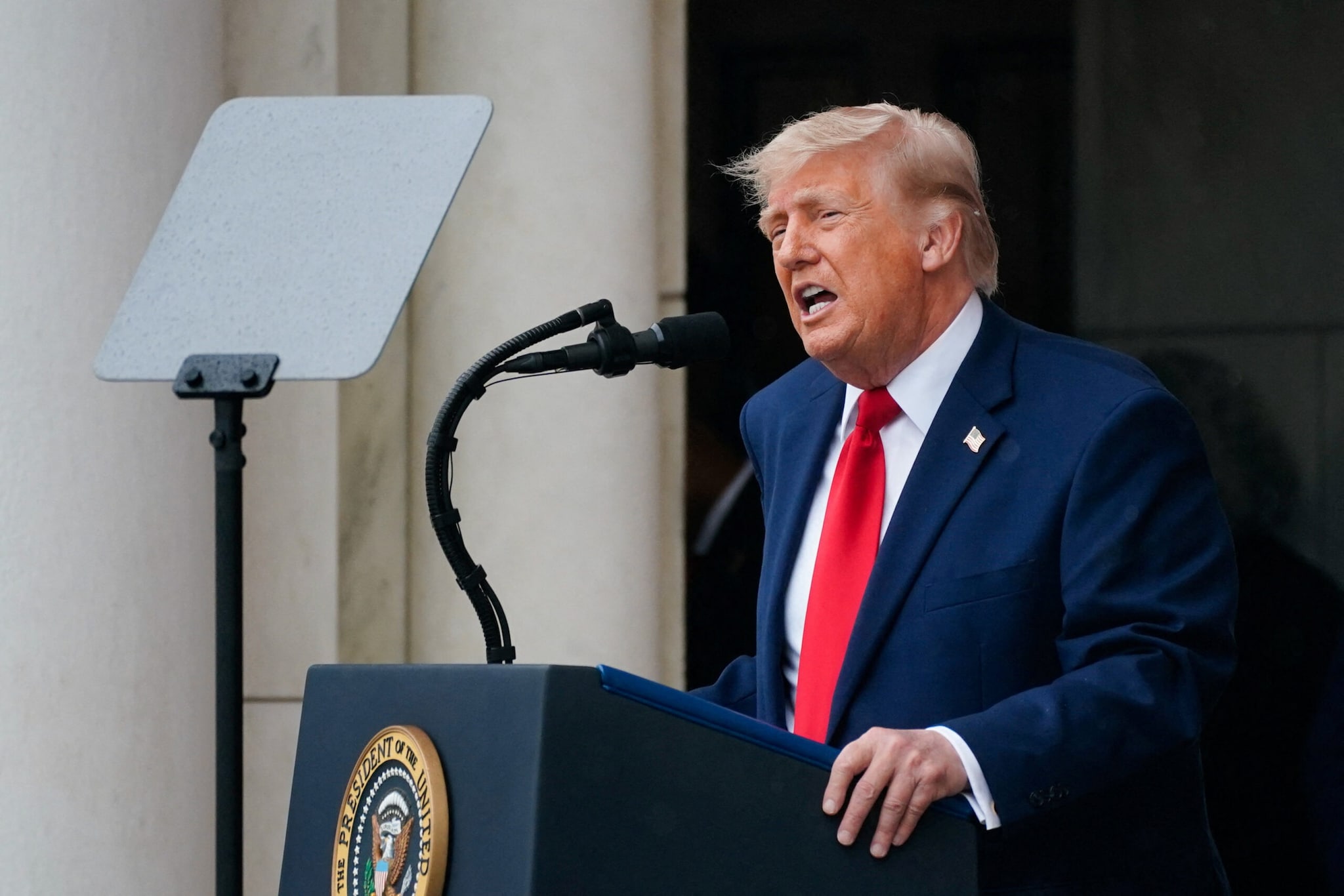
The teacup did not rattle, but the air in the room changed. It was late autumn in Washington, the kind of afternoon where the light dies early and leaves the windows looking like smoked glass. Across the desk, a retired career diplomat—a man who had spent thirty years watching the Middle East through the reinforced glass of various embassies—smoothed a crease in his trousers. He did not look at his phone. He did not need to. The news of Donald Trump’s latest tirade against Benjamin Netanyahu was already rippling through the secure channels, but to this man, the noise was just weather. The real story was the silence that followed it.
For years, the public narrative surrounding the alliance between Washington and Jerusalem was treated as a monolith. It was painted in the broad, unyielding strokes of eternal brotherhood and shared strategic destiny. But statesmanship is not a monument; it is a high-wire act performed in a gale. When Trump called the Israeli Prime Minister "crazy" and openly accused him of complicating peace talks with Iran, he did not create a rift. He merely pulled back the heavy velvet curtain to reveal a stage that had been rotting from moisture for a very long time.
Geopolitics, at its core, is not about treaties. It is about human friction. It is about two men sitting in rooms with bulletproof glass, realizing that their personal survival strategies are actively cannibalizing each other’s futures.
The Anatomy of an Outburst
To understand why a single word from a former and future president can send treasury bonds into a stutter and cause military commanders to redraw logistics maps, you have to look at the machinery of Middle Eastern diplomacy. It resembles a massive, interconnected clockwork gear system. Turn one wheel in Tel Aviv, and a pendulum swings in Tehran. Jam a wedge into the gear in Washington, and the entire apparatus groans under the sudden torque.
For decades, the standard playbook for American leaders was one of performative alignment. You air your grievances in secret, over secure satellite lines, while presenting a united front to the world. This discretion was not born out of politeness. It was a calculated tactic designed to deny adversaries any leverage. If Iran believes that the thread connecting the Pentagon to the Israeli Defense Forces is unbreakable, their calculus remains defensive.
Then came the blunt force of modern political rhetoric.
When the critique is delivered not through a diplomatic demarche but via a jagged public statement, the calculus shifts overnight. The accusation that Israel is actively sabotaging back-channel diplomacy with Iran changes the nature of the conversation. It suggests that the driver and the navigator are no longer looking at the same map.
Imagine a night flight through severe turbulence. The passengers are already white-knuckled, watching the wings flex against the dark. Suddenly, the captain leans over the intercom and shouts that the co-pilot is actively trying to steer the aircraft into a thunderhead. The panic that follows is not a reaction to the storm outside. It is the terrifying realization that the cockpit is a battleground.
The Invisible Stakes in the Sandbox
Behind the headlines lies a reality that rarely makes it to the evening broadcast. In the border towns along the northern ridge of Israel, where the wind smells of wild thyme and spent artillery casings, the macro-politics of Washington feel less like strategy and more like gravity. You cannot argue with it; you can only survive it.
A local councilman from a small community near the border once explained the geography of fear to me. He pointed to a ridge line less than two miles away, where the gray concrete outposts of a hostile militia cut into the sky.
"When Washington speaks clearly," he said, holding a cold cup of black coffee, "the ridge stays quiet. When Washington hesitates, or when the tone turns volatile, the ridge starts to test the fences. They want to see if the shield is still there, or if it has turned into glass."
This is the human cost of rhetorical volatility. It is measured in the sleepless nights of parents who listen to the sky, trying to distinguish between the rumble of a passing truck and the low drone of an incoming unmanned aircraft. When American leadership brands a key ally's strategy as erratic, it signals to every hostile actor in the region that the shield is vibrating.
The friction between Trump and Netanyahu is not merely a clash of oversized egos, though that is the easiest narrative to sell. It is a fundamental disagreement on the utility of leverage. The American perspective, particularly from the business-centric view of the Trump circle, views everything as a deal waiting to be closed. Everything is negotiable if you apply enough pressure to the right pressure points. Iran, in this view, is a bankrupt corporate entity that can be forced into a restructuring agreement if the terms are harsh enough.
The Israeli perspective, forged through decades of existential proximity, views the situation through a darker lens. To them, the adversary is not a corporation looking for a settlement; it is an ideological force that views time not in fiscal quarters, but in centuries. In that framework, a compromise is not a victory—it is a tactical pause before the next assault.
The Architecture of Miscalculation
Consider what happens next when the communication lines between allies begin to fray publicly.
In the highly stylized world of international relations, ambiguity is often used as a tool to prevent conflict. It is called strategic ambiguity. By leaving your exact reactions undefined, you force your opponent to prepare for the worst possible outcome, which often deters them from taking the first step.
But there is a point where ambiguity stops being strategic and starts becoming dangerous.
[Washington Rhetoric] ---> [Regional Uncertainty] ---> [Calculated Provocation]
          |                                                    |
          v                                                    v
[Allied Isolation]   <---   [Tactical Misjudgment]  <--- [Escalation Spiral]
When a superpower openly states that its primary ally is complicating peace, it creates a vacuum. History abhors a vacuum, but geopolitics despises it. Into that empty space steps miscalculation.
A commander in Tehran, reading the transcripts of American political rallies, might reasonably conclude that the operational green light has turned amber, or perhaps even red. They might calculate that a limited strike or a maritime provocation in the Strait of Hormuz will not trigger a joint American-Israeli response. They might believe the partner in Washington will stand down, content to let its "crazy" ally fend for itself.
That is how regional wars begin. Not with a grand declaration, but with a middle manager in an intelligence agency making a logical deduction based on a public insult.
The tragedy of this dynamic is that it isolates the very people who have the least say in the matter. The civilian populations on both sides of the divide become hostages to the rhetoric. For an Israeli family in Ashkelon or an Iranian student in Isfahan, the grand pronouncements from Western capitals are not talking points for Sunday morning news shows. They are environmental hazards, like a sudden drop in barometric pressure before a cyclone.
The Long Shadow of the Deal
The diplomat in Washington finally reached for his tea, but it had gone cold. He looked out at the streetlights flickering on along the avenue.
"The problem with treating foreign policy like a real estate transaction," he said softly, "is that you can't walk away from the property if the negotiation falls through. You are stuck living in the house, even if the roof is on fire."
The assertion that Israel is complicating peace talks with Iran assumes that a stable peace was a viable commodity on the shelf, ready to be purchased. It ignores the decades of scar tissue, the proxy networks stretching from Yemen to Lebanon, and the fundamental reality that some conflicts are not problems to be solved, but conditions to be managed.
When the rhetoric from the American leadership shifts from strategic partnership to public recrimination, it does not incentivize the Israeli leadership to become more compliant. It does the exact opposite. It forces them into a corner. A leadership that believes it can no longer rely implicitly on the American umbrella will inevitably take more drastic, unilateral actions to ensure its own survival. They will strike harder, move faster, and consult less.
The very outcome that Washington seeks to avoid—an uncontrolled escalation that drags American forces back into the sands of the Middle East—becomes more likely the more the alliance is publicly questioned.
The real story of the West Asia crisis is not found in the transcripts of political rallies or the digital noise of social media feeds. It is found in the quiet rooms where analysts look at satellite imagery and realize that the margins for error have just shrunk to the width of a razor blade. It is found in the sudden, heavy silence of a diplomatic corps that realizes the old rules no longer apply, and the new ones are being written in real-time by men who value the spectacle more than the structure.
The sun went down completely, turning the smoked glass of the window into a mirror. In the reflection, the room looked small, fragile, and entirely at the mercy of the dark outside.