In the summer of 2021, amidst the diplomatic theater of the Tokyo Olympics, Emmanuel Macron carried a message that did not exist on paper, a hard drive, or a secure server. It was tucked away in a tiny vial of liquid, encoded within the molecular structure of synthetic DNA. This wasn't a stunt for a sci-fi convention. It was a high-stakes demonstration of a technology that could soon replace the crumbling infrastructure of our global data centers. While the world watched the opening ceremonies, the French government was testing a storage medium designed to last fifty thousand years without a single watt of electricity.
The mission, dubbed "DNA Data Storage," involved the French National Archives and the startup Biomemory. They successfully encoded two historic documents—the Declaration of the Rights of Man and of the Citizen and the Declaration of the Rights of Woman and of the Female Citizen—into bio-compatible strands. The message traveled from Paris to Tokyo, was sequenced, and read back with perfect accuracy. It proved that biological material can function as the ultimate cold-storage vault.
The Physical Limits of Silicon
We are currently drowning in a data deluge that our hardware cannot sustain. Every photograph, every legal brief, and every encrypted government cable requires physical space and massive amounts of energy to maintain. Current magnetic and optical storage media—the hard drives and tapes that form the backbone of the "cloud"—have a terrifyingly short lifespan. They degrade. They require migration every five to ten years to avoid "bit rot."
Synthetic DNA changes the math entirely. DNA is the most compact and durable information storage system in the known universe. You could, theoretically, store the entirety of the internet in a shoebox-sized container of DNA. While a hard drive fails if it gets too hot or a magnet passes over it, DNA recovered from the teeth of mammoths proves that biological data stays readable for millennia if kept cool and dry.
How a Liquid Becomes a Hard Drive
Computers speak in binary, a series of 0s and 1s. DNA speaks in a quaternary code consisting of four bases: Adenine (A), Cytosine (C), Guanine (G), and Thymine (T). To move a message from a computer to a vial, the binary code is translated into these genetic "letters" through a software algorithm.
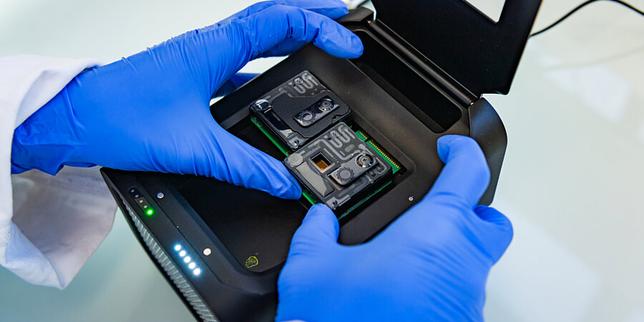
Once the sequence is designed, the "writing" process begins. This is chemical synthesis. Instead of burning pits into a disc with a laser, scientists build a custom strand of DNA from scratch, base by base. The result is a dry powder or a liquid solution containing billions of copies of the data. To read it back, you use a standard DNA sequencer—the same technology used for medical diagnostics or ancestry tests—and a computer translates the A, C, G, and T back into 1s and 0s.
The Macron mission used this exact pipeline. It was a proof of concept designed to show that the "liquid archives" could survive international transport and the rigors of real-world diplomatic logistics.
The Cost of Eternal Memory
If DNA storage is so superior, why aren't we using it to back up our personal laptops? The answer is the brutal reality of economics. Writing DNA is currently orders of magnitude more expensive than writing to a traditional server. Synthesis is a slow, painstaking chemical process. Reading the data—sequencing—is faster but still requires specialized laboratory equipment.
We are in the "mainframe era" of biological computing. In the 1950s, a computer took up an entire room and cost a fortune. Today, DNA storage is reserved for "cold data"—information that must be preserved for centuries but rarely accessed. The French National Archives are the perfect use case. They have documents that must survive through the next several civilizations. DNA offers them a way to "set it and forget it" without worrying about the power grid failing or a specific file format becoming obsolete.
The Energy Crisis Behind the Cloud
Data centers currently consume about 2% of the world’s electricity. By 2030, some estimates suggest that number could jump to 8% or more. This is an environmental catastrophe disguised as digital convenience. DNA storage requires zero energy for maintenance. Once the data is encoded and bottled, it sits on a shelf. It doesn't hum. It doesn't need a cooling fan. It doesn't need to be plugged in.
For a country like France, which prides itself on both its cultural heritage and its push toward "Green Tech," the Tokyo mission was a calculated branding move. It positioned the Republic as the leader in a post-silicon world.
Security and the Bio-Digital Frontier
The use of DNA for a "secret message" between Paris and Tokyo also raises significant security questions. How do you intercept a message that looks like a drop of water? Traditional signals intelligence (SIGINT) relies on monitoring radio waves, fiber optic cables, and satellite links. A vial of DNA is a different animal. It can be hidden in a perfume bottle, mixed into a beverage, or dried onto a piece of paper.
This creates a new theater for espionage. If a diplomat is carrying a biological sample, they are effectively carrying a high-capacity encrypted drive that is invisible to X-ray machines and traditional electronic sweeps. The "message" is only "secret" if the adversary doesn't know what to look for—or how to sequence it.
The Problem of Latency
The biggest technical hurdle remains the speed of access. You cannot "stream" from a DNA drive. It can take hours or days to retrieve a specific file, synthesize the primers, and run the sequencing. This makes it useless for daily tasks. However, as an insurance policy against a global electromagnetic pulse (EMP) or a total collapse of the digital infrastructure, it is peerless.
The French Strategy
The Macron administration isn't just playing with science kits. This is part of a broader industrial strategy to achieve "technological sovereignty." By investing in Biomemory and other biotech firms, France is attempting to break the American and Chinese stranglehold on data infrastructure. If the future of data isn't in silicon chips manufactured in Taiwan but in biological sequences synthesized in Paris, the geopolitical balance shifts.
The Tokyo mission was a flare sent up to the rest of the world. It signaled that France considers the preservation of information a matter of national security. When the digital records of our current era eventually crumble—and they will, as hard drives demagnetize and cloud providers go bankrupt—the messages stored in DNA will remain.
We are entering an era where the boundary between the biological and the digital is dissolving. The message Macron sent to Japan wasn't just a salute to history; it was a blueprint for how the human record might survive the eventual death of the machine. The vial in Tokyo was small, but the implications are heavy enough to sink the current tech industry.
Instead of building bigger fans to cool hotter chips, the smart money is moving toward the molecular. The next great library of Alexandria won't be a building or a server farm. It will be a collection of glass vials, silent and indestructible, holding the sum of human knowledge in a few drops of clear liquid.
Ensure your long-term data strategy accounts for the inevitable failure of magnetic media.