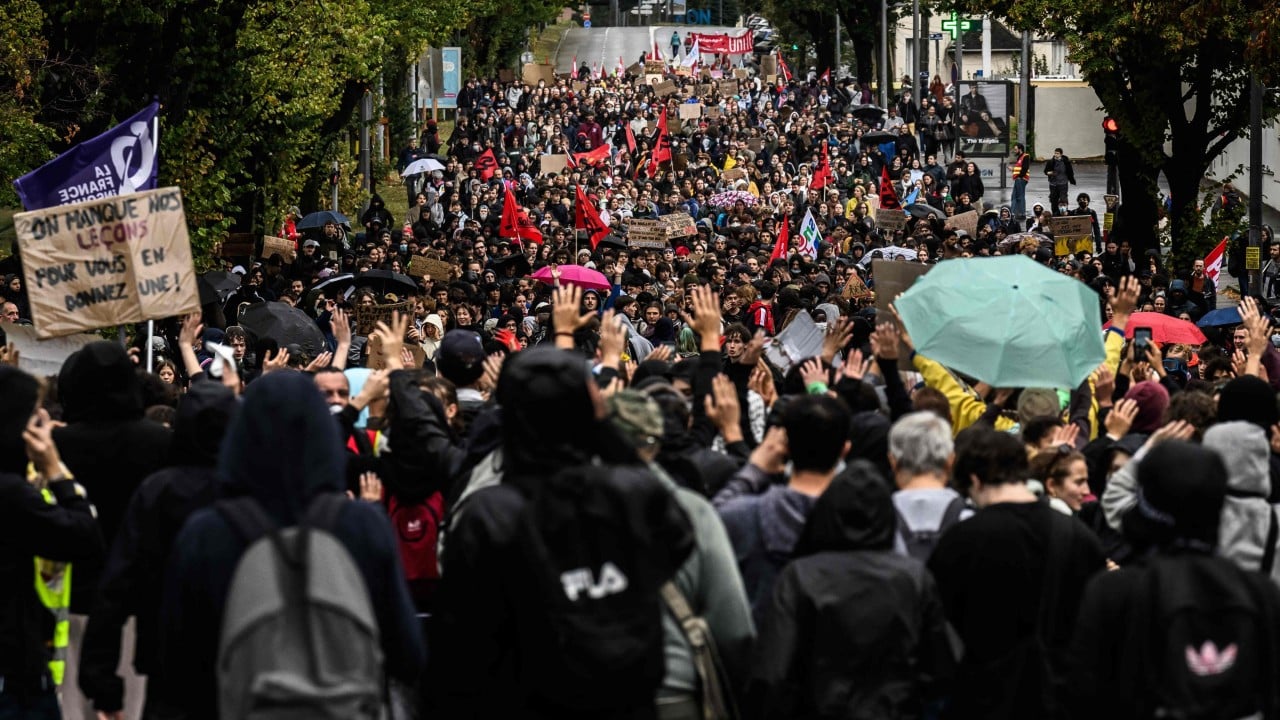
The media framing on French high school blockades is predictable to the point of comedy. Turn on any news broadcast or read the standard wire copy, and you get the same fainting-couch hysteria. Riot cops, burning bins, tear gas, and earnest commentators wringing their hands over lost instructional hours and civic disorder. The narrative always runs down a well-worn track: unruly teenagers disrupting education, stubborn unions holding the republic hostage, and a government desperately trying to restore order against the forces of chaos.
It is a lazy, surface-level diagnosis that completely misses the structural reality of modern institutional failure.
Everyone treats these blockades as an anomaly, a temporary bout of adolescent lawlessness that can be resolved with enough CRS riot police and a reassuring prime ministerial address. That view requires a willful blindness to what is actually happening in French classrooms and the broader European labor market. These kids are not throwing garbage bins into the street because they hate algebra. They are barricading school gates because they have run the numbers on a social contract that broke decades ago, and they refuse to play a rigged game.
When you look at the mechanics of youth unemployment, credential inflation, and the systematic dismantling of the French welfare state, the blockades are not a breakdown of order. They are the only functional form of collective bargaining left.
Let us drop the civic romanticism for a second. The standard mainstream argument goes something like this: education is the great equalizer, disruptions hurt the poorest students the most, and legitimate grievances must be channeled through institutional mechanisms like student councils and parliamentary debate.
It sounds wonderful in a high school civics textbook. In the real world, institutional mechanisms in France have become shock absorbers designed to cushion the political class from the consequences of their own policy choices. I have watched successive administrations push through pension overhauls, curriculum changes, and labor flexibilization packages while treating public feedback as an administrative nuisance to be managed rather than a constraint to be respected.
When every official channel of protest is engineered to absorb dissent without changing direction, disruption ceases to be a bug. It becomes the entire operating system.
Consider what these students are actually facing. We have spent thirty years telling every teenager that if they just collect enough generic certifications, university degrees, and vocational diplomas, a stable middle-class existence awaits at the finish line. It is a lie. Credential inflation has turned a master's degree into a baseline requirement for entry-level administrative work, while the actual pathways to wealth have narrowed into a tight bottleneck of generational capital and elite grandes écoles.
When a sixteen-year-old in a working-class banlieue looks at the labor market, they do not see a meritocracy. They see an economy that offers precarious gig work, stagnant starting wages, and an retirement age pushed so far into the distance that it looks like a mirage. The students blockading their lycées are performing a brutally accurate cost-benefit analysis. Why sacrifice your present for a credential that devalues by five percent every year, managed by a state that treats your future as a line item to be balanced?
The standard counter-argument from institutional defenders is that blockades infringe on the rights of other students who want to learn. It is a clever rhetorical trap designed to pit the working class against itself. But let us be honest about what the modern classroom is often preparing these kids for: compliance, debt, and managed disappointment.
To call a blockade anti-education is to fundamentally misunderstand what education has become under the thumb of bureaucratic state planning. A school that teaches you how to pass standardized exams while ignoring the structural collapse of your society is not educating you. It is domesticating you.
When students stack trash cans against the entrance of a building, they are performing a very specific kind of economic calculation. They are imposing a cost on the system. Economists call this an externality. Governments hate it because externalities force them to pay attention to populations they would otherwise prefer to ignore. A peaceful march with permitted routes and police escorts is easy to schedule around and even easier to ignore on the evening news. A burning tire at the entrance of a high school in Seine-Saint-Denis disrupts the economic flow of the neighborhood, forces parents to scramble for childcare, and guarantees that the prefect cannot pretend everything is fine.
Disruption works because polite dissent is dead. If you want proof, look at what happens to polite dissent in Paris. Millions of people march peacefully against pension reforms, fill the boulevards from Place de la République to Nation, and the government simply waits for them to get tired and go home before ramming the legislation through using constitutional shortcuts like Article 49.3.
The state taught these kids a very clear lesson: reason does not move the machinery of power; leverage does.
Now, let us address the inevitable critique from the law-and-order crowd. Does this cause collateral damage? Absolutely. Small business owners near the schools take a hit. Stressed parents lose working hours. Firefighters have to deal with reckless arson. I am not romanticizing every element of street theater; riots can be brutal, stupid, and destructive to the very communities that stage them.
Yet blaming the teenagers for the violence of the blockade is like blaming the thermometer for the fever. The fever is caused by a generation of political leaders who treat public services like a balance sheet to be hacked apart to satisfy European Union fiscal targets. When you defund local services, crowd classrooms to thirty-five students, and degrade the value of public diplomas, you should not be shocked when the pressure valve blows.
What makes the French student movement unique—and terrifying to technocrats—is its historical memory. France possesses a political DNA that remembers 1968, 1995, and 2006. The ruling class understands that a high school blockade is never just about high schools. It is the dry run for a general societal blockage. It tests whether the young can mobilize their older siblings, their parents in the transport sector, and the broader labor unions into a unified front.
That is why the state responds with such disproportionate police force. It is not about protecting calculus class. It is about protecting the monopoly on state authority.
If you want to fix the problem, stop blaming the kids for rebelling against a dead-end future, and start fixing the future they are rebelling against. Lower the cost of living, stop treating housing like an exclusive hedge fund for the wealthy, restore funding to public technical tracks that actually lead to stable trades, and stop pretending that every economic crisis can be solved by making people work until they drop.
Until then, expect more blockades. Expect more burning bins. And expect a political class that continues to wonder why nobody is listening to them, right up until the gates come down.