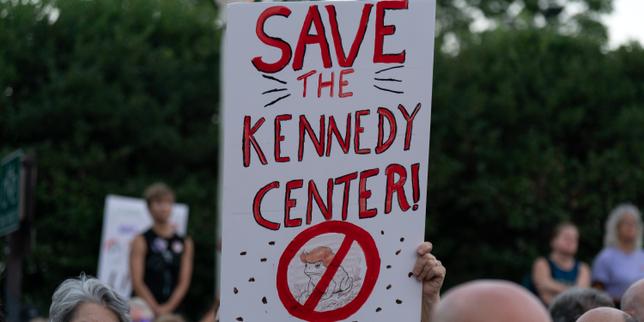
The hand-wringing over Donald Trump and the Kennedy Center is a masterclass in missing the point. When foreign commentators look across the Atlantic and shriek that American political interference spells doom for institutional culture, they reveal a profound misunderstanding of how art actually survives and mutates. The lazy consensus is that state-backed institutional fortress walls protect creativity from the barbarians at the gates.
Absolute nonsense.
I have spent decades watching arts administrators in Paris panic every time a budget gets slashed or a political shift threatens their grant money. They act as though state funding is the oxygen of culture. It is not. It is a sedative. When you tie an artist’s livelihood to the bureaucratic whims of a ministry, you do not get a flourishing avant-garde. You get compliance. You get a sterile, self-referential ecosystem designed to appeal to committees in government offices rather than human beings in the real world.
The panic over the Kennedy Center assumes that American cultural institutions operate like European ones. They do not. American philanthropy and board-driven governance have always been volatile, messy, and fiercely contested. But that volatility forces artists to look outward, to audiences, to patrons, to friction. In France, the state acts as an eternal wet nurse. The result is an institutionalized cultural monoculture where risk is treated as a hazard rather than the entire point of the enterprise.
Let us dismantle the core myth: that political pressure on a landmark venue destroys its artistic soul. The truth is that institutional culture in France was already neutralized long ago—not by politicians with wrecking balls, but by accountants with spreadsheets and bureaucrats with rubber stamps.
When a theater or an opera house receives ninety percent of its operating budget from the state, the audience stops being a patron and becomes a statistical checkbox. The director does not need to sell tickets; they need to check boxes for diversity metrics, regional outreach, and ideological compliance mandated by the latest decree from the Rue de Valois. That is not freedom. That is state-sanctioned mediocrity wrapped in red velvet.
Look at the history of modern art. It was never born in committee rooms funded by taxpayers. It was born in the margins, in the friction between rebellious creators and hostile markets, in cabarets, garages, and underground presses. Every great artistic movement of the past two centuries thrived despite the cultural elite, never because of them.
The French model treats culture like a public utility, akin to sewage treatment or electricity distribution. But art is not water. The moment you sanitize it, subsidize every seat, and insulate producers from the consequences of empty houses, you kill the urgency. Why take a genuine risk when the subsidy check clears regardless of whether anyone showed up?
To understand why institutions rot, you have to look at the incentives. A private venue owner who misreads the public goes broke. A state-funded director who alienates ninety percent of the population simply writes a longer grant proposal explaining that the audience was too uneducated to appreciate the brilliance of the production. That arrogance is a direct byproduct of guaranteed funding.
Critics of American political appointments to cultural boards love to paint a picture of pristine artistic independence being soiled by crude political actors. This ignores the reality of how European boards operate. They are packed with political appointees, former ministers, and corporate cronies handpicked by the ruling party. The ideology is simply more polite, more whispered, and infinitely more entrenched. At least in the American system, the meddling is transparent and prone to pushback. In France, the capture of culture by the state apparatus is so total that most people don't even notice the cage.
Imagine a scenario where every major national theater, orchestra, and museum in France was forced to survive on box office revenue and voluntary donations for three years. Half of the bloated administrative staff would vanish in month one. The endless cycles of self-congratulatory festivals that serve no one except the participants would evaporate. And the artists left standing would suddenly remember how to talk to human beings instead of patrons in government ministries.
The fear of political interference is a convenient smokescreen. It allows the cultural establishment to pretend that their decline is caused by external enemies rather than internal rot. When an institution becomes so brittle that a change in political administration threatens its entire existence, the institution was already dead. It was a monument to past glory kept on life support by public funds.
Stop mourning the death of state-supported sanctuaries. True art does not need a sanctuary. It needs a battlefield. The sooner European cultural institutions are thrown into the cold water of economic reality, the sooner we will see a revival of actual creativity instead of state-approved wallpaper.
Culture is not protected by preserving the museum. It is saved by burning it down and starting over in the streets.


