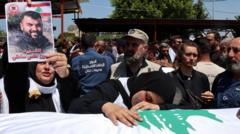
The guns were supposed to fall silent across the Litani River, yet the soil of southern Lebanon remains stained with fresh blood. In the days following the high-profile announcement of a cessation of hostilities, dozens of Lebanese civilians and security personnel have been killed in a series of targeted Israeli strikes. This is not a failure of diplomacy in the traditional sense. It is the result of a deliberate, aggressive interpretation of "enforcement" that has effectively turned a peace agreement into a tactical pause for unilateral kinetic action. While the international community celebrated a diplomatic breakthrough, the reality on the ground has shifted from full-scale war to a deadly, sporadic policing action that ignores the basic protections of a truce.
The primary friction point lies in the ambiguity of the "right to respond." Under the terms brokered by international mediators, Israel maintains the authority to strike if it perceives a violation of the agreement by Hezbollah. However, the threshold for what constitutes a violation has become impossibly low. Moving a vehicle, returning to a damaged home in a "restricted zone," or even the presence of Lebanese Army personnel in certain border areas has triggered lethal force. This isn't just a breakdown in communication. It is a fundamental disagreement over who owns the space between the border and the river.
The Doctrine of Preemptive Enforcement
For decades, military doctrine centered on the idea that a ceasefire meant a total freeze of movement. Today, the Israeli Defense Forces (IDF) are operating under a different mandate. They are not waiting for a rocket launch to justify a strike. Instead, they are targeting what they describe as "infrastructure recovery"—a broad term that can include anything from a concrete mixer to a group of men clearing rubble near a former militant outpost.
When a strike hits a village like Nabatieh or a coastal town near Tyre, the official report often cites the presence of "terrorist elements." But the investigative reality frequently uncovers a different story. The victims are often displaced families attempting to salvage what remains of their lives before the winter rains set in. By treating any movement in the south as a potential security breach, the IDF has created a de facto "kill zone" that extends far beyond the immediate border fence.
This aggressive posture serves a dual purpose. First, it ensures that Hezbollah cannot easily re-establish its physical presence or tunnel networks. Second, it sends a psychological message to the Lebanese government that their sovereignty is conditional. The cost of this message, however, is measured in the lives of non-combatants who believed the televised promises of safety.
The Vanishing Role of the Lebanese State
Central to the ceasefire's long-term survival was the deployment of the Lebanese Armed Forces (LAF). They were meant to be the buffer, the legitimate state power that would replace the shadow government of the militia. Yet, in recent strikes, even the LAF has not been spared. When a national army is hit while trying to establish checkpoints or clear roads, the entire architecture of the deal begins to crumble.
The Lebanese government finds itself in a paralyzing vice. If they protest too loudly, they risk the total resumption of full-scale bombardment. If they remain silent, they lose the last shred of domestic credibility they possess. This vacuum of authority is where the violence thrives. Without a neutral arbiter capable of verifying "violations" in real-time, the word of the IDF becomes the law of the land.
The international monitoring committee, led by the United States and France, is designed to settle these disputes. But committees move at the speed of bureaucracy, while drones operate at the speed of light. By the time a complaint is filed and a meeting is convened, the funeral processions have already ended. The mechanism for peace is being outpaced by the technology of war.
The Intelligence Gap and the Civilian Toll
The most harrowing aspect of the recent killings is the apparent failure of precision. Modern warfare prides itself on "surgical" capabilities, yet when dozens die in a matter of days during a supposed period of calm, the surgery is failing. Investigative tracks show that many strikes are based on signal intelligence—the tracking of phones or radio frequencies—that may be months old.
Consider the case of a residential building leveled in the Bekaa Valley. The target may have been a mid-level commander who stayed there in August. If the strike occurs in December, after the ceasefire, the only people in that building are likely a family of six who rented it because their own home was destroyed. The logic of the strike remains consistent in a military database, but it is a moral and legal catastrophe in the context of a truce.
This intelligence lag creates a permanent state of danger for anyone who has ever had a tangential connection to the previous conflict. In the eyes of the targeting algorithms, there is no such thing as a "former" zone of interest. The war has simply slowed down, not stopped.
Economic Sabotage Through Kinetic Pressure
Beyond the immediate loss of life, there is a secondary, more subtle objective at play. Southern Lebanon is an agrarian heartland. Tobacco, olives, and citrus are the lifeblood of the local economy. By maintaining a high-intensity strike pattern during the ceasefire, the IDF effectively prevents the harvest. Farmers are too terrified to enter their fields, and the equipment needed for processing remains trapped in warehouses that are frequently targeted.
This is a form of economic warfare that bypasses the headlines. It doesn't look like a blockade, but the result is the same. If the south becomes uninhabitable not because of constant shelling, but because of the threat of a single, lethal strike at any moment, the population will eventually drift north. Depopulation is a tactical advantage for a military looking to create a permanent buffer zone. It turns the land into a lunar landscape where nothing moves without permission.
The Geopolitical Gamble
Israel is betting that the international community has no appetite for another round of condemnation. With the world's eyes often diverted toward other global flashpoints, the "low-level" violence in Lebanon is seen as an acceptable price for preventing a larger conflagration. It is a cold calculation. If fifty people die in a week during a ceasefire, it is viewed as a tragedy; if five thousand die in a day during a war, it is a crisis. By keeping the numbers just below the threshold of global outrage, the status quo of "violent peace" is maintained.
However, this gamble ignores the radicalization of the survivors. Every "mistake" or "enforcement strike" that kills a civilian provides the very recruitment material that the ceasefire was meant to eliminate. You cannot kill an ideology with a Hellfire missile if the missile itself is what gives the ideology its power.
The Architecture of a Failed Truce
The fundamental flaw in this agreement is the lack of a clear, shared definition of "hostile intent." To one side, hostile intent is a man carrying a shovel near a bunker. To the other, it is a drone hovering over a school. Without a synchronized understanding of these terms, the ceasefire is merely a period of unmonitored execution.
The strikes of the last few days have proven that a signature on a piece of paper in Washington or Paris means very little to a commander in a mobile operations center. They see targets, not treaties. They see threats, not neighbors. The shift from active combat to "ceasefire enforcement" has become a semantic cloak for the continuation of the war by other means.
If the goal was truly to end the suffering of the Lebanese and Israeli people, the enforcement would be handled by the neutral third parties promised in the agreement. Instead, the prosecutor, judge, and executioner are all the same entity. This is not how peace is built; it is how the next war is prepared. The silence in the south is not the sound of peace, but the sound of the world holding its breath before the next inevitable explosion. The ceasefire hasn't ended the war; it has merely refined the targets.
The persistence of these strikes makes one thing clear: the war never ended, it just changed its rules of engagement without telling the people caught in the middle.