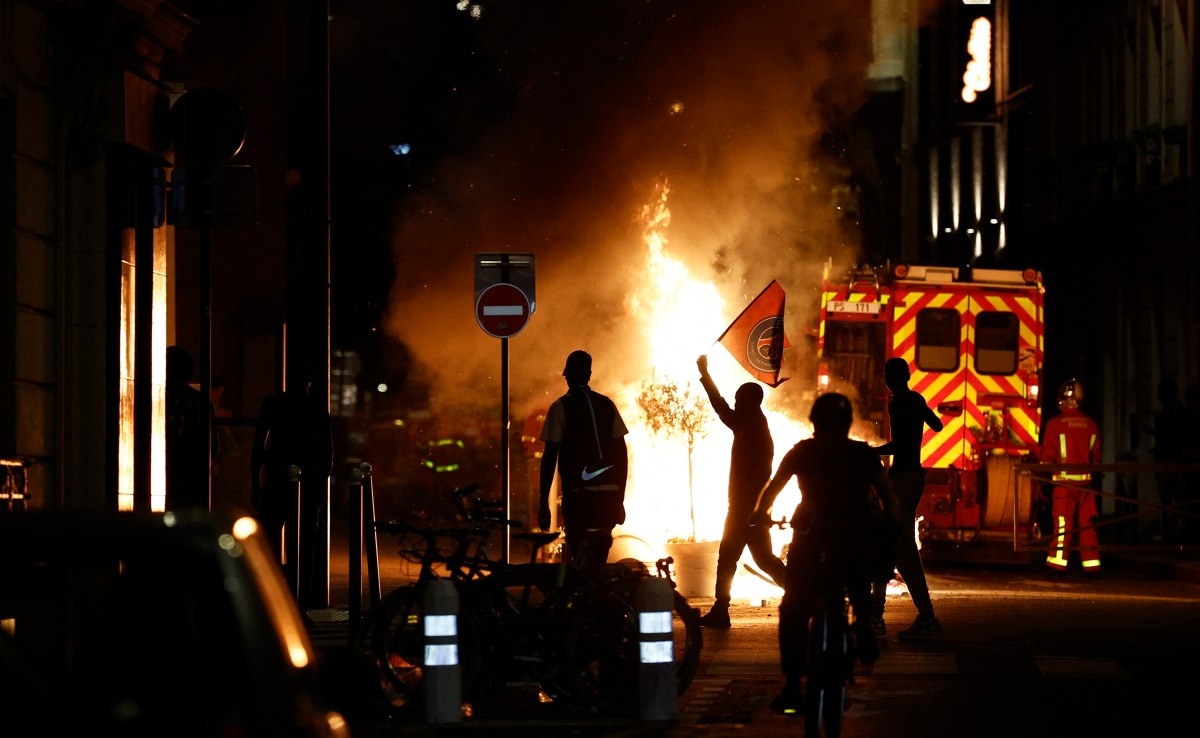
The scent of roasted chestnuts usually wins. On any normal Tuesday evening where the Boulevard Saint-Germain meets the narrow, winding veins of the Latin Quarter, that warm, smoky aroma blankets the sidewalk. It competes with the sharp tang of espresso and the buttery wealth of fresh croissants. But by eight o'clock, the air changed. The chestnuts were gone, replaced by the acrid, metallic sting of tear gas and the sour stench of burning rubber.
Paris did not just experience a riot. It fractured.
When a metropolis of over two million people bleeds into chaos, standard news reports tend to view the event from thousands of feet in the air. They count the number of shattered storefronts. They tally the arrests. They reduce human fury and terror to a sterile ledger of property damage and police logistics. But cities are not made of glass and asphalt. They are made of people. To understand how one of the world's most celebrated cultural sanctuaries turned into a smoke-choked battleground overnight, you have to look at the cobblestones from the ground up.
The Anatomy of an Escalation
Step away from the macro-narratives. Consider instead a small café tucked just off the main boulevard. The owner, a third-generation Parisian named Jean-Louis, spent the afternoon polishing brass fixtures and folding linen napkins. He knew a protest was scheduled. In Paris, protests are as common as rain. They are part of the civic rhythm, a democratic ritual conducted with banners and megaphones during the day, usually wrapping up in time for dinner.
Then the rhythm broke.
The crowd that poured down the boulevard as dusk fell was different. The peaceful marchers, the union workers holding printed signs, were suddenly swallowed by a wave of moving black cloth. These were the opportunists of chaos, individuals clad in heavy leather, faces masked by motorcycle goggles and bandanas. Within minutes, the air filled with the rhythmic, terrifying thud of heavy boots on stone.
Panic is a physical force. It ripples through a crowd like a shockwave through water. Jean-Louis watched from behind his glass door as the casual strollers—tourists clutching maps, couples walking hand-in-hand—realized the atmosphere had curdled. Their pace quickened from a leisurely walk to a frantic sprint.
The first cobblestone left the street.
Parisian cobblestones, known as pavés, carry a heavy historical weight. They are the literal building blocks of French revolution, dug up in 1789, in 1968, and again on this night. When thrown, they do not just break windows; they break the illusion of safety. The heavy glass facade of a luxury boutique across the street didn't just crack. It exploded with a sound like a gunshot.
The thin line separating civilization from anarchy dissolved.
The Cost of the Chaos
The dry statistics released by the prefecture the following morning stated that thirty-two police officers were injured, three dozen vehicles were set ablaze, and over a hundred businesses suffered significant damage.
Numbers insulate us from reality.
To feel the truth of those numbers, look at the smoking carcass of a delivery van tipped on its side near the metro station. It belonged to an independent courier who used it to support a young family. As the flames licked the sky, painting the classic Haussmann facades in horrific shades of orange and crimson, that livelihood vanished in a cloud of black smoke. The grand narrative of political frustration looks very different when your sole source of income is reduced to a blackened chassis.
Sirens provided the soundtrack for the night. A relentless, two-tone wail that echoed off the stone walls, creating a disorienting labyrinth of sound. Emergency vehicles struggled to navigate streets blocked by burning barricades made of overturned trash bins, electric scooters, and cafe furniture.
Hospital emergency rooms, already strained by the daily demands of a massive urban center, suddenly transformed into triage units. Medical staff, exhausted from long shifts, found themselves treating an influx of patients suffering from severe smoke inhalation, lacerations from flying glass, and deep contusions from projectiles. The human toll was not confined to those actively participating in the violence; it swept up transit workers trying to secure subway stations, bystanders trapped in doorways, and residents watching anxiously from their balconies.
The Invisible Stacks
The true damage inflicted upon a city during an uprising is rarely visible when the sun rises the next morning. Municipal workers are astonishingly efficient. By dawn, the heavy sweepers are out, washing away the ash, clearing the broken glass, and erasing the physical scars of the night before. By noon, a tourist might walk down the same boulevard and notice nothing more than a boarded-up window or a faint smell of smoke.
But the psychological architecture of the city remains damaged.
A metropolis thrives on a fragile, unwritten contract. We agree to walk among strangers in peace. We trust that the subway will take us home safely, that the shopkeeper will be there tomorrow, that the streetlamps will illuminate a path free of danger. When that contract is torn up, even for a few hours, fear takes root in the soil.
Consider the economic ripples that follow the smoke. Small business owners, already operating on razor-thin margins, must bear the immediate cost of repairs and the long-term sting of skyrocketing insurance premiums. For many, a single night of vandalism represents the tipping point between survival and bankruptcy.
The hospitality industry, the lifeblood of the city's global identity, faces a different kind of erosion. Travelers look at the images of burning streets and quiet their desires. They cancel reservations. They divert their journeys elsewhere. The loss isn't just measured in unsold hotel rooms or empty restaurant tables; it is measured in the quiet desperation of waiters, tour guides, and artisans whose futures depend on the footsteps of strangers.
The Morning After
The fires eventually burned out, starved of fuel and suppressed by the relentless pressure of water cannons. The tear gas cleared, leaving only a bitter residue on the leaves of the chestnut trees.
As the first gray light of dawn filtered through the low clouds, the city began the slow process of exhaling. The silence that followed the chaos was heavy, almost suffocating. It was the silence of a community surveying its own self-inflicted wounds, wondering how the distance between political disagreement and destructive rage had grown so incredibly short.
A lone street sweeper moved methodically along the curb, the bristles of his broom scraping against the asphalt. He paused to pick up a melted plastic fragment, once part of a rearview mirror, and tossed it into the bin.
Beside him, a shattered storefront lay exposed to the cool morning air. Inside, a display mannequin stood entirely untouched, draped in an elegant silk scarf, staring out through the jagged frame of broken glass at the empty, altered street.