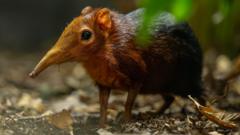
The fluorescent lights of the nocturnal breeding lab hum with a sterile, relentless vibration. It is 3:00 AM. Most people are asleep, oblivious to the fact that inside a climate-controlled glass enclosure, a tiny, insect-eating mammal the size of a teacup is currently rewriting the survival odds for its entire species.
A conservation biologist sits frozen in an ergonomic chair, coffee long turned cold, watching a live-feed infrared camera. Her eyes burn from strain. On the screen, a mother sengi—often called an elephant shrew, though it is more closely related to an actual elephant than a common shrew—is meticulously grooming two blind, hairless bundles of pink flesh. Each pup weighs barely more than a single coin. They are the second pair born here this season.
To the casual zoo visitor glancing at a press release, it is a cute milestone. A brief headline to scroll past on a lunch break. But for the handful of humans who spent the last decade tracking these creatures through fragmented coastal forests, this moment is a breathless victory in a war against quiet extinction.
The Sound of an Empty Forest
To understand why two tiny mammals matter, you have to understand the silence they leave behind.
Imagine walking through the dense, leaf-littered floor of an African coastal forest. Under normal circumstances, the ground is alive with a subtle, rhythmic rustling. Sengis are perpetual motion machines. They use their elongated, trunk-like noses to probe the soil for ants and beetles, their long hind legs launching them over twigs like miniature kangaroos. They are ecosystem engineers on a microscopic scale, turning over soil, dispersing seeds, and keeping insect populations in check.
Then, the bulldozers arrive. Or the climate shifts just enough to dry out the moisture-loving insects.
The rustling stops. The forest floor goes dead.
When a keystone species vanishes, the collapse is rarely cinematic. There are no falling meteorites or dramatic explosions. Instead, it is a slow, unraveling fabric. A species of beetle overpopulates. A certain type of seedling fails to germinate because the soil is too compacted. The birds that feed on the beetles begin to migrate elsewhere. The entire ecosystem tilts on its axis, all because a creature that fits in the palm of your hand disappeared.
The keeper watching the monitor knows this grim trajectory all too well. Years ago, during a field expedition, she walked through acres of degraded habitat where the sengis had vanished. The silence was heavy. It felt like visiting a house where the family had suddenly packed up and left, leaving the lights on but the warmth gone.
That memory is what drives the late nights and the obsessive data tracking. The stakes are completely invisible to the public, but they are massive.
The Chemistry of Intimacy
Breeding sengis in captivity is not a matter of simply putting a male and a female in a cage and hoping for the best. It is a delicate, agonizingly complex puzzle of behavioral chemistry.
In the wild, these animals are fiercely territorial. They do not share well. If you introduce a male and a female at the wrong moment, they will not mate; they will fight, often with devastating consequences for creatures so fragile.
For months, the husbandry team acted as high-stakes matchmakers. They analyzed hormone levels from fecal samples. They monitored vocalizations—tiny, high-frequency squeaks that human ears can barely register without specialized equipment. They arranged "first dates" through mesh dividers, watching for signs of aggression or curiosity.
Consider what happens next when the chemistry finally aligns:
The gestation period of a sengi is remarkably short, yet the pressure on the mother is immense. Unlike many other small rodents that give birth to large litters of helpless young, sengis typically give birth to just one or two pups. But those pups are highly developed. Within hours of birth, their eyes pop open. Their tiny legs begin to twitch with the same frantic energy as their parents.
When the first pair of pups was born earlier this year, the team celebrated with hushed whispers and high-fives in the dark. It proved the protocol worked. But a single litter is a fluke. A second litter, born to the same pair just months later, is a trend. It means the environment created by human hands is stable enough, safe enough, and precise enough to trick nature into thriving.
The Human Cost of Conservation
There is a misconception that zoo conservation is purely scientific, driven by cold data and clinical detachment. The truth is far more vulnerable.
The people who dedicate their lives to these animals trade away their weekends, their sleep, and their emotional stability. They carry a heavy burden of guilt and anxiety. When a pup fails to thrive, it is not just a statistical loss; it is a personal blow that echoes through the entire department. They question every variable. Was the humidity too low? Did a sudden noise scare the mother?
This second birth represents a rare moment of pure, unadulterated relief.
It validates the tedious hours spent chopping crickets into microscopic pieces. It justifies the endless grant applications and the battles for funding against more charismatic, photogenic animals like lions or elephants. Sengis do not have roaring fan clubs. They do not inspire viral memes. They are small, brown, and mostly hidden from view. Yet, their survival is just as critical to the biodiversity of our planet as any apex predator.
The Path Back to the Wild
The ultimate goal of any reputable breeding program is never just to keep animals behind glass for display. The glass is a temporary shield against a hostile world.
The success of this second pair of pups ripples far beyond the walls of the laboratory. Each successful birth adds genetic diversity to a vital insurance population. In the event of a catastrophic wildfire, disease outbreak, or total habitat destruction in their native lands, these captive-born generations hold the genetic blueprint for their entire race.
Biologists are already working with international partners to secure and restore protected wild corridors. The dream is a seamless transition from the climate-controlled lab back to the chaotic, rich soil of the wild.
But for now, the victory is small, localized, and intensely personal.
The biologist in the lab finally stands up from her chair, her knees popping in the quiet room. On the monitor, the two new pups have tucked themselves beneath their mother’s flank, safe from the predators and dangers of a world they have yet to see. She makes a final notation in the logbook, clicks off the screen, and steps out into the cool morning air.
The sun is just beginning to break over the horizon, lighting up the sky in shades of amber and violet. Somewhere across the world, a forest is waiting for its engineers to return. Each tiny heartbeat in the dark brings that day just a little bit closer.