The wind at Blakeney Point doesn't just blow. It scours. It carries the sharp, metallic tang of the North Sea and flings microscopic shards of flint against your skin until your cheeks burn. If you stand perfectly still on the shingle ridge, the ground seems to move. It is a trick of the light and the coarse sand, but for the people who spend their lives here, the instability is entirely real.
To understand what happened on this desolate stretch of the Norfolk coast, you have to understand the sheer weight of forty years. Four decades is not just a statistical milestone. It is a working lifetime. It is the span of time it takes for a young, enthusiastic volunteer with clear eyes to become a gray-haired warden with creaking knees and a face mapped by deep salt-wrinkles.
They came here in the early 1980s to wage a war that no one else was paying attention to. The enemy wasn’t a corporation or a chemical spill. It was everything. High tides, hungry foxes, soaring rats, holidaymakers who didn't know where to step, and the crushing, indifferent hand of changing weather.
The prize they fought for weighs less than a smartphone.
The Vulnerability of a Pebble
Consider the little tern. It is a bird of impossibly delicate proportions, a silver-gray dart with a jet-black cap and a yellow bill that looks like it was painted on with a fine brush. While other birds seek the safety of dense forests or high, inaccessible cliffs, the little tern chooses the most dangerous place imaginable to raise a family: the open, naked beach.
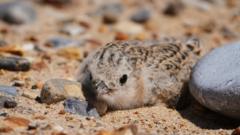
They do not build nests. They scrape a shallow depression directly into the shingle. To the untrained eye, a little tern egg is indistinguishable from a grey-speckled flint pebble. This is an evolutionary masterpiece of camouflage, right up until the moment a heavy leather boot steps on it.
Imagine walking along the shoreline on a bright June afternoon. The sun is warm, the surf is a gentle hiss, and you are lost in thought. You have no idea that three inches from your right toe, a microscopic heartbeat is pulsing inside a shell. The parent bird, terrified by your approach, has already fled the nest, screaming a shrill kree-ik into the wind. If you stop to take a photo of the scenery, the June wind will chill that exposed egg in less than ten minutes. The embryo dies. You walk away, entirely unaware that you have just committed a quiet execution.
This was the reality facing a small band of conservationists forty years ago. The little tern populations were tanking. The birds were returning from their wintering grounds in West Africa, exhausted and depleted, only to find their traditional nesting beaches overrun by a post-war boom in coastal tourism and a exploding population of coastal predators.
The math was brutal. If the birds couldn't fledged chicks, the colony would vanish.
The Long Watch
The solution sounded simple on paper: protect the beaches. In practice, it meant entering a monastic existence defined by isolation and vigilance.
Think about the sheer psychological grit required to watch a patch of sand for months on end. The wardens set up camp in basic wooden huts, often without running water or electricity, right at the edge of the breeding colonies. When the storms rolled in from the Atlantic, turning the North Sea into a frothing, gray monster, the huts shuddered and groaned. The rain didn't fall; it drove sideways, finding every crack in the timber.
But the real problem lay elsewhere, away from the weather. It lay in the darkness.
At night, the beach becomes a different world. The camouflage that protects the eggs by day is useless against a red fox hunting by scent. A single fox, slipping past the dunes under the cover of a moonless night, can destroy an entire colony’s reproductive output for the year in a matter of hours. They don't just eat what they need; they kill in a frenzy of instinct, leaving broken shells and headless chicks scattered across the stones.
To counter this, the wardens became nocturnal. They patrolled the perimeter of the colonies by flashlight, tracking footprints in the sand like detectives at a crime scene. They erected miles of electric fencing, a fragile wire barrier strung across shifting sands that required daily maintenance because the wind constantly buried the bottom wires or blew the sand out from beneath them.
Every morning brought a tense inventory. How many nests survived the night? How many high-tide waves lapped dangerously close to the ridge?
There were years when the losses were total. A sudden summer gale would push the sea over the shingle spit, washing away hundreds of nests in a single tide. You could see the wardens standing in the receding waters, soaked to the skin, holding the waterlogged corpses of chicks that had hatched just days before. It would have been easy to quit then. To pack up the binoculars, abandon the drafty hut, and concede that nature had run its course.
But they didn't. They stayed because they understood a fundamental truth about conservation that is rarely spoken aloud: it is not a series of grand victories. It is a relentless, exhausting holding action.
The Psychology of Coexistence
As the years rolled into decades, the strategy shifted from mere physical defense to a complex game of human psychology. You cannot save a species by fighting the public; you have to make the public care about something they can barely see.
The wardens became teachers, diplomats, and sometimes, gentle enforcers. They stood at the edge of the cordoned-off rope lines, engaging with dog walkers and beachgoers who were often annoyed by the restrictions.
"Why can't my dog run on the spit?" a visitor might ask, gesturing to the vast, seemingly empty expanse of stones.
Instead of citing local bylaws or lecturing on biodiversity, a seasoned warden would hand over their binoculars. They would point to a specific spot on the ridge, wait for the visitor's eyes to adjust, and let them witness the magic. Through the lens, the empty beach suddenly came alive. They would see a male tern arriving from the sea, a tiny, glittering silver sandeel clamped in its beak, performing a high-speed aerial dance to impress a waiting female.
Once someone sees that—once they realize the stones are alive—the restriction ceases to be an annoyance. It becomes a shared responsibility.
The results of this multi-decade siege did not manifest overnight. They accumulated in fractions. A few more chicks fledged this year than last. A new sub-colony established itself a mile down the coast because the main site was secure. The data began to show a slow, agonizingly beautiful upward curve.
By managing the predators, managing the people, and physically moving nests higher up the beach when the spring tides threatened to overwhelm them, the project created a sanctuary out of a battleground.
The Fragile Horizon
Today, the little terns still arrive in Norfolk every spring. Their return is a miracle of navigation and endurance, a living thread that connects the British coastline to the tropical waters of Africa. They drop from the sky like falling stars, their cries filling the salt air just as they have done for millennia.
But the success is bittersweet. The forty-year project has proven that we can pull a species back from the brink through sheer, stubborn persistence. Yet, it also reveals the terrifying artificiality of modern nature. These birds survive because they are on life support. The moment the wardens stop patrolling, the moment the electric fences are taken down, the moment the public loses interest, the colony will collapse.
We have created a world where wilderness requires a management plan and twenty-four-hour surveillance.
As the sun begins to dip below the horizon at Blakeney Point, bleeding orange and deep violet across the salt marshes, a lone warden walks the fence line. The wind is picking up again, cold and relentless. A tiny silver bird rises from the shingle, hovers for a second against the gale, and then dives into the dark water.
It is a beautiful sight, but it is a beauty earned through forty years of calloused hands, sleepless nights, and an stubborn refusal to let the darkness win.