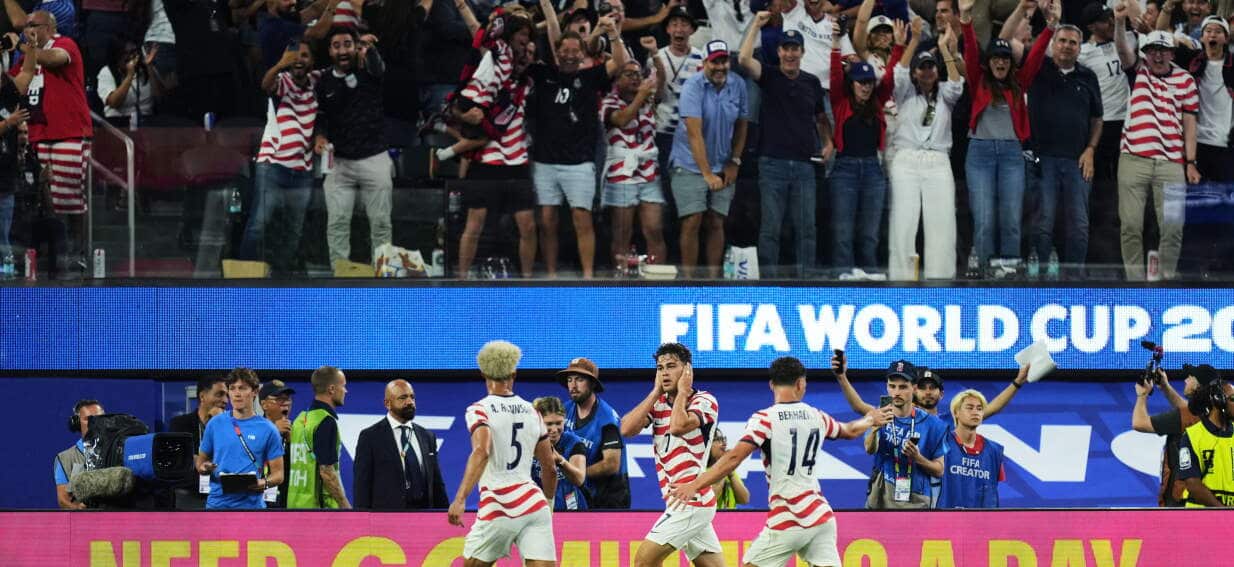
Folarin Balogun choosing the United States Men's National Team (USMNT) over England was hailed as a monumental coup. The narrative was neat, packaged perfectly for American soccer media: a young, elite striker rejects the old guard to become the face of a rising soccer superpower just in time for the World Cup. It looked like a masterstroke. It felt like a paradigm shift.
It was actually a calculated retreat that masked a deeper structural problem in modern international football.
The sports media elite loves a romantic defection story. They told you Balogun’s move was about ambition, heritage, and "unlocking potential." They lied. The reality is far colder. International allegiance swaps are increasingly used as a branding band-aid for players who realize they cannot survive the meritocratic meat grinder of elite European national teams. By choosing the USMNT, Balogun didn't elevate his career; he traded the brutal, developmental crucible of the English system for the comfortable, unearned security of guaranteed international minutes.
The Illusion of the "Golden Generation" Savior
The lazy consensus states that a world-class dual-national choosing the USMNT changes the trajectory of the program. This logic is fundamentally flawed because it misunderstands how international success is actually built.
Teams win World Cups because of deep, institutionalized development structures, not individual recruitment drives. Look at France, Germany, or Argentina. They don't rely on convincing a 21-year-old French-born striker to switch allegiances to save them; they produce dozens of them every decade through rigorous academy systems.
When Balogun committed to the USMNT, he was instantly anointed as the missing piece—the elite number nine the country had starved for since Jozy Altidore's prime. But filling a tactical vacuum by default is not the same as earning a spot on merit.
In the English setup, Balogun was battling Harry Kane, Ivan Toney, and Ollie Watkins. To play for Gareth Southgate, and subsequently Thomas Tuchel, you cannot just be good; you have to be undeniable week in and week out in the toughest leagues in the world. By stepping away from that fight, Balogun chose a ecosystem where his starting spot is practically guaranteed regardless of his club form. That kills competitive edge.
The Monaco Regression: Club Form Follows International Comfort
We have seen this play out before. When a player removes the absolute highest level of international pressure, their club career frequently plateaus.
Consider the mechanics of Balogun's club career post-decision. His spectacular 21-goal season at Stade de Reims came while he was still fighting for international recognition, hungry to prove he belonged in the conversation with Europe's elite. Once the USMNT switch was finalized and the hype engine peaked, he secured a big-money move to Monaco.
The result? The sharp, lethal edge faded. The tactical urgency dropped. When you know you are the undisputed star of a national team simply by showing up, the desperate hunger required to fight for your life in Ligue 1 or the Premier League diminishes.
"I’ve watched sporting directors throw millions at players based entirely on international hype generated by thin player pools. It almost always ends in overpayment and underperformance."
The USMNT fan base asks: How do we get Balogun scoring like he did in Reims? The brutal answer: You can't, because you've already given him the reward without making him do the work.
Dismantling the "World Cup Marketing" Fallacy
The commercial argument for Balogun’s switch seemed ironclad. Nike deals, American marketing dollars, and the chance to be a poster boy for a home World Cup. It sounds brilliant in a boardroom. It fails on the pitch.
Let's look at the actual data of American soccer stardom. The US market is notoriously fickle. It does not reward mere participation; it rewards historic, transcendent winning. Christian Pulisic achieved genuine cultural crossover in America not just because he wore the US shirt, but because he was winning the Champions League with Chelsea and performing at AC Milan.
Balogun was sold a bill of goods that international celebrity could precede club dominance. If you are not scoring 20 goals a season in a top-five European league, American casual sports fans do not care about your international goals against CONCACAF opposition in the Nations League. The marketing engine only works if the engine under the hood is elite.
The Hidden Cost of CONCACAF Competition
The tactical regression of players moving from UEFA youth setups to full CONCACAF international play is rarely discussed, but it is devastating to development.
To refine your skills as a world-class forward, you need to be consistently tested against elite defensive structures. In Europe, international windows mean facing Virgil van Dijk, Antonio Rüdiger, or Rúben Dias. It requires elite movement, immaculate hold-up play, and split-second decision-making.
In CONCACAF, a striker spends half their international windows playing on substandard pitches against low-block defenses that rely on physical intimidation rather than tactical sophistication. It is a completely different sport.
- UEFA Defenses: Force intelligent movement, tactical fluidity, and technical perfection.
- CONCACAF Defenses: Force physical survival, long-ball reliance, and chaotic transitions.
Spending your formative years adapting to the chaotic transition play of North American qualifiers doesn't prepare you for a World Cup quarterfinal against France. It prepares you to beat El Salvador on a Tuesday night in San Salvador. Balogun exchanged the highest-level tactical education for regional dominance.
Stop Asking "Who Can We Recruit?" Start Asking "Why Aren't We Producing?"
The obsession with landing dual-nationals like Balogun, Yunus Musah, or Sergiño Dest highlights a massive systemic failure within the United States soccer apparatus. It is the scouting equivalent of corporate outsourcing. Instead of fixing the broken, pay-to-play academy systems that systematically exclude low-income talent within the borders of the United States, US Soccer relies on European clubs to do the heavy lifting for them.
Balogun is a product of the Arsenal academy. Musah spent his formative years at Arsenal and in Italy. Dest was built by Ajax. The USMNT is building a house using bricks borrowed from Europe's elite, then wondering why the foundation shakes during major tournaments.
If the USMNT wants to truly compete on the world stage, the federation needs to stop celebrating international commitments as if they are trophies. Landing a player who couldn't break into the England squad isn't a victory; it’s a symptom of your own inability to develop an equivalent talent at home.
The Hard Truth of International Football
Choosing the path of least resistance is rarely the catalyst for sporting greatness. The players who win World Cups are those who have spent their entire lives surviving the most cutthroat environments imaginable. They don't look for guarantees. They don't look for a country that needs them more than they need the country.
Folarin Balogun took the easy way out. He accepted the adulation of a desperate fan base and the safety of a guaranteed starting spot. In doing so, he removed the exact pressure cooker environment that makes strikers elite.
The next time a high-profile dual-national chooses the USMNT over a traditional European powerhouse, don't celebrate. Demand to know why America couldn't build one themselves. Stop treating a soft exit from elite competition as a career victory. Textbooks don't write chapters about players who avoided the fight.