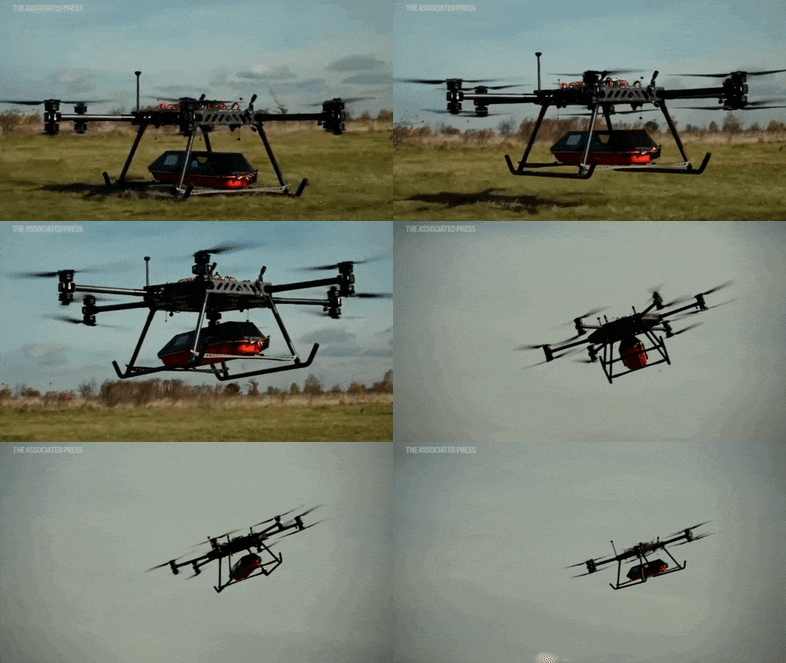
Sending a heavy-lift quadcopter into an active kill zone to haul out a bleeding soldier sounds heroic. On paper. In reality, it is a physics problem colliding with an electromagnetic nightmare.
Most coverage of unmanned casualty evacuation treats the battlefield like a warehouse with mud on the floor. A wounded soldier drops. A big drone whirs in. A cable lowers. Boom—instant medevac without risking a helicopter crew. That is the lazy consensus repeating press-release optimism as operational doctrine. Learn more on a similar topic: this related article.
It falls apart the second you look at payload math, acoustic signatures, electronic warfare, and human physiology.
A combat casualty in full kit—body armor, helmet, rifle, webbing, and trauma gear—easily clears 100 kilograms. Often closer to 120. Lift that weight vertically on electric rotors in contested airspace and you are not flying a stealthy little scout. You are flying a loud, wide, heat-emitting target that draws every gun, mortar, and first-person-view (FPV) kamikaze drone within earshot. Additional reporting by TIME explores similar views on this issue.
I have watched defense startups and acquisition committees burn millions chasing flashy hardware demos on flat test ranges while ignoring what happens when a real artillery barrage lands 400 meters away. Smooth hover tests over green grass prove nothing. Combat evacuation happens under fire, over broken terrain, with terrified people and zero margin for error.
Why "The Kill Zone" Breaks Every Assumption of Drone Medevac
People use the phrase "kill zone" as if it is a line on a map you can simply step over with better autonomy. In modern trench and drone warfare, the kill zone is a layered volume of constant surveillance and precision fire. Overhead recon drones watch roads and tree lines. Loitering munitions wait for movement. Radio links get jammed or geo-located.
To understand why casualty evacuation by air is so brutal, you first have to define the terms properly. CASEVAC (casualty evacuation) is the urgent movement of wounded personnel from the point of injury using whatever platform is available—often non-medical vehicles or ground drones—before formal clinical care begins. MEDEVAC (medical evacuation) implies dedicated medical transport with en-route care capabilities. Conflating a heavy cargo drone with a true MEDEVAC platform is a dangerous category error. A stretcher strapped to an airframe is not a flying trauma bay.
Consider the physics of vertical lift. Hovering and climbing with a human payload requires massive power draw. Battery energy density remains the stubborn bottleneck of electric flight. High power draw means heavy batteries, which cut flight time and endurance. If an evacuation drone loses a motor, suffers a control link drop, or runs short on juice mid-extraction, the cargo is not a crate of rations. It is a severely injured human being falling from altitude or stranded halfway between lines.
Then comes the signature problem. Large multi-rotor drones are notoriously noisy. On a quiet frontline sector, you can hear a heavy lift platform coming long before you see it. Enemy operators do not need a miracle to hit a slow, bulky, heavily loaded aircraft flying a predictable extraction profile. They just need to spot it once and commit two cheap FPV drones to intercept.
A heavy evacuation drone does not bypass the kill zone. It becomes the highest-value target inside it.
The Myth of Autonomous Rescue Under Fire
Advocates love to claim that autonomy solves radio jamming. If electronic warfare severs the datalink, the drone just switches to onboard navigation and finishes the mission.
That sounds neat until you ask what happens when an injured soldier shifts weight, a strap catches on brush, or a branch clips a rotor near a tree line. Real battlefields are cluttered, smoky, chaotic, and full of unpredictable obstacles. Fully autonomous terminal guidance around trees, collapsed buildings, and human helpers in tight spaces is vastly harder than flying a waypoint mission over open fields.
Even if the flight computer works, human beings on the ground still have to load the patient safely. Loading an immobilized or panicking casualty under incoming shrapnel takes precious seconds that feel like minutes. A hovering drone blowing rotor wash—mud, dust, debris, and deafening noise—directly onto medics and wounded troops makes communication and secure strapping harder, not easier.
The Questions Everyone Asks Instead of the Ones That Matter
Whenever a new casualty-evacuation drone hits the headlines, the same predictable questions pop up in search feeds. Most of them start from a flawed premise.
Can drones replace helicopters for battlefield medevac?
No. Not anytime soon, and not in high-threat airspace. Helicopters carry far more payload, travel faster over longer distances, and allow trained flight medics to actively manage airways, bleeding, and shock in flight. When air defenses or dense drone coverage make rotary-wing flight suicidal, helicopters pull back. A small or medium unmanned aircraft does not magically gain immunity to the same threat environment—it just trades a crew for a high risk of mission failure and lost payload.
Are unmanned ground vehicles better than flying drones for evacuating the wounded?
They are often more realistic for short, low-profile hauls, though they bring their own headaches. A tracked or wheeled ground evac platform hugs the ground, avoids high-altitude visual detection in some terrain, and can carry heavier loads without fighting gravity every second. Yet ground drones get bogged down in mud, craters, rubble, and dense woods, and they still struggle with anti-tank mines, artillery, and ambush lanes. Neither air nor ground is a silver bullet.
How fast can a drone get a wounded soldier to a field hospital?
Speed on a spec sheet is a trap. Top airspeed means nothing if the drone spends ten minutes warming up, navigating around electronic warfare zones, hovering during loading, or flying a zig-zagging route to stay low. In trauma care, the real clock is time to hemorrhage control and skilled surgical stabilization—not just raw transit speed over a few kilometers.
What Heavy Hitters in Warfare and Trauma Actually Know
Serious military planners and combat trauma specialists have wrestled with evacuation bottlenecks for decades. Figures like Col. John Holcomb, a leading authority on military trauma care and hemorrhage control, helped drive the shift toward point-of-injury interventions—tourniquets, hemostatic dressings, and rapid blood products—because getting a critically bleeding patient out of a hostile zone always takes longer than Hollywood suggests.
Modern conflict analysis from institutions like the Royal United Services Institute (RUSI) and defense analysts studying the war in Ukraine has repeatedly highlighted a harsh operational reality: proliferation of cheap reconnaissance and strike drones has compressed timelines and expanded danger zones deep behind the forward edge. When a single cheap quadcopter can spot movement and direct fire within minutes, any slow, high-signature movement stands out.
The lesson from experienced commanders and medics is blunt. Evacuation is a system of systems, not a single clever machine. If point-of-injury care is weak, or if command-and-control at the trench line is chaotic, a shiny evacuation drone arriving late does not save a life that bled out in the first five minutes.
Where My Contrarian Take Could Bite Me
Let me put my cards on the table, because intellectual honesty matters more than scoring points.
Technology moves fast. Battery chemistry improves. Acoustic masking gets quieter. Edge AI and optical terrain navigation get sharper every year. If a breakthrough dramatically lowers acoustic signature, hardens navigation against jamming, and boosts payload-to-weight ratios, today's limitations will look dated faster than critics expect.
There is also a narrow edge case where an air evac drone could beat the alternatives: a soldier trapped in flooded, mined, or heavily collapsed terrain where wheeled or tracked ground vehicles physically cannot pass, and where weather or threat levels ground manned aircraft. In that specific gap, an imperfect aerial option beats leaving someone behind with zero extraction path.
Still, betting the house on aerial casualty evacuation as a mainstream solution to kill-zone rescues is bad engineering and worse tactics.
Imagine a Different Evacuation Chain
Imagine a scenario where a squad leader's radio man is hit by shrapnel inside a wooded tree line. Artillery is walking closer. Overhead, an enemy spotter drone is loitering.
If the unit waits for a large evacuation drone to fly in from three kilometers back, hover down through the canopy, get strapped in, and lift out, three things can go wrong before it even clears the trees: the spotter calls fire on the landing spot, a rotor clips a branch, or the drone gets hit mid-climb.
Now picture a different chain. First, buddies and combat medics stop catastrophic bleeding on the spot using proven tourniquets and packing, and keep the casualty warm and breathing. Second, a small, low-cost unmanned supply drone delivers extra tourniquets, blood warming gear, or communications gear without risking a human-sized airframe. Third, extraction happens via a covered route or low-signature ground platform once suppressive fire or smoke covers the move—saving the high-value airlift or ground evac for the moment and place where it actually has a shot at surviving.
That approach is far less glamorous than a headline about a "wounded-lifting battle drone." It is also far closer to how real people survive bad days.
Practical Moves That Actually Work Right Now
If you are building systems, allocating defense R&D dollars, or studying modern combat logistics, stop chasing rescue theater and focus on what moves the needle.
- Prioritize resupply and casualty-aid delivery first. Use drones to fly blood products, hemostatics, batteries, water, and medical gear to the forward line before trying to fly wounded humans out of it. The payload is lighter, the risk of losing a human life to a crash is zero, and early medical supplies buy crucial time.
- Design for EW resilience and low signature from day one. Any platform operating near the front must survive contested spectrums, avoid predictable flight paths, and minimize noise and thermal contrast. If it needs pristine GPS and quiet skies to work, keep it out of the war zone.
- Invest in rugged ground mobility and modular payloads. Build evacuation platforms around reliable chassis that can haul supplies, ammo, and—where terrain permits—casualties, rather than single-purpose fragile marvels that break the first time mud hits a sensor.
- Train medics and squads for delayed evacuation. Assume extraction will take longer than planned. Drill prolonged field care, airway management, hypothermia prevention, and calm coordination under noise and stress so casualties stay alive until safe transport is actually possible.
- Measure success by survival rates, not demo videos. A smooth autonomous takeoff on a sunny airfield means nothing. Judge every concept by survivability under fire, payload reliability, maintenance burden in the mud, and real clinical outcomes.
Stop romanticizing the flying stretcher in the kill zone. Fix the medicine at the point of injury, harden the logistics that keep units alive, and respect the physics.