The salt air usually smells like freedom. For the passengers aboard a luxury liner cutting through the crisp Atlantic waves, that scent is a promise of escape. You leave the land, the emails, and the anxieties of the shore behind. But on a recent voyage, the air changed. It didn't happen with a siren or a loudspeaker announcement. It happened in the quiet, sterile hallways of the infirmary and in the frantic, whispered phone calls between maritime authorities and Swiss hospitals.
A virus was on board. Not the one the world spent three years hiding from, but something rarer, older, and far more erratic: Hantavirus.
Consider a hypothetical passenger named Marc. Marc is a retired engineer from Lyon who saved for two years to see the fjords. He is currently sitting in a stateroom, watching the horizon tilt, unaware that his name is on a list in a government office in Paris. He is a "cas contact." To the bureaucrats, he is a data point in a containment strategy. To Marc, he is just a man who shared a dinner table with a stranger who started shivering before the main course was served.
This is the reality of modern travel. We move across the globe in steel cathedrals, bringing our biological baggage with us.
The Rodent in the Engine Room
Hantavirus isn't a "human" disease in the way we usually think of the flu. It belongs to the wild. Typically, it lives in the lungs and kidneys of rodents—deer mice, rice rats, or bank voles. They carry it without a cough. They shed it in their waste. When that waste dries and turns to dust, it becomes an invisible mist.
Usually, this is a rural tragedy. A hiker cleans out an old cabin in the Rockies; a farmer sweeps a barn in the Limousin region. They breathe in the dust. A week later, their lungs fill with fluid. But on a cruise ship? That is a different kind of nightmare. It suggests a breach of the sanctuary.
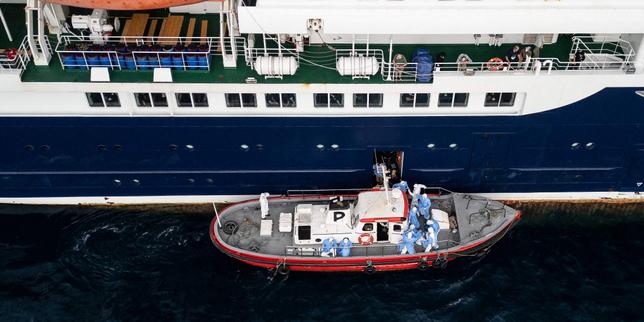
On this particular vessel, the alarm bells began to ring when three passengers had to be evacuated. This wasn't a standard "seasickness" protocol. This was a high-stakes extraction. One of those passengers ended up in a Swiss hospital bed, tethered to monitors, fighting a fever that felt like a physical weight.
How does a forest virus find its way onto a floating city of glass and steel? It exposes the fragility of our supply chains. Every pallet of fresh strawberries, every crate of fine linens brought onto a ship is a potential bridge for a hitchhiker from the wild. We spend billions on radar and navigation to avoid icebergs, yet the smallest threat—a microscopic strand of RNA—is what truly dictates the course of the ship.
The Invisible Stakes of Contact
When the French health authorities identified a citizen as a contact case, the machinery of modern biosecurity hummed to life.
Imagine the logistical vertigo. You are in the middle of a vacation, perhaps enjoying a glass of Chardonnay as the sun dips below the water line, and there is a knock at the door. You are told you might be carrying a pathogen that most doctors only see in textbooks.
The fear isn't just about the fever. It’s about the uncertainty. Hantavirus is a shapeshifter. In the Americas, it primarily attacks the lungs (Hantavirus Pulmonary Syndrome). In Europe and Asia, it often targets the kidneys (Hemorrhagic Fever with Renal Syndrome). It starts with the mundane: a headache, a muscle ache, a touch of fatigue.
The danger lies in the "incubation window." It’s a biological countdown. You feel fine. You walk the deck. You play trivia in the lounge. But inside, the virus is looking for a door into your vascular system.
The French passenger—our "cas contact"—represents the terrifying bridge between the isolated environment of a ship and the porous reality of the mainland. If he walks off that gangplank undetected, the virus travels with him to the TGV, to the local boulangerie, and into the heart of a crowded city.
A Breach in the Dream
We treat cruise ships as closed loops. We pay for the illusion of total control. The buffet is always full, the sheets are always crisp, and the environment is curated to exclude the messiness of the natural world.
But nature is persistent.
The evacuation of three passengers and the hospitalization of a fourth in Switzerland isn't just a news tidbit. It is a reminder that our mastery over our environment is a thin veneer. When we gather thousands of people from different corners of the globe and put them in a pressurized, recirculating environment, we aren't just vacationing. We are conducting a massive experiment in epidemiology.
The Swiss hospital room where a passenger now lies is a far cry from the moonlight on the deck. There, the "human element" is stripped down to its most basic form: breath and survival. The sterile smell of disinfectant replaces the salt air. The humming of a ventilator replaces the sound of the waves.
The Weight of the Wait
For the French traveler marked as a contact, life has become a waiting game. There is no magic pill for Hantavirus. There is no "cure" in the traditional sense. Medical science can support the body—hydrate it, oxygenate it, keep the kidneys from failing—but ultimately, it is a duel between the individual’s immune system and a legacy of the wilderness.
He has to wonder: was it the handrail? Was it a stowaway in the ventilation? Or was it just a stroke of cosmic bad luck?
This incident forces us to look at the "hidden cost" of our interconnectedness. We want the world to be small when we are booking a flight or a cruise. We want every horizon to be reachable within a few hours. But when a rare virus hitches a ride, we suddenly wish the world were much, much larger. We wish there were more buffers, more distance, more space between the forest floor and the cabin door.
The ship continues its journey, but the atmosphere has been permanently altered. The luxury is still there, the gold-leaf trim and the five-course meals, but there is a ghost in the machine now. Every cough in the theater makes the person in the next seat stiffen. Every time a member of the cleaning crew passes by in a mask, the illusion of the "perfect escape" cracks a little more.
We are never as far from the wild as we like to think. We are merely guests in a world that doesn't always recognize our borders, our passports, or our desire to be left alone.
The Frenchman waits. The Swiss doctors monitor the screens. The ship sails on. And under the floorboards, in the dark corners where the light of the atrium doesn't reach, the invisible world continues its silent, relentless work.
The horizon remains beautiful, but it is no longer empty. It is crowded with the things we tried to leave behind.