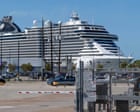
Midnight on the open ocean is a heavy, velvet black that swallows sound. On the fourteenth deck of a modern mega-ship, a live band might still be playing brassy covers of seventies hits while hundreds of vacationers clink plastic cups of watered-down rum under neon-lit cabanas. Three decks below, inside a soundproofed interior cabin with no windows to mark the passing of time, the hum of the diesel engines vibrates through the floorboards like a steady, indifferent heartbeat.
Silence. For an alternative look, consider: this related article.
That is the reality of the modern cruise industry—a multi-billion-dollar floating city designed entirely around the illusion of carefree escape. When a Texas man was recently charged with the murder of a woman aboard an MSC cruise ship, the headlines treated it like a macabre anomaly. A dark, sensationalized blip in an otherwise sunny travel brochure. News outlets dutifully recited the cold, clinical facts: a body discovered, a suspect detained in the ship’s brig, federal authorities waiting at the port of disembarkation, a murder charge filed under maritime jurisdiction.
The public reads those three paragraphs, shakes their head at the tragedy, and goes right back to booking their next Caribbean getaway. Further analysis on this trend has been published by The Washington Post.
We have gotten the story of cruise ship crime completely backward. The arrest in the MSC case wasn't a triumph of a well-oiled security apparatus; it was a rare exception in a legal twilight zone where accountability routinely evaporates into the salt air. When you step across that gangway, you aren't just leaving your daily stresses behind. You are stepping off the edge of the constitutional map, entering a jurisdictional labyrinth where the rules that protect you on dry land suddenly bend, blur, or vanish entirely.
The Architecture of Illusion
To understand how a fatal tragedy unfolds inside a luxury vessel, you first have to understand how these ships are engineered to manipulate human psychology. I spent three years working as a maritime safety consultant and investigative journalist, walking the narrow, fluorescent-lit crew corridors that passengers never see. On the guest decks, everything is brass, glass, and boundless horizon. Below the waterline, it is a cramped, hyper-efficient industrial machine operating under immense financial pressure to keep the party moving at all costs.
Consider a hypothetical couple—let’s call them Elena and Marcus—boarding a massive Mediterranean-style liner out of Galveston or Miami. They have saved for two years for a seven-day itinerary. The moment they scan their keycards, their phones go into airplane mode. Wi-Fi packages cost thirty dollars a day, so they disconnect. Drinks flow freely on unlimited beverage packages that encourage rapid, heavy consumption from noon until two in the morning. By the third night at sea, their sense of time, geography, and normal social boundaries has been systematically dissolved.
Now, strip away the vacation glamour and look at the cold operational math. A vessel like an MSC mega-ship carries upwards of six thousand passengers and nearly two thousand crew members. That is the population of a small American town packed into a steel hull roughly eleven hundred feet long.
Yet, how many trained law enforcement officers are aboard that floating town?
Zero.
Cruise ships do not carry police. They carry private security guards employed directly by the cruise line—corporate personnel whose primary training revolves around crowd control, checking boarding passes, and protecting company liability, not preserving a homicide scene or conducting forensic interviews. When violence erupts behind a locked stateroom door at three in the morning, the people kicking down that door are corporate employees whose paycheck depends on the company’s reputation remaining spotless.
The Jurisdictional Maze
When the news broke that federal prosecutors had charged a Texas man with murder following the death of a woman aboard the MSC vessel, most readers assumed the legal process was straightforward. A crime happened; the police arrested him; a trial will follow.
If only maritime law were that clean.
To grasp the legal chaos of the high seas, picture a chessboard where every square changes color depending on which way the wind blows. When a ship leaves port, its legal reality is governed by a tangled web of international treaties, coastal state boundaries, and a bizarre antique concept known as the "flag of convenience."
Most major cruise lines, despite being headquartered in Miami, Geneva, or Seattle, do not register their ships in the United States or Western Europe. They register them in countries like Panama, the Bahamas, or Malta. Why? Because registering a vessel under a foreign flag allows corporations to bypass strict labor laws, minimum wage requirements, corporate taxes, and rigorous safety oversight.
Under traditional international maritime law, the country whose flag flies on the stern of the ship holds primary legal jurisdiction over crimes committed aboard in international waters. Think about what that means in practice. If a crime occurs two hundred miles off the coast of Mexico aboard a Maltese-flagged ship operated by a Swiss-Italian company carrying American passengers, who actually owns the crime scene?
In the case of the Texas man charged with murder, federal authorities in the United States were able to step in because of a specific legal mechanism called Special Maritime and Territorial Jurisdiction. Under federal statute, the U.S. can claim jurisdiction if the victim or the perpetrator is an American national, and the vessel departs from or arrives at a U.S. port—provided the foreign flag state doesn't assert its own authority first.
That legal hook is the only reason this suspect ended up in a federal courtroom rather than slipping through an international crack. Had the victim and the accused been citizens of different nations without strong bilateral extradition treaties, or had the ship been sailing an itinerary that never touched American soil, the path to a murder charge would have turned into a diplomatic nightmare stretching across three continents.
What Happens Before the FBI Arrives
Even when federal jurisdiction applies, a massive, terrifying gap exists between the moment a crime occurs and the moment an actual badge steps onto the deck.
Let's walk through what happens in those critical first twelve hours. Imagine the scene aboard the ship after the discovery of the woman's body. The vessel is hours, perhaps a full day, away from the nearest port. The ocean is rolling beneath the keel.
First, shipboard security arrives. They are operating without a crime lab, without luminol, without forensic photographers, and often without basic training in chain-of-custody protocols. Their immediate priority is containment—keeping the tragedy invisible to the five thousand other guests eating pancakes at the buffet two decks up.
I remember interviewing a former shipboard security officer who described cleaning up a violent assault scene in a luxury suite because the captain refused to take the cabin out of commission before the next turnaround day. When corporate liability collides with criminal investigation, evidence gets wiped down with industrial bleach before a detective ever smells the salt air.
Second, witnesses disperse. On land, police tape off a neighborhood, canvas doors, and subpoena local cell towers. On a cruise ship, the witnesses are tourists from forty different states and a dozen countries. By the time the ship docks and FBI agents march up the gangway, those witnesses have already cleared customs, boarded connecting flights at the airport, and scattered to the winds. Memories fade. Digital photos get deleted. Crucial corroborating details vanish into thin air.
Third, there is the brig. Cruise ships possess small holding cells—essentially windowless rooms with a bolted-down bed and a reinforced door—where suspects like the Texas man are confined until port arrival. Detaining a murder suspect in the middle of the ocean requires constant, exhausting surveillance by private guards who were never trained to handle a potentially suicidal or violent homicide defendant for forty-eight consecutive hours.
It is a miracle any forensic integrity survives the voyage at all.
The Numbers They Don't Print in the Brochure
For decades, the cruise industry fought tooth and nail to keep crime statistics hidden from the public. When families of victims began testifying before Congress in the late 2000s—telling harrowing stories of loved ones vanishing over railings or being assaulted in cabins while crew members shrugged—lawmakers finally passed the Cruise Vessel Security and Safety Act of 2010.
That law forced cruise lines to report serious crimes—homicides, suspicious deaths, missing U.S. nationals, kidnappings, and sexual assaults—to the FBI and the Department of Transportation.
Look closely at the numbers that emerged once the curtain was pulled back. According to federal transportation data compiled over the last several years, sexual assault remains by far the most frequently reported major crime on cruise ships, accounting for dozens of incidents every single quarter across major lines. Physical assaults with serious bodily injury follow closely behind. Homicides and suspicious deaths, while statistically rarer than sexual assaults, occur with chilling regularity—several times a year across the global fleet.
And those are only the crimes that meet the strict, narrow reporting thresholds of U.S. law.
If an incident happens on a ship that does not embark or disembark in the United States, it never touches that federal database. If a passenger disappears overboard and the cruise line classifies it immediately as a "probable suicide" without an independent autopsy, it often evaporates from the criminal ledger entirely.
The industry loves to point out that per capita, crime rates at sea are far lower than in major American cities. That comparison is a masterclass in statistical sleight of hand. A major American city has a permanent population dealing with systemic poverty, gang violence, and property crime. A cruise ship is a gated, ultra-wealthy resort where every single inhabitant has been screened, paid thousands of dollars to be there, and is under near-constant surveillance by thousands of closed-circuit cameras. Comparing a luxury liner to a sprawling metropolis isn't just inaccurate; it’s absurd.
The Vulnerability of the Closed Environment
Why do people snap at sea? Why do domestic disputes escalate into fatal violence inside a hundred-and-eighty-square-foot cabin, as investigators allege happened in the MSC tragedy?
Psychologists who study isolated environments—from Antarctic research stations to offshore oil rigs and cruise liners—point to a phenomenon called "cabin fever amplification." On land, when an argument between partners turns toxic, there is an exit valve. One person grabs their car keys, walks out the front door, drives to a friend's house, or checks into a motel down the highway. Space creates cooling-off time.
At sea, there is no front door. There is no highway.
You are trapped inside a steel box smaller than a suburban walk-in closet, surrounded by thousands of strangers, miles from shore, with unlimited alcohol flowing at every corner bar. Tensions that might dissipate during a twenty-minute drive on dry land instead ricochet off metal walls. Resentments boil over. When alcohol lowers inhibitions and strips away impulse control, a cramped stateroom becomes a pressure cooker with no release valve.
The victim in this case—like so many women who suffer violence behind closed doors on vacation—had nowhere to run. You cannot call 911 on a cruise ship. You can dial the ship's emergency extension, which routes to the bridge or the guest services desk, triggering an internal corporate response rather than an independent emergency dispatch.
I admit, writing about this still makes my stomach knot. Whenever I board a vessel now, even on a perfectly sunny afternoon, I instinctively look at the latches on the cabin doors. I note the distance to the nearest stairwell. I look at the young, exhausted crew members wiping down the handrails and wonder what protocols they were actually taught during their three-day safety orientation in Manila or Jakarta. The veneer of luxury is so thick, so convincing, that even someone who knows the dark statistics can easily be lulled into forgetting them.
Navigating the Blind Spot
Does this mean nobody should ever take a cruise? Of course not. Millions of travelers sail every year and return home with nothing worse than a mild sunburn and five extra pounds from the midnight buffet.
It means you must stop treating a cruise ship like an extension of your hometown neighborhood. When you step aboard, you are entering a foreign, self-regulated territory where your personal safety depends heavily on your own situational awareness rather than an invisible net of municipal protection.
If you or someone you love plans to sail, treat the ship with the same street-smart caution you would use in an unfamiliar international city:
- Understand the communication gap. Standard cellular service dies miles offshore. Before leaving port, ensure everyone in your travel party knows how to use the cruise line’s internal messaging app, and establish physical meeting points in case phones die or Wi-Fi drops.
- Treat your cabin like a hotel room in a high-traffic area. Always engage the deadbolt and the secondary privacy latch the moment you enter your room. Never leave your balcony door unlocked at night, even on upper decks; adjoining partitions can be bypassed more easily than passengers realize.
- Watch the alcohol math. Unlimited drink packages are engineered to override your natural pacing. On a moving vessel, dehydration and motion fatigue amplify the effects of alcohol rapidly, turning minor disagreements into volatile confrontations and leaving solo travelers dangerously vulnerable.
- Know your jurisdictional lifeline. If a crime or serious threat occurs aboard a ship sailing to or from the U.S., demand immediately that ship security contact the FBI’s maritime liaison office—not just internal corporate risk management. Insist on preserving your cabin untouched until federal agents board at the next port.
The Wake Left Behind
When the headlines about the Texas man charged with murder aboard the MSC liner eventually fade from the news cycle, the judicial machinery will grind forward slowly. Prosecutors will present timelines pulled from keycard swipes—those tiny plastic rectangles that track every drink ordered, every door opened, every step taken across the decks. Defense attorneys will argue over jurisdiction, forensic contamination, and what really happened inside that cabin in the dead of night.
Meanwhile, the ship itself will be scrubbed clean, restocked with fresh linens and crates of champagne, and sent back out into the deep water.
Next Friday afternoon, another six thousand people will stand along the upper rails with frozen drinks in their hands, cheering as the massive horn blasts and the tugboats pull away from the pier. They will watch the coastline shrink into a thin gray line on the horizon, smiling at the feeling of total freedom, never realizing that the moment the land disappears, the rules that keep them safe disappear right along with it.