The rain in Shenzhen doesn't fall; it occupies the air. It sticks to your skin, thick with the scent of ozone and the relentless hum of industrial air conditioners. On a Tuesday evening in the Longgang District, a young engineer named Chen stares at a battery cell through three layers of protective glass. His eyes are bloodshot. He hasn't slept properly since Brussels announced the provisional anti-subsidy duties.
For months, Chen and his team worked sixteen-hour shifts to shave three cents off the manufacturing cost of a single lithium iron phosphate cell. Three cents. In the cutthroat world of electric vehicles, three cents is a victory celebrated with cheap beer and lukewarm takeout. Then, with a single stroke of a pen thousands of miles away, European regulators threatened to slap tariffs of up to 38% on Chinese EV imports.
Just like that, the three-cent victory was obliterated.
This is the new theater of global trade. It is no longer just about who can build a better battery or a cheaper chassis. It is about geography, steel, and a sudden, desperate scramble for the high seas. While the Western world debates the policy papers and drafts the trade barriers, China’s largest electric car maker, BYD, is executing a plan so audacious it sounds like something from a mid-century naval history book.
They are building their own navy.
The Chokepoint at the Dock
To understand why a car company would suddenly decide to become a maritime shipping tycoon, you have to stand on the docks of Shanghai or Shenzhen and watch the bottleneck happen in real time.
Imagine spending billions of dollars optimizing a automated factory. Gigantic robotic arms move with the precision of ballet dancers, stamping out a shiny new electric sedan every sixty seconds. The factory is a triumph of modern automation. It is fast, efficient, and relentless.
But then the cars stop.
They roll off the assembly line and straight into a parking lot. Then another parking lot. Soon, there are thousands of them, gleaming under the coastal sun, waiting for a savior that isn't coming. That savior is a specialized vessel known as a RoRo—short for "Roll-on/Roll-off" car carrier.
A RoRo ship is essentially a floating, multi-story parking garage designed to cross oceans. And right now, the world is running out of them. When the global pandemic destabilized supply chains, older vessels were scrapped. When the EV boom exploded, demand for these ships skyrocketed. Charter rates for a single 6,500-vehicle RoRo vessel went from roughly $10,000 a day to an astronomical $115,000 a day.
If you are an executive at an legacy European or American automaker, this shipping crisis is a massive headache. If you are BYD, looking down the barrel of Western tariffs designed to lock you out of the market, it is an existential threat.
The math is brutal. If it costs you more to ship the car across the ocean than it did to invent the battery inside it, your business model is dead. If a foreign shipping conglomerate decides to prioritize your competitors, you are stranded.
So, BYD did the only logical, terrifying thing left to do. They ordered eight of their own massive ocean-going car carriers.
The Steel Giants
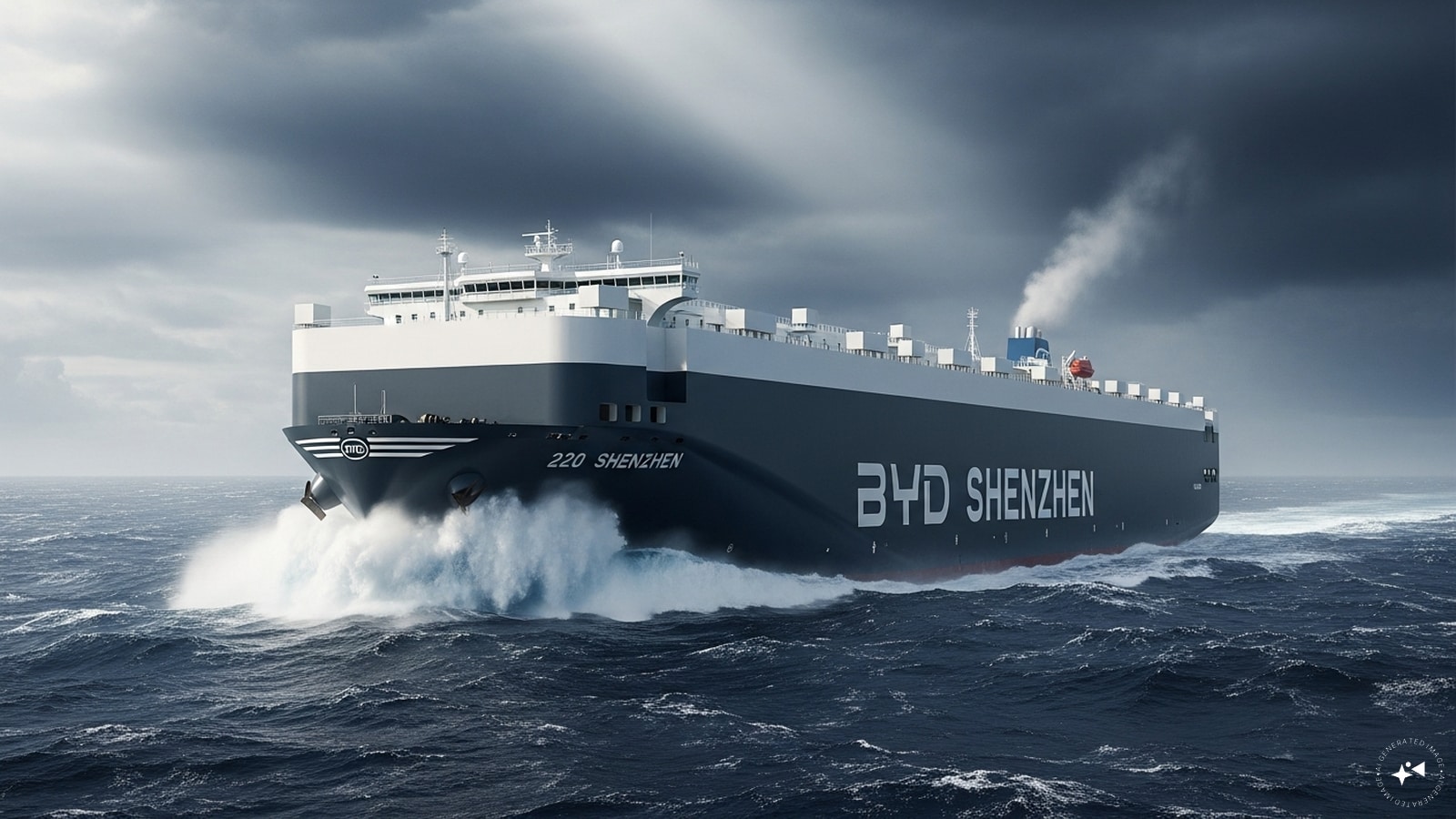
The first of these monsters, the BYD Explorer No. 1, delivered its initial payload to Europe earlier this year. It is a beast of a ship, stretching nearly 200 meters long, capable of carrying 7,000 vehicles at a time. It doesn't fly the flag of a traditional shipping line. It flies the corporate banner of the company that built the cars in its belly.
Think about the sheer scale of this pivot. Car companies build engines. They build software. They do not, historically, navigate the English Channel or manage maritime crew rotations.
By taking ownership of the entire logistics chain, BYD is attempting something unprecedented in the modern automotive era: total insulation from global friction. If the European Union raises tariffs, BYD can absorb the blow because they have eliminated the middleman at sea. They control the freight costs. They control the schedules. They control the destiny of every single piece of steel that leaves their shores.
This isn’t just vertical integration; it’s a geopolitical chess move played with 40,000-ton ships.
Western automakers have traditionally relied on asset-light models. They outsource the shipping, they outsource parts of the supply chain, and they manage the brand. It is an elegant way to run a business when the world is peaceful and trade lanes are wide open. But we do not live in that world anymore.
Consider the perspective of a traditional European automotive executive right now. You are watching a competitor who not only refines their own lithium, manufactures their own microchips, and builds their own batteries, but now owns the very vessels delivering those vehicles to your local dealerships.
It is a sobering realization. You aren't just competing against a car company. You are competing against an ecosystem.
The Human Toll of Efficiency
Back in Shenzhen, the pressure of this global race filters down to the individual human beings who make the gears turn. It manifests in the quiet intensity of the R&D labs. It is felt by the dockworkers loading the Explorer No. 1 under the glare of midnight floodlights.
There is a distinct cultural engine driving this frantic expansion. In China, they call it the "996" work culture—9 a.m. to 9 p.m., six days a week. While that extreme rhythm has faced a domestic backlash from a younger generation weary of burnout, the institutional momentum remains fierce. The speed at which these ships were ordered, built, and deployed is a direct reflection of that urgency.
But it also breeds a unique kind of anxiety. Engineers know that their margins are being chased by foreign legislation. Every time a politician in Washington or Brussels gives a speech about protecting domestic manufacturing, a midnight meeting is called in Shenzhen to figure out how to shave off another fraction of a yuan.
The stakes are deeply personal for these workers. They are the first generation in their families to taste true global middle-class prosperity. They bought apartments based on the trajectory of the tech boom. For them, these car carriers aren't just symbols of corporate dominance; they are lifeboats holding up their economic future.
The Illusion of Protection
There is a grand irony at play in the global EV trade war. Tariffs are designed to slow a competitor down, to give domestic industries a breathing room to catch up. But economic history tells us that when you block a river with a dam, the water doesn't just stop. It builds pressure until it finds a crack, or it carves an entirely new channel.
By building its own fleet, BYD has carved that new channel.
The Western strategy assumes that higher costs at the border will make Chinese EVs uncompetitive. But when a company owns the entire pipeline, from the lithium mine to the ocean liner, their ability to absorb tariff shocks is vastly superior to a company buying components from thirty different suppliers across three continents.
Furthermore, these ships don't just sail to Rotterdam or Hamburg. If Europe becomes too hostile, the fleet can pivot. They can head toward the ports of South America, the Middle East, or Southeast Asia—regions where the appetite for affordable electric transport is massive and the tariff walls do not exist.
The fleet provides flexibility, and in a volatile world, flexibility is the ultimate currency.
The Wake Left Behind
The sun sets over the South China Sea, casting a long, amber shadow behind a departing vessel. From the shore, it looks like any other cargo ship cutting through the waves. But to those who understand the industry, it represents a profound shift in the balance of industrial power.
For decades, the West defined how cars were made, marketed, and moved. The grand vessels of Wallenius Wilhelmsen or Eukor carried the world's automotive ambitions from West to East.
Now, the tide has turned.
The ships leaving Shenzhen are a declaration. They say that the traditional rules of engagement no longer apply. If the road is blocked, they will take the sea. If the sea is crowded, they will build the boats.
As the BYD Explorer No. 1 disappears past the horizon, carrying thousands of silent, battery-powered vehicles toward distant showrooms, it leaves a churning white wake in the dark water. It is a line drawn in the ocean—a reminder that in the modern global economy, protectionism doesn't stop the future; it just forces it to learn how to swim.