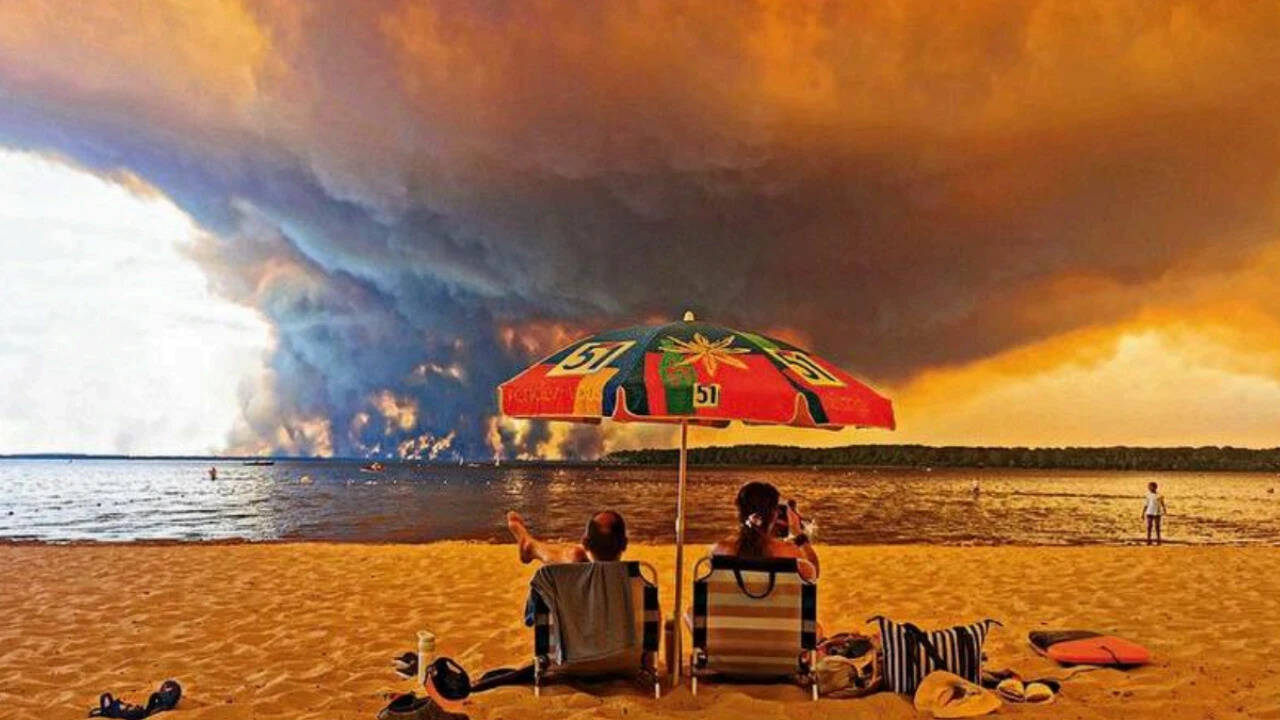
The air did not just feel hot; it felt heavy, vibrating with a low, mechanical hum that settled directly behind the teeth.
Imagine standing fifty yards away from a roaring bonfire, feeling the draft pull your jacket toward the embers. Now scale that physics problem up by a factor of ten thousand. In the pine-heavy flatlands of Gironde, southwest France, a wildfire broke out near Saumos. It started the way they always do—a spark, dry timber, a merciless sun. But within forty-eight hours, the blaze stopped behaving like a fire. It started behaving like a living thing with an atmospheric appetite.
By Friday evening at precisely twenty past six, the departmental fire and rescue service watched something rise that they had never before recorded in French history.
The smoke column stopped drifting. It thickened, blackened, and shot skyward with ferocious velocity, punching through the troposphere until it curdled into an immense, bruised-purple thunderhead. Inside that vault of ash and vapor, friction took over. Water droplets rushed past the freezing level, turning into ice crystals that collided and violently tore electrical charges apart.
Then came the flash.
The cloud lit from within, a pulsing neon web of raw voltage. And it did something terrifying. It spat lightning back down at the earth, striking miles away from the original perimeter, planting brand-new fires in unburned timber.
The fire was no longer reacting to the wind. It was manufacturing its own weather system.
When the Smoke Becomes a Storm
Fire meteorologists call this a pyrocumulonimbus, or a pyroCb. For decades, firefighters in Europe watched these meteorological monsters form across the scorched expanses of Australia or the deep boreal forests of Canada, where a record-shattering 142 of them materialized in a single season. They were treated as distant anomalies—exotic, terrifying extremes belonging to other continents.
Until Saumos. Until 420 square kilometers of French scrubland and pine forest dissolved into ash. Until 220,000 people were forced to pack what they could fit into a backseat and flee the Gironde department.
To understand why a pyroCb is the ultimate nightmare for emergency responders, you have to look at the geometry of panic. When a normal wildfire burns, seasoned crews look at the topography and the prevailing wind. They read the land. They predict where the flames will march based on dry grass and sloping hills. They carve firebreaks and anchor hoses.
When a pyroCb locks onto a landscape, those rules evaporate.
The monster cloud acts like an atmospheric vacuum cleaner. It pulls violent, erratic surface winds directly toward the core, feeding its own monstrous appetite. But the physics do not stop at the intake. The cloud breathes out, too. Downbursts punch downward with the force of a shattered dam, slamming into the ground and scattering embers in every conceivable direction.
A single front fractures into four. Flames race backward against the supposed wind. Escape routes that were safe ten minutes prior suddenly become walls of radiant heat as a lightning strike from the cloud’s anvil ignites a fresh pocket of timber a mile behind the retreat line.
Direct attack becomes a suicide mission. Crews are forced to pull back, abandoning the fight against the advance to simply hold a defensive line around civilian homes. In Gironde, more than 240 houses were swallowed or broken by the fury.
The Anatomy of a Feedback Loop
The mechanics of this phenomenon are deceptively simple, governed by the brutal logic of heat transfer. You do not need a specific high temperature to breed a pyroCb. You need an atmospheric trap.
Think of it as a vertical highway of instability. Near the surface, the air is searingly hot and bone-dry. Higher up, the atmosphere is cold and moist. When a massive fire detonates below, it acts like a giant piston, shoving massive volumes of hot air, smoke, and moisture upward at breakneck speeds. As that column climbs into the freezing upper layers, water vapor condenses around millions of microscopic particles of ash.
The ash becomes the seed of the cloud. The ice crystals become the battery. The lightning becomes the match.
And once the loop closes, the fire feeds the cloud, and the cloud feeds the fire. It is a self-sustaining engine of destruction that defies easy prediction. The cloud weakens overnight as the night air cools and humidity creeps up, offering a brief, exhausted window for firefighters to claw back a few meters of ground. Then the sun rises, the temperature spikes, and the beast reforms in the sky.
Scientists studying the shift—part of broader continental efforts like the European ROSETTA research project—are racing to figure out if these events are becoming the new baseline for Mediterranean and Western European summers. The data is sparse, but the trajectory is starker than the numbers suggest. As landscapes dry out and heatwaves linger longer, the atmosphere grows more volatile, providing the raw ingredients for fires that can build their own heavens.
The smoke clears slowly over the pine barrens of southwest France, leaving behind skeletal trunks and a profound, ringing silence. The human cost is measured in displaced families and burned thresholds. But the psychological shift is deeper.
The sky used to be the ceiling of the earth, a neutral backdrop against which we lived our lives. Now, when the heat climbs high enough, the smoke learns how to bite back.