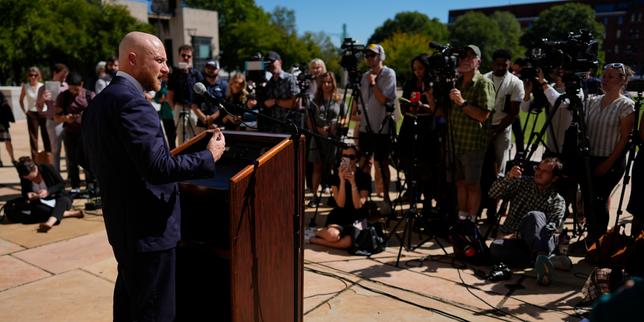
The machinery of state execution operates in sterile whispers. Fluorescent lights hum above stainless steel tables. Monitors track the quiet descent of a human heartbeat, line by flattening line, until silence takes the room. Most citizens never hear that hum. They see only the aftermath on an evening broadcast—a brief graphic, a solemn anchor, a dry accounting of a life ended by legislative decree.
Then, distance dissolves.
When Pope Francis stepped onto the global stage to condemn the death penalty with renewed urgency, he did not speak from the detached neutrality of a distant Vatican archive. He spoke in the immediate shadow of human agony—specifically, following the botched execution of Kenneth Eugene Smith in Alabama, where protocol frayed into cruelty and the machinery stalled midway.
Silence broke. Old tensions flared. And the ancient moral weight of the Vatican collided head-on with the raw, polarized politics of modern America.
The Room Where the Machine Stalled
Consider the perspective of someone standing just outside that chamber in Atmore, Alabama. For years, the narrative surrounding capital punishment has been sanitized by language. We speak of "protocols," "substances," and "termination." We distance ourselves from the physical reality of what it means for a government to strap a citizen to a gurney and extinguish their breath.
When the execution of Kenneth Smith went awry in January 2024—failing the standard lethal injection protocols before nitrogen hypoxia was ultimately deployed in a separate attempt weeks later—it exposed a grim truth. The state’s attempt to project clinical precision had collapsed into visible, agonizing error. Witnesses heard the gasps. They saw the struggle against the restraints.
The illusion of a clean, painless death vanished.
And from across the Atlantic Ocean, a frail man in white robes watched, listened, and reacted. Francis did not offer a diplomatic platitude. He named the horror directly. He challenged the fundamental moral premise that any government, regardless of the atrocity committed, retains the divine or civil right to end a human life.
The Anatomy of an Unlikely Feud
This intervention was never going to land softly in Washington, D.C., or on the volatile landscape of American partisan politics.
Years earlier, Francis had already rubbed raw the sensibilities of the American political right. During the 2016 presidential campaign, when asked about Donald Trump’s signature proposal to build a border wall along the southern frontier, the pontiff offered a sentence that stung like salt in a wound: "A person who thinks only about building walls, wherever they may be, and not building bridges, is not Christian."
Trump’s swift, sharp retaliation set a tone of mutual suspicion that has never truly faded. The billionaire populist, preaching a gospel of raw national sovereignty and uncompromising strength, found himself at odds with a pope who preaches radical mercy, environmental stewardship, and the abolition of the ultimate punishment.
When Francis waded back into the American consciousness by denouncing the death penalty in the wake of botched executions, he knowingly poked a sleeping bear. For many conservative voters and leaders who champion capital punishment as the ultimate measure of retributive justice—particularly in cases involving heinous, violent crimes—the pope's stance is viewed not as moral leadership, but as foreign interference from a pontiff out of touch with the realities of American crime and punishment.
The friction is real. The ideology is incompatible. On one side stands the belief in the absolute sovereignty of the state to exact the ultimate penalty for the ultimate crime. On the other stands the conviction that human dignity is inviolable from the womb to the grave, and that a society willing to kill its own is morally bankrupting its own soul.
The Long Shadow of an Infallible Shift
To understand why this friction matters so deeply, we have to look past the immediate political theater of a papal statement versus a political rally. We have to look at the evolution of an institution that measures time in millennia.
For centuries, Catholic moral theology tolerated the death penalty under specific, narrow conditions. If the state had no other way to protect its citizens from a dangerous predator, execution was viewed as a regrettable necessity. Thomas Aquinas argued for it. Popes accepted it.
Yet Francis changed the catechism itself.
He declared the death penalty "inadmissible" because it represents an attack on the inviolability and dignity of the person. He did not frame it merely as a bad policy choice or a flawed legal mechanism. He framed it as a sin against human worth.
That shift sent shockwaves through Catholic communities in the United States, where conservative bishops and laypeople had long found common ground with the Republican party on issues like abortion, while quietly differing on capital punishment. Francis forced a reckoning. He stripped away the comfortable middle ground.
When an execution goes wrong—when a vein cannot be found, when a prisoner convulses, when the state stumbles in the dark while trying to look competent—it exposes the inherent violence of the act. It forces people to stop looking at the crime and start looking at the executioner.
The Conscience of the Spectator
We live in a culture that hungers for finality. We want villains punished, victims vindicated, and equations balanced. The death penalty promises a clean ledger.
Yet reality refuses to be clean.
Every botched execution is a cracked mirror held up to a society that claims to value human life while maintaining the machinery to destroy it. When the pope speaks out against these tragedies, he is not offering a legal brief. He is acting as a persistent conscience, interrupting the comfortable sleep of a culture that has grown numb to the sound of the monitor flatlining.
The feud with political figures like Trump is merely the surface turbulence of a much deeper, older current. It is the clash between power and mercy, between the state’s demand for absolute retribution and a faith that insists redemption is never off-limits to the living.
As long as the state holds the power to strap a human being to a table and extinguish their breath, and as long as those attempts occasionally curdle into agonizing spectacles of failure, the debate will not die. And neither will the voice from Rome, reminding the world that every time a life is taken by legal decree, something essential within the collective conscience dies with it.