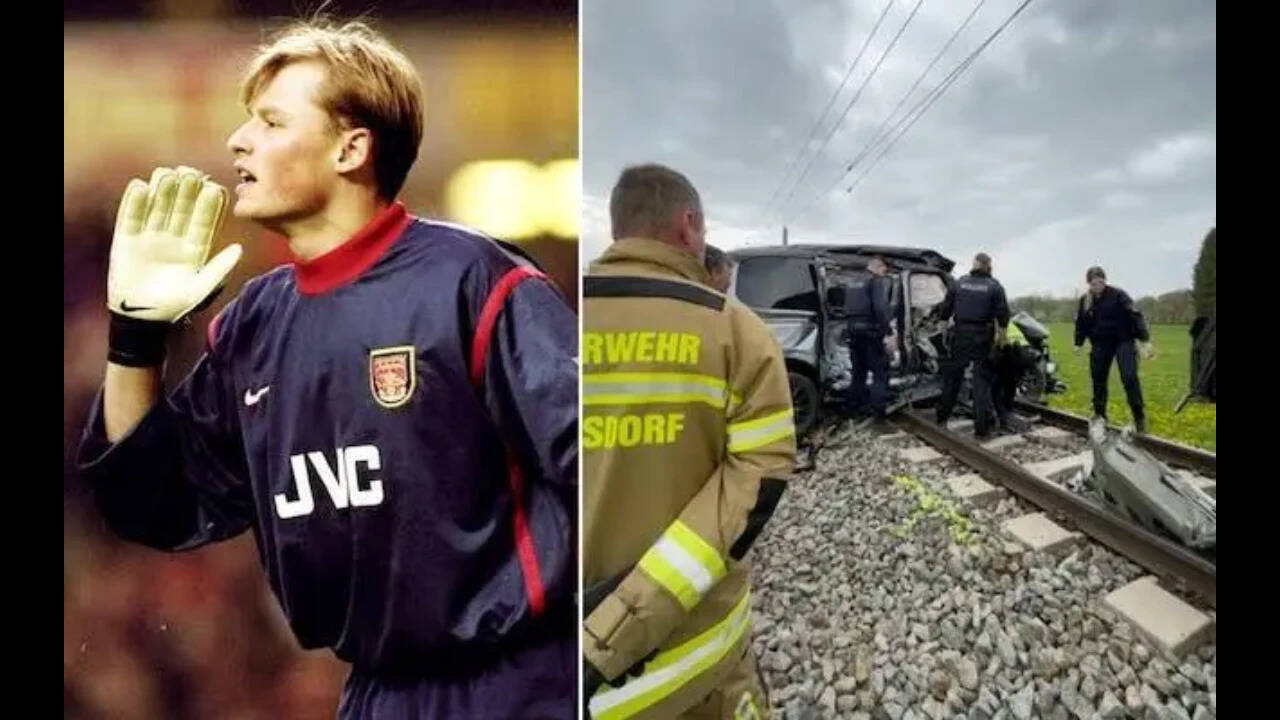
The air in North London carries a specific weight on match days. It is a mixture of fried onions, damp wool, and an electricity that hums through the pavement. For Alex Manninger, that hum was once the soundtrack of his life. He stood between the posts at Highbury, a young Austrian with ice in his veins, tasked with the impossible: filling the gloves of the legendary David Seaman. He didn't just fill them. He became a cult hero. He kept six consecutive clean sheets during the 1997-98 double-winning season. He was the silent guardian of a golden era.
Footballers often seem like gods until the moment they aren't. We see them in high-definition, frozen in heroic lunges, their names etched into the silver of trophies. We rarely think about the quiet drives home. We don't consider the mundane seconds that exist between the glory and the end.
Then, the world stops.
The news broke with a clinical coldness that felt like a betrayal of the man’s legacy. A train crash. A car on the tracks. A life extinguished in a tangle of metal and momentum.
The Physics of a Moment
To understand the tragedy, one must look past the headlines and into the terrifying geometry of a level crossing. It is a place where two worlds collide: the heavy, unstoppable force of transit and the fragile autonomy of a personal vehicle. When a train traveling at high speed encounters an obstacle, the result is not a collision in the way we think of two cars bumping in a parking lot. It is an erasure.
A train cannot swerve. It cannot stop on a dime. By the time a driver sees a car resting on the rails, the math is already written. The momentum of thousands of tons carries a grim inevitability. In this instance, the quiet Austrian who once commanded a penalty box with such authority found himself in a space where no amount of reflexes could save him.
The report was brief. Precise. Heartbreaking. Manninger’s car had ended up on the tracks in his native Austria. The locomotive, unable to shed its speed, struck the vehicle with a violence that defies easy description. Just like that, a hero of the Invincibles era was gone.
The Ghost in the Arsenal Goal
Fans of a certain age remember the 1990s as a time of transition. Arsène Wenger was still a "professor" from France whom nobody knew, and the "Boring, Boring Arsenal" tag was being peeled away to reveal something sleek and dangerous. Manninger was a vital part of that transformation. He was the deputy who proved he could lead.
Think of the pressure. You are twenty years old. You are playing for one of the biggest clubs in the world. The man you are replacing is a national icon with a ponytail and a mustache that seems to command the wind. One mistake, and the fans will never forgive you. Manninger didn't blink. He went to Old Trafford and stood like a wall. He helped secure a Premier League title. He earned his medal not through luck, but through a terrifyingly calm competence.
That calm was his trademark. While other keepers screamed at their defenders, Manninger operated with a surgical focus. He was the quiet professional. In a sport increasingly defined by ego and neon-colored boots, he was a throwback to a more stoic age.
The Invisible Danger of the Everyday
We move through the world with a sense of invincibility. We cross tracks, we merge into traffic, and we navigate the thousand small dangers of a Tuesday afternoon without a second thought. We assume the system works. We assume the gates will drop, the lights will flash, and the path will be clear.
When that system fails—or when a split second of human error occurs—the gap between "normal life" and "catastrophe" vanishes.
Consider the hypothetical mechanics of such an accident. Perhaps the sun was at the wrong angle. Perhaps a mechanical glitch stalled the engine at the precise, nightmare moment. Or perhaps, in the deep silence of a rural crossing, the rhythm of the tracks felt distant until it was too late. For Manninger, a man who spent his career calculating the flight of a ball and the timing of a striker’s run, the one variable he couldn't account for was the sheer, brutal speed of the regional express.
The loss ripples outward. It isn't just about a former athlete. It is about a family in Austria. It is about teammates like Ian Wright and Tony Adams, men who shared the heat of the dressing room with him. It is about the fans who still wear the old yellow away kits, remembering the night he defied Manchester United.
The Fragility of the Heroic
There is a specific cruelty in seeing a sportsman die in a way so disconnected from their craft. We want our heroes to go out in a blaze of glory, or at least in the peaceful twilight of old age, surrounded by their scrapbooks. We don't want them to be victims of infrastructure and physics.
But death is rarely poetic. It is often a matter of being in the wrong place at the wrong interval of time.
The statistics regarding level crossing accidents are often buried in safety brochures that no one reads. They tell a story of "passive" vs "active" crossings, of warning times and braking distances. To the engineers, it is a problem of logistics. To the rest of us, it is a reminder of how thin the ice really is. Every year, hundreds of people lose their lives in these intersections of road and rail. Each one is a world ended. Each one leaves a vacuum.
A Silence in the North London Air
When the news reached the Emirates Stadium, a shadow fell over the modern glass and steel. Manninger belonged to the old Highbury, the place with the marble halls and the cramped corridors, but his spirit was part of the club’s DNA. He represented the idea that the "backup" is just as important as the star. He was the safety net that held when the main cord snapped.
The tributes began to pour in. They spoke of his kindness, his lack of pretension, and his technical skill. They spoke of a man who moved back to his homeland after a storied career across Europe—playing for Juventus, Fiorentina, and Augsburg—to live a life of relative quiet. He had survived the pressure of the world stage, the scrutiny of the British press, and the physical toll of elite sport.
He was fifty-one years old.
In the grand arc of a human life, that is barely the half-time whistle. He should have had decades of coaching, of watching games from the stands, of telling stories to a new generation of keepers about what it felt like to hear the Highbury roar.
Instead, there is only the report of the crash. The investigation will look at the signals. They will examine the wreckage. They will try to find a "why" in a situation that is defined by "what." They will look for a technical failure to explain a human tragedy.
But for those who watched him play, the "why" doesn't matter. The loss is absolute.
The image that remains isn't of the twisted metal on a rural Austrian track. It is of a young man in a green jersey, leaping into the air, his fingers tipping a goal-bound shot over the crossbar. It is the image of a man who, for a few brilliant months in 1998, seemed like he could stop anything.
The world moves on. The trains continue to run. The crowds will gather again at the Emirates, singing songs for the living and the dead. But somewhere in the quiet corners of football history, a clean sheet remains untarnished, and a goalkeeper finally finds the rest that the frantic world denied him.
The game is over.